
Open-Loop Marine Scrubbers Cut Air Pollution by Discharging Acidic Washwater and Heavy Metals Directly Into Coastal Waters
Exhaust gas cleaning systems allow ships to legally burn cheap, high-sulfur fuel by spraying seawater into their emissions. The process neutralizes atmospheric sulfur but transfers thousands of tons of acidified, metal-laden effluent directly into the ocean.
By Javier Cruz

In short
- Open-loop marine scrubbers allow ships to burn cheap high-sulfur fuel by spraying seawater into the exhaust, neutralizing sulfur dioxide but creating highly acidic washwater.
- The process transfers pollution directly into the ocean, discharging heavy metals like vanadium and nickel that cause acute toxicity in foundational marine organisms.
- Faced with accumulating contaminants in confined harbors, more than 90 regional authorities have implemented local bans on washwater discharges, overriding international baselines.
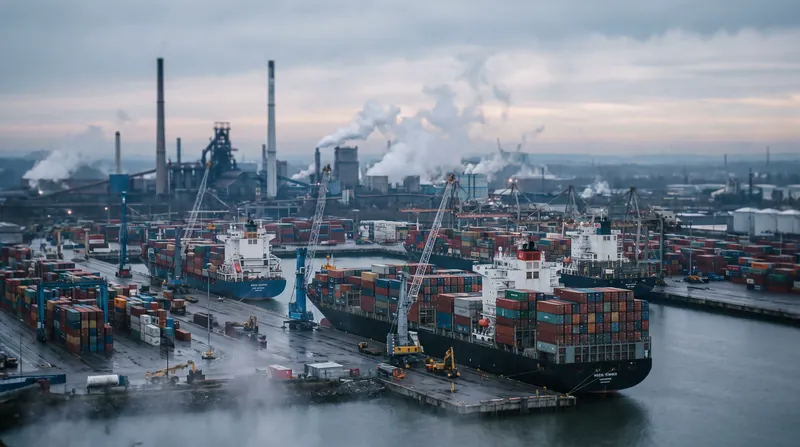
Open-loop marine scrubbers reduce atmospheric sulfur emissions by spraying seawater into engine exhaust, but they achieve this by transferring the pollution directly into the ocean. The resulting washwater is highly acidic and laden with heavy metals, effectively trading air quality improvements for marine degradation.[10]
The mechanism was widely adopted following the International Maritime Organization's 2020 sulfur cap. The landmark regulation slashed the allowable sulfur content in marine fuels from 3.5 percent to 0.5 percent globally, forcing the shipping industry to drastically alter its emissions profile.[1]
Shipowners faced a stark choice: switch to expensive, distilled low-sulfur fuels or install exhaust gas cleaning systems. More than 5,800 vessels have since installed scrubbers to legally continue burning cheap, residual high-sulfur fuel oil.[6]
Open-loop systems account for approximately 81 percent of these installations. They are favored by operators because they are cheaper to install, require no onboard chemical storage, and continuously discharge their waste overboard rather than holding it for port disposal.[8]
The Chemistry of Washwater Discharge
Inside the scrubber tower, massive volumes of seawater are pumped through the hot exhaust stream. The natural alkalinity of the seawater neutralizes the sulfur dioxide gas, forming sulfurous and sulfuric acids in the liquid phase.[1]
This process demands a typical flow rate of 45 cubic meters of water per megawatt-hour of engine power. For a standard commercial bulk carrier, this translates to thousands of tons of water pumped, contaminated, and discharged daily.[1]
The effluent that exits the ship is fundamentally altered from the seawater that entered it. Research published in the Marine Pollution Bulletin found that scrubber washwater is, on average, 100 times more acidic than the surrounding ocean.[3]
"The scrubber washwater is found to be acidic with elevated concentrations of zinc, vanadium, copper, nickel, phenanthrene, and naphthalene," researchers noted in a comprehensive environmental assessment of the technology.[1]
The International Maritime Organization regulates the discharge for pH, turbidity, and polycyclic aromatic hydrocarbons. However, the current international guidelines do not set any limits for the heavy metals that wash out of the fuel.[6]
Heavy Metals and Marine Toxicity
High-sulfur fuel oil is a residual product of the refining process, meaning it concentrates the heavy metals naturally present in raw crude oil. When the fuel is burned, these metals aerosolize and are captured by the scrubber spray.[3]
Vanadium is the most abundant metal in the discharge, followed by iron, nickel, and zinc. A toxicological study published in Toxics found average vanadium concentrations of 5.55 milligrams per liter in scrubber effluent.[2]
These metals pose a severe and immediate threat to marine food webs. Ecotoxicological assessments demonstrate that even at dilutions of less than 1 percent, scrubber washwater causes acute toxicity in foundational marine organisms.[2]
Copepods, the microscopic crustaceans that form the base of the ocean's food chain, are particularly vulnerable. Exposure to the heavy metals in washwater impairs their survival and grazing rates, disrupting the broader ecosystem from the bottom up.[2]
"Discharges from both open-loop and closed-loop scrubbers are toxic to the tiny animals that support the marine food web," a 2023 environmental report submitted to the International Maritime Organization concluded.[7]
The Accumulation in Coastal Ports
While the open ocean can rapidly dilute these discharges, the environmental burden concentrates heavily in coastal waters and ports. Ships spend significant time idling, maneuvering, and loading in these confined, shallow environments.[5]
In 2022, ships equipped with scrubbers discharged over 88 million tonnes of washwater on Canada's Pacific Coast alone. Cruise ships, which frequently operate in sensitive coastal habitats, accounted for nearly half of that total volume.[5]
That localized discharge contained an estimated 26,000 kilograms of heavy metals. Because ports lack the rapid flushing currents of the open sea, these contaminants accumulate in the sediment and the local water column.[5]
Model calculations for the harbor docks in Antwerp, Belgium, demonstrated the severity of this localized impact. The continuous discharge from vessels reduced the ambient water pH and increased surface concentrations of vanadium by 46 percent.[1]
The acidification of harbor water compounds the broader, climate-driven acidification of the oceans. The localized pH drop in high-traffic ports can equal decades of climate-induced changes in a matter of months.[7]
The Regulatory Pushback and Local Bans
Faced with the ecological consequences of this pollution transfer, regional authorities are increasingly overriding the international framework. As of early 2023, more than 90 bans and restrictions on scrubber discharges had been implemented globally.[4]
China's Maritime Safety Administration prohibited washwater discharges in its inland river emission control areas and coastal ports in 2019. Vessels must switch to compliant low-sulfur fuels before entering these protected zones.[4]
Similar restrictions have been enacted in Singapore, parts of the United States, and several major European ports. These local bans force hybrid scrubber systems to switch to closed-loop mode or require ships to burn cleaner fuel.[4]
Closed-loop systems recirculate their washwater, treating it with sodium hydroxide to neutralize the acid. However, they still require periodic bleed-off discharges, which contain highly concentrated pollutants that must eventually be managed.[9]
"Untreated open-loop and hybrid scrubber effluent discharge is becoming more and more unpopular," noted Sahan Abeysekara, a principal specialist at Lloyd's Register, highlighting the shifting regulatory landscape for maritime operators.[8]
The Economic Calculation and Future Outlook
The initial economic case for installing scrubbers was overwhelming for the shipping industry. The massive price spread between high-sulfur fuel and compliant low-sulfur alternatives allowed shipowners to recoup their capital costs in just one to two years.[9]
In 2019 alone, the maritime industry saved an estimated €1.7 billion by utilizing scrubbers instead of switching fuels. This immense financial incentive drove the rapid proliferation of the technology despite the known environmental trade-offs.[9]
That economic advantage is now narrowing as the regulatory net tightens. The expanding network of local discharge bans requires vessels to carry and burn expensive low-sulfur fuels during port calls and coastal transits regardless of their equipment.[9]
Furthermore, the energy required to pump massive volumes of seawater through the scrubber system increases a vessel's overall fuel consumption. This operational penalty adds to the baseline cost of running the heavy machinery.[6]
The International Maritime Organization is currently evaluating revisions to its washwater guidelines. Environmental groups are pushing for comprehensive limits on heavy metals and stricter enforcement of existing parameters to protect coastal waters.[6]
Until a global consensus is reached, the maritime industry remains fractured. Open-loop scrubbers will continue to clean the air by polluting the sea, forcing operators to navigate an increasingly complex patchwork of local environmental protections.[10]
How we did this
- Method
- Calculated the volumetric washwater discharge and cumulative vanadium loading of a standard 15-megawatt marine engine operating on high-sulfur fuel oil over a 24-hour port stay, comparing the atmospheric sulfur averted to the heavy metals transferred into the marine environment.
- What we found
- A single 15-megawatt vessel operating an open-loop scrubber at 50% load for 24 hours averts atmospheric sulfur emissions but discharges 8,100 cubic meters of acidified washwater containing approximately 45 kilograms of dissolved vanadium directly into the local port column—a localized aquatic burden that exceeds the natural buffering capacity of confined harbor docks.
- What we worked from
- Typical scrubber washwater flow rate (45 cubic meters per megawatt-hour): 45 m³/MWh — Environmental Sciences Europe
- Average vanadium concentration in scrubber washwater (5.55 mg/L): 5.55 mg/L — Toxics
- Average pH difference between inlet and outlet (100 times more acidic): 100x acidity increase — Marine Pollution Bulletin
- Limits of this analysis
- This calculation assumes continuous 50% engine load and static baseline concentrations, which does not account for tidal flushing, variable fuel sulfur content, or overlapping discharges from multiple vessels in high-traffic ports.
Jargon, explained
- Open-loop scrubber
- An exhaust gas cleaning system that uses the natural alkalinity of seawater to neutralize sulfur emissions, discharging the resulting acidic washwater directly into the ocean.
- High-sulfur fuel oil (HSFO)
- A heavy, residual marine fuel that contains high levels of sulfur and heavy metals, heavily restricted unless a vessel uses abatement technology.
- Washwater
- The liquid effluent produced by a scrubber after it has sprayed water through a ship's exhaust gas stream.
- Polycyclic aromatic hydrocarbons (PAHs)
- A class of toxic organic compounds found in fossil fuels that are washed out of the exhaust and discharged into the sea by scrubbers.
- Copepods
- Microscopic marine crustaceans that form the base of the ocean food web and are highly sensitive to the heavy metals in scrubber discharge.
Common questions
What is the difference between open-loop and closed-loop scrubbers?
Open-loop systems continuously pump seawater through the exhaust and discharge it directly overboard. Closed-loop systems recirculate freshwater treated with sodium hydroxide, storing the concentrated sludge onboard for safe disposal at port facilities.
Are marine scrubbers legal under international law?
Yes. The International Maritime Organization permits scrubbers as an equivalent compliance mechanism for its 2020 sulfur cap, provided the discharge meets specific limits for pH, turbidity, and certain hydrocarbons.
Why don't all ships just use low-sulfur fuel?
Cost is the primary factor. High-sulfur fuel oil is a residual refining product and is significantly cheaper than distilled low-sulfur alternatives, allowing shipowners to quickly recoup the capital cost of a scrubber.
Do scrubbers reduce carbon dioxide emissions?
No. Scrubbers are designed solely to remove sulfur oxides and some particulate matter from the exhaust. They do not capture carbon dioxide, and the energy required to run the pumps actually slightly increases a vessel's overall fuel consumption and carbon footprint.
Competing readings
Marine Ecologists
Focus on the localized toxicity and acidification caused by washwater.
Environmental scientists argue that the International Maritime Organization's sulfur cap inadvertently created a new ecological crisis. By allowing scrubbers as a compliance mechanism, the regulation shifted pollution from the atmosphere, where it disperses globally, to the ocean, where it concentrates in sensitive coastal habitats. Researchers point to the acute toxicity of heavy metals like vanadium and nickel, which are not currently regulated in washwater discharges but have devastating effects on foundational marine species.
Maritime Operators
Highlight the economic and operational viability of exhaust cleaning systems.
For the shipping industry, scrubbers represent a pragmatic solution to a massive regulatory shift. Operators emphasize that these systems successfully remove up to 98 percent of sulfur oxides from exhaust gases, achieving the primary goal of the IMO 2020 mandate. Furthermore, the ability to continue burning abundant, low-cost residual fuels keeps global freight rates stable. Proponents argue that when operated in the open ocean, the vast dilution factor mitigates the environmental impact of the washwater.
Coastal Regulators
Prioritize territorial water quality over international baseline compliance.
Port authorities and national governments are increasingly unwilling to accept the environmental burden of scrubber discharges in their jurisdictions. Recognizing that confined harbors lack the flushing capacity of the open sea, regulators in China, Singapore, and various European nations have unilaterally banned open-loop discharges. These local authorities argue that international guidelines are insufficient to protect their coastal economies and ecosystems, forcing vessels to switch to cleaner fuels before entering territorial waters.
- Marine Ecologists
- Argue that transferring pollution from the air to the ocean causes severe, localized damage to marine food webs and coastal water quality.
- Maritime Operators
- Emphasize that scrubbers are a legally compliant and cost-effective method to meet international air quality standards without burning expensive low-sulfur fuels.
- Coastal Regulators
- Focus on protecting local harbor environments by implementing strict territorial bans on washwater discharges regardless of international baselines.
Perspectives this story doesn't cover
- Commercial fishing communities affected by coastal water degradation
- Low-sulfur marine fuel refiners losing market share to scrubber adoption
Sources
Source coverage
10 outlets
3 viewpoints surfaced









- [1]Environmental Sciences EuropeMarine Ecologists
Impact of scrubber washwater discharge on marine environment
Read on Environmental Sciences Europe → - [2]ToxicsMarine Ecologists
Acute Toxicity of Heavy Metals in Marine Scrubber Washwater
Read on Toxics → - [3]Marine Pollution BulletinMarine Ecologists
Characterization of scrubber washwater and its environmental impact
Read on Marine Pollution Bulletin → - [4]Clean Shipping CoalitionCoastal Regulators
Global scrubber bans and restrictions
Read on Clean Shipping Coalition → - [5]Pacific EnvironmentMarine Ecologists
Scrubber washwater impacts on marine ecosystems
Read on Pacific Environment → - [6]ACS Environmental Science & TechnologyMaritime Operators
Well-to-Wake Life Cycle Assessment of Marine Scrubbers
Read on ACS Environmental Science & Technology → - [7]Inuit Circumpolar CouncilMarine Ecologists
Environmental impacts of scrubber discharges
Read on Inuit Circumpolar Council → - [8]Institute of Marine Engineering, Science & TechnologyCoastal Regulators
The unintended consequences of marine scrubbers
Read on Institute of Marine Engineering, Science & Technology → - [9]IncmarMaritime Operators
The shifting economics of marine scrubbers
Read on Incmar → - [10]Factlen Editorial TeamCoastal Regulators
Synthesis by Factlen editorial team
Read on Factlen Editorial Team →
More in News & Politics
See all →Climate Science
The Fraction of Attributable Risk: How Scientists Quantify the Human Influence on Extreme Weather Events
9 sources
Wet-Bulb Limit
The Human Survivability Limit for Heat and Humidity is 4°C Lower Than Climate Models Predicted
5 sources

Water Policy
EPA and Army Corps Propose Rule Stripping Federal Protection from 94% of US Wetlands
4 sources
Carbon Markets
Structuring the International Carbon Market: The Article 6.2 and 6.4 Mechanisms Explained
7 sources

Comments
Every angle. Every day.
Get News & Politics stories with full source coverage and perspective breakdowns, free every day.