
full timeline
Russia–Ukraine war
The Western military alliance has ordered the deployment of early-warning aircraft to monitor Polish airspace following recent incursions by Russian projectiles.
Follow Russia–Ukraine war in the Factlen app and get an alert when there is news. Get the app
Share this story
Latest report
NATO Deploys AWACS Surveillance Aircraft to Poland After Russian Missile Violations
The Western military alliance has ordered the deployment of early-warning aircraft to monitor Polish airspace following recent incursions by Russian projectiles. The move aims to bolster NATO's eastern flank defenses and track potential threats spilling over from the war in Ukraine.
- NATO has deployed AWACS surveillance aircraft to Poland following recent incursions by Russian missiles into allied airspace.
- The aircraft can monitor airspace within a 400-kilometer radius, providing early warning of low-flying cruise missiles and drones.
- Polish authorities requested the deployment after tracking a suspected Russian projectile that entered the country's airspace for three minutes.
- The airborne radar network will integrate with ground-based Patriot batteries and combat air patrols to secure the eastern flank.
The North Atlantic Treaty Organization has ordered the immediate deployment of Airborne Warning and Control System aircraft to Poland. The specialized surveillance planes will monitor the alliance's eastern borders following a series of alarming airspace violations by Russian missiles targeting western Ukraine.[1][2]
The deployment, officially announced on November 23, 2026, represents a significant reinforcement of the military bloc's defensive posture in Eastern Europe. The aircraft will operate out of forward bases to track incoming projectiles, monitor regional flight patterns, and coordinate potential interception efforts across the contested region.[4][5]
The official press releases from the alliance announcing the deployment did not include direct quotations from NATO commanders regarding the specific rules of engagement. However, the operational mandate clearly focuses on passive surveillance and early warning rather than active interception over foreign territory.[1][3]
The decision follows a severe incident earlier this week where a suspected Russian cruise missile entered Polish airspace during a large-scale bombardment of Ukrainian infrastructure. The projectile reportedly traveled several kilometers inland before altering its trajectory and returning to Ukrainian skies.[2][5]
The Airspace Incursion
Polish military radar installations tracked the unidentified object for approximately three minutes before it exited the country's sovereign airspace. Authorities immediately scrambled armed F-16 fighter jets to intercept the threat, though no kinetic engagement occurred during the brief operational window.[4][6]
Warsaw subsequently requested an extraordinary meeting of the NATO Council to address the breach and coordinate a unified response. Polish defense officials emphasized that the proximity of Russian strategic strikes to the border creates an unacceptable risk of miscalculation and accidental escalation.[5]
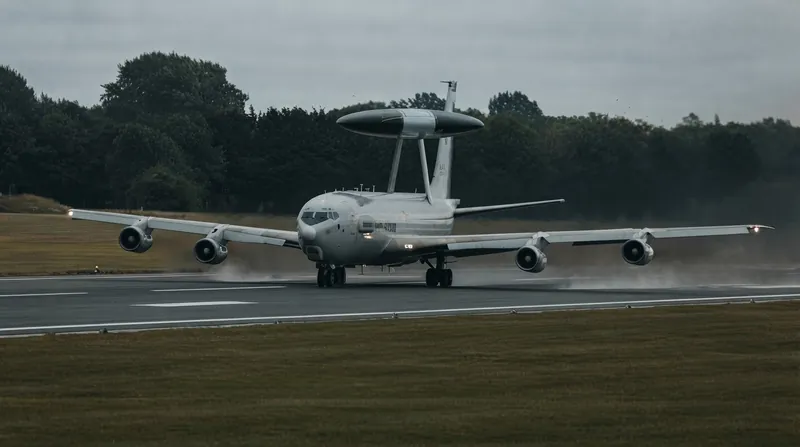
The AWACS fleet, instantly recognizable by the massive rotating radar domes mounted on their upper fuselages, serves as the alliance's primary airborne early-warning mechanism. A single aircraft flying at an altitude of 30,000 feet can monitor airspace within a 400-kilometer radius.[1][3]
This extensive operational range allows the specialized crews to detect low-flying cruise missiles, stealthy unmanned aerial vehicles, and conventional aircraft deep inside neighboring territory. The system provides ground commanders with critical minutes of advance notice to activate air defense batteries.[2][4]
Bolstering the Eastern Flank
The incoming surveillance planes will seamlessly integrate with existing ground-based Patriot missile systems and combat air patrols already stationed in Poland. This layered, multi-domain defense network aims to create an impenetrable shield over the highly vulnerable border region.[5][6]
Polish defense officials have consistently emphasized that the enhanced radar coverage is explicitly designed to secure the frontier against unpredictable spillover. The rapid deployment is widely viewed across European capitals as a clear signal of allied solidarity in the face of mounting regional instability.[2][5]
The aircraft are drawn from NATO's multinational fleet permanently based in Geilenkirchen, Germany. The fleet operates as one of the few military assets owned, maintained, and commanded directly by the alliance rather than by the individual armed forces of member states.[1][3]
Flight operations are scheduled to begin immediately, with the aircraft conducting continuous rotational patrols to ensure uninterrupted coverage. The missions will primarily focus on the airspace adjacent to the Ukrainian border and the heavily militarized Russian exclave of Kaliningrad on the Baltic Sea.[4][6]
Escalating Border Tensions
The recent airspace violation is not an isolated incident in the ongoing conflict. Since the full-scale invasion of Ukraine began, Russian projectiles have crossed into Polish territory on multiple occasions, fundamentally altering the security calculus and risk tolerance in Eastern Europe.[2][5]
In late 2022, a stray air defense missile tragically struck a Polish farming village near the border, killing two civilians. While that incident was ultimately attributed to Ukrainian interceptors attempting to down a Russian weapon, it highlighted the inherent dangers of the adjacent conflict.[5]
More recently, Russian attack drones targeting Ukrainian port infrastructure on the Danube River have repeatedly crashed inside Romanian territory. These persistent southern incursions have prompted similar NATO surveillance deployments to the Black Sea region to monitor the evolving threat landscape.[1][4]
Moscow has routinely dismissed diplomatic protests regarding these territorial violations, attributing them to technical malfunctions or denying the incursions entirely. The Russian defense ministry has not officially commented on the latest Polish radar tracks or the subsequent NATO surveillance deployment.[2][6]
Strategic Implications
The AWACS deployment underscores the delicate strategic balance NATO must maintain. The alliance seeks to aggressively protect its members and deter further incursions without becoming directly involved in the kinetic conflict between Russian and Ukrainian armed forces.[3][5]
By relying strictly on passive surveillance rather than active interception over Ukrainian territory, NATO commanders aim to avoid direct confrontation with Russian aerospace forces. The surveillance aircraft will strictly remain within allied airspace during their patrols to prevent any pretext for escalation.[1][4]
However, the enhanced radar picture generated by the AWACS flights will inevitably be shared with Ukrainian defense forces. This real-time intelligence sharing has been a cornerstone of Western support, enabling Kyiv to optimize its limited air defense resources against incoming barrages.[2][5]
Independent military analysts have noted that precise information is just as critical as ammunition in this contested environment. The AWACS data allows Ukrainian defenders to prioritize targets and conserve valuable interceptors for the most dangerous threats approaching the western border.[3][6]
Long-Term Security Posture
The duration of the new surveillance mission remains completely open-ended. NATO officials have indicated the aircraft will remain on station for as long as the security situation dictates, signaling a long-term, structural commitment to frontier defense rather than a temporary reaction.[1][5]
This indefinite commitment significantly strains the alliance's limited AWACS inventory. The aging Boeing E-3 Sentry aircraft require intensive maintenance cycles, and continuous combat air patrols demand substantial logistical support from host nations and allied ground crews to sustain operations.[3][4]
To address these mounting operational demands, NATO is accelerating its transition to the next-generation E-7 Wedgetail platform. The first of these modern, highly capable surveillance aircraft is expected to achieve initial operating capability by the end of the decade.[1][2]
Until those new airframes arrive, the current legacy fleet must shoulder the heavy burden of monitoring the increasingly volatile eastern frontier. The multinational crews face grueling flight schedules as they maintain the continuous radar watch over the contested borderlands.[4][6]
Approaching Winter Campaign
As the harsh winter of 2026 approaches, both sides are bracing for an intensified aerial campaign. Russian forces have historically targeted Ukrainian energy infrastructure during the colder months, dramatically increasing the volume of missile traffic and the likelihood of further border incidents.[2][5]
The continuous presence of the AWACS aircraft ensures that NATO commanders will not be caught off guard by sudden shifts in Russian targeting. The airborne radar network provides the ultimate insurance policy against the conflict inadvertently spilling over the border into allied territory.[1][3]
The ultimate test of this defensive posture will be whether the enhanced surveillance successfully deters future incursions. If Russian flight paths continue to brush against allied airspace, political pressure may mount across European capitals for a more aggressive, active interception policy.[4][5]
Sources
- [1]Anadolu Agency — NATO to deploy surveillance aircraft following Polish airspace violations Read on Anadolu Agency →
- [2]Kyiv Post — NATO to Deploy Early-Warning Aircraft to Poland Following Russian Missile Incidents Read on Kyiv Post →
- [3]The Express Tribune — NATO to deploy AWACS in Poland Read on The Express Tribune →
- [4]Türkiye Today — NATO orders AWACS deployment after Russian missiles violate Polish airspace Read on Türkiye Today →
- [5]UNITED24 Media — NATO Eyes New European Force Moves Following Russian Breach of Polish Skies Read on UNITED24 Media →
- [6]Ajel English — NATO sends AWACS to Poland after Russian missile incident Read on Ajel English →
- [7]Báo Lao Động — NATO deploys AWACS early warning aircraft to Poland sau a missile and UAV incident entered the country's airspace Read on Báo Lao Động →
What to watch
- US lawmakers have given SpaceX CEO Elon Musk until November 30 to confirm the preservation of documents related to Starshield satellite network outages.
- The US Treasury's temporary license allowing the import of Russian diesel is set to expire in April 2027.
- The European Union's extended economic sanctions regime against Russia faces its next renewal deadline in 2029.
- The US Congress is threatening to block future funding for SpaceX systems if the company and the administration withhold answers regarding the Starshield speed restrictions.
- NATO must decide whether to risk direct engagement with Russian munitions to secure the Black Sea maritime corridor following Bulgaria's formal request for combat aircraft and anti-drone systems.
Earlier updates
1 update
Russia Launches Massive Pre-Summit Aerial Assault Against Ukrainian Energy Infrastructure
Key point: Russia launched a massive drone and missile assault on Ukraine's energy infrastructure, causing widespread power and water outages just days before U.S.-led peace negotiations are set to begin.
The November 16 assault shattered the previous record of 1,200 drones launched in a single wave.From: Ukraine Strikes Kerch Bridge in Record 1,300-Drone Aerial Assault Across Russia Russia launched a massive overnight aerial assault on Ukraine's energy infrastructure on November 3, utilizing nearly 300 drones and dozens of missiles. The bombardment targeted power generation facilities and substations across up to 10 regions, prompting widespread emergency power cuts and water outages, particularly in Kyiv.
Ukrainian President Volodymyr Zelensky reported that the overnight strikes involved 17 ballistic missiles and several dozen cruise missiles alongside the drone swarm. Ukraine's Energy Minister Denys Shmyhal highlighted the severe risks of the operation, noting that three drones specifically targeted a substation critical to the stable operation of the Khmelnytskyi Nuclear Power Plant. Meanwhile, DTEK, Ukraine's largest private energy company, stated that three of its thermal power plants were forced to suspend electricity generation due to extensive destruction.
The assault marks one of the largest attacks on Ukraine's energy grid this year and occurred shortly after the United States announced it would lead a new round of peace negotiations between Moscow and Kyiv in the United Arab Emirates next week. In addition to crippling the energy grid, the strikes inflicted heavy civilian casualties; a Russian strike on a hospital in Kharkiv left 73 people injured, while an attack on a humanitarian aid distribution site in the Zaporizhzhia region killed at least 29 people.
Russia has repeatedly targeted Ukraine's energy infrastructure in the lead-up to the winter months, aiming to disrupt heating and electricity supplies as temperatures drop. The renewed campaign raises concerns about a potential energy crisis similar to previous wartime winters, as local officials and utility workers scramble to stabilize the grid, repair damaged facilities, and restore essential water and power services to millions of residents.
2 updates
US, Ukraine, and Russia to Hold Trilateral Peace Talks in Abu Dhabi
Key point: The United States will mediate trilateral peace talks with Ukraine and Russia in Abu Dhabi on November 10 and 11.
The United States, Ukraine, and Russia are scheduled to hold trilateral peace talks in Abu Dhabi on November 10 and 11. The upcoming negotiations were announced by U.S. official Steven Witkoff, marking a significant diplomatic development in the ongoing conflict.
The meetings will be the first direct talks involving the three nations since February. The United States will act as a mediator during the discussions in the United Arab Emirates, reflecting ongoing efforts by the Trump administration to secure a peace deal.
Ukraine Hacks Russian Emergency Alert System in Retaliation for Similar Cyberattack
Key point: Ukrainian President Volodymyr Zelenskyy confirmed that Ukraine hacked Russia's emergency alert system in retaliation for a similar Russian cyberattack that sent fake nuclear threat warnings to Ukrainian civilians.
Securing an energy truce to protect civilian infrastructure is Kyiv's primary objective for the November talks.From: Ukraine Confirms Trilateral November Peace Summit With United States and Russia in Abu Dhabi Ukrainian President Volodymyr Zelenskyy confirmed that Ukraine infiltrated Russia's emergency alert system in a retaliatory cyberattack. The operation was launched after Russian hackers compromised Ukraine's Air Alert application, which millions rely on for warnings about incoming missile and drone strikes.
The reciprocal breaches occurred hours apart on November 1 and 2, causing both nations' public warning systems to broadcast fabricated alerts. Ukrainian users received fake notifications of radiation hazards, chemical threats, and street fighting in Kyiv, while the hacked Russian app warned residents across 33 regions of incoming nuclear warheads and urged them to seek shelter.
Zelenskyy stated the retaliatory strike was necessary after it became clear the initial Russian hack deliberately targeted the civilian population. The digital assaults coincided with the end of a limited humanitarian ceasefire and highlight the increasing vulnerability of critical public safety infrastructure in the ongoing conflict.
1 update
Russia Resumes Attacks on Kherson Region as Oleshky Ceasefire Ends
Key point: Russian forces have renewed their attacks on the Kherson region after the Oleshky ceasefire ended, having reportedly used the pause to fortify their positions.
AIRussian forces reportedly used a five-day humanitarian ceasefire to reoccupy positions in Oleshky, directly across the Dnipro River from Kherson.From: Ukraine Expresses Concern Over US-Brokered Local Ceasefire as Russian Forces Re-Enter Oleshky Russian forces have resumed attacks on Ukraine's Kherson region following the conclusion of the Oleshky ceasefire. Kyiv reported that the temporary truce has ended, leading to renewed military strikes in the area.
Ukraine's General Staff stated that Russian troops utilized the pause in fighting to strengthen their defensive positions around Oleshky. The brief ceasefire had previously offered civilians a short respite from the ongoing violence that has plagued the region.
The renewed hostilities in Kherson follow a period of heightened digital warfare between the two nations. As ground engagements reignite, authorities are already dealing with the fallout from recent cross-border cyberattacks that broadcast false warnings on civilian emergency alert applications.
Charts, maps and images
Timeline
November 2026
NATO Deploys AWACS Surveillance Aircraft to Poland After Russian Missile Violations
Polish Authorities Confirm Russia Mounted Two Assassination Attempts Against Ukrainian Rapper
AIAIAIAIUS Senate Prepares Inquiry Into Disruptions to Ukraine's Starshield Access
AIAIDenmark Expels Russian Defense Attaché Over Alleged Plot to Assassinate Ukrainian Rapper
AIAITrump Envoy Jared Kushner Signals US Openness to NATO-Like Security Guarantees for Ukraine
AIAIAIAITrump, Xi, and Putin Commence Unprecedented Trilateral Economic Summit in Shenzhen
AIAIAIAI















How the story developed
The conflict saw intensifying economic and asymmetric warfare through the summer. On June 26, the European Union extended its economic sanctions against Russia, later agreeing on September 25 to an unprecedented three-year extension in exchange for removing billionaires Alisher Usmanov and Mikhail Fridman from the restricted list. In July, a new analysis estimated combined casualties surpassed two million, with Russian losses reaching 1.4 million. European intelligence agencies formally linked a pan-continental sabotage campaign targeting defense infrastructure to Russian military intelligence, prompting NATO to evaluate its collective defense thresholds by August 24. Concurrently, German prosecutors charged a former Ukrainian army officer with orchestrating the 2022 Nord Stream pipeline bombings.
Ukraine escalated its reliance on domestic weapons to bypass Western restrictions, launching a massive drone strike on Russia's Novorossiysk naval base on August 13. By late September, Ukraine's long-range drone campaign had crippled up to 25 percent of Russia's oil refining capacity, triggering domestic fuel shortages. In response to the conflict's economic toll, the US Senate passed legislation on August 9 granting authority to impose 100 percent tariffs on the top importers of Russian oil and gas, a bill President Donald Trump signed into law on September 21. Meanwhile, Russia integrated 8,500 North Korean military personnel into its Kursk region operations by September 1, later expanding the deployment to 18,000 troops in exchange for assisting Pyongyang with Shahed drone manufacturing.
Diplomatic efforts to halt the infrastructure attacks gained momentum in September. The US proposed a three-part diplomatic framework, and on October 10, the US Treasury waived sanctions on Russian diesel imports through April 2027 following an agreement between Trump and Putin. On October 11, Trump announced an immediate bilateral "energy ceasefire," but Russian forces struck Ukrainian power facilities hours later. Ukraine officially abandoned the fragile truce on October 15, resuming strikes on Russian oil refineries. The diplomatic rift deepened as Trump condemned the Ukrainian strikes and suspended new congressional Russia sanctions on October 17. To bolster Kyiv's defenses, the US formally granted Ukraine licenses to domestically produce Patriot air defense interceptor missiles on September 26.
As Ukraine deployed its domestically built FP-7 ballistic missile in combat for the first time on October 3, its drone operations faced new hurdles. On October 14, SpaceX imposed an unannounced 160 km/h speed limit on its military-grade Starshield satellite network in Ukraine, grounding high-speed interceptor drones. Zelenskyy accused SpaceX of deliberately capping speeds, while the White House reportedly directed the restriction amid disputes over the refinery strikes. On the battlefield, Putin announced on October 17 the creation of a permanent, non-negotiable security buffer zone inside Ukrainian territory. In November, a massive data breach of Russia's state statistics agency revealed internal death certificates explicitly linking nearly 400,000 fatalities to the invasion.
Direct diplomatic engagement resumed when US Special Envoy Steve Witkoff met Putin in St. Petersburg on October 21, coinciding with Russia's release of detained American Stephen Hubbard. Following a localized humanitarian ceasefire in Oleshky brokered by First Lady Melania Trump on October 24, delegations from Ukraine, Russia, and the US convened for peace talks in Abu Dhabi on November 10 and 11. European envoys secured seats at the summit after rejecting a US proposal to renegotiate the continent's security architecture. The Abu Dhabi talks concluded with an agreement on a large-scale prisoner exchange but yielded no breakthrough on territorial control, as Zelenskyy rejected a US proposal to cede the Donbas region in exchange for NATO membership.
Following the Abu Dhabi summit, hostilities intensified. On November 12, Ukrainian officials reported Russian forces re-entered Oleshky, erasing tactical gains. Ukraine launched a record 1,300-drone assault on November 16, striking the strategic Kerch Bridge and forcing its closure. In retaliation, Russian ballistic missiles severed critical bridges across the Dnipro River in Kyiv on November 17. Amid the escalation, reports emerged that French military personnel have been secretly operating inside Ukraine since the summer in non-combat training and logistics roles. The mounting military pressure set the stage for the November 19 trilateral summit in Shenzhen, where the US, China, and Russia convened amid deep structural divides over the conflict.