
How Quadratic Voting Replaces Majority Rule in Community Budgets
Local governments and digital communities are adopting a mathematical voting mechanism that measures how much voters care about an issue, not just what they prefer. By making additional votes exponentially more expensive, quadratic voting aims to break legislative gridlock and protect passionate minorities.
By Ivan Smirnov

- Mechanism Designers
- Advocates for mathematical governance argue that traditional voting fundamentally fails to capture preference intensity.
- Municipal Reformers
- Local government officials view the mechanism as a practical tool to break budget gridlock.
- Transparency Advocates
- Watchdogs and legal advocates prioritize public visibility over mathematical efficiency.
Perspectives this story doesn't cover
- Voters with limited technical literacy who might find the quadratic math confusing or exclusionary.
- Traditional democratic theorists who argue one-person-one-vote is a moral absolute, regardless of preference intensity.
On February 13, 2026, the open-source funding platform Gitcoin launched "Streaming Quadratic Voting," a system that allows community members to continuously allocate governance support to projects over time. The release marks the latest evolution of a mathematical voting mechanism that has quietly moved from academic theory into local government budget meetings and digital communities. Traditional democratic voting systems ask participants to select their favorite option, but they fail to measure how much the voter actually cares about the outcome. Quadratic voting attempts to solve that blind spot by introducing a market-like cost to the ballot box, forcing voters to weigh their priorities against a finite budget of influence.[3][5]
The mechanism was designed to address a structural flaw in standard majority rule, which economists often call the tyranny of the majority. In a standard one-person-one-vote system, a proposal supported by 51 percent of participants wins, even if that majority is largely indifferent to the outcome. If the remaining 49 percent consider the issue a matter of existential importance, their intensity of preference is mathematically invisible to the ballot. This dynamic frequently leads to outcomes where a mildly engaged majority overrules a passionate minority, fueling polarization and reducing overall community satisfaction with the democratic process.[2][4]
Quadratic voting fixes this by giving each participant an equal budget of "voice credits" to spend across a range of issues. A voter can choose to place multiple votes on a single issue they care deeply about, but the cost of doing so increases quadratically. Casting one vote on an issue costs one voice credit. Casting two votes costs four credits. Three votes cost nine credits, and four votes require 16 credits. This escalating cost curve prevents any single participant from dominating the outcomes across the board, while still allowing highly motivated individuals to amplify their voice on the specific questions that matter most to them.[2][4]
By making each additional vote progressively more expensive, the system incentivizes voters to spread their credits across multiple issues rather than dumping them all into a single extreme position. A voter with a budget of 16 credits could apply one vote to 16 different municipal projects, or they could exhaust their entire budget to cast exactly four votes on a single zoning change. The quadratic formula is mathematically calibrated to align the marginal cost of a vote with the voter's actual marginal valuation of the outcome, encouraging participants to reveal their true preferences rather than voting strategically.[2][4]
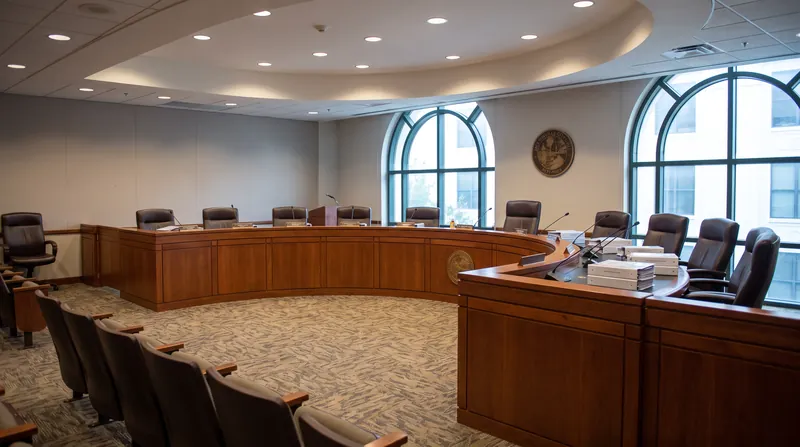
Local governments have begun testing the mechanism to resolve contentious budget fights. The Nashville Metropolitan Council Finance Committee deployed quadratic voting to review the mayor's proposed annual budget, replacing a traditional process where council members simply submitted amendments and advocated for their pet projects. The Government Finance Officers Association, which tracked the Nashville experiment, noted that traditional budgeting often forces people to pick a side and discourages compromise. "Budget decisions today are often made in an environment of high conflict and low trust," the association reported, noting that the share of Americans who believe most people can be trusted has dropped to 30 percent.
Local governments have begun testing the mechanism to resolve contentious budget fights.
The Nashville pilot demonstrated that the mathematical approach could break legislative gridlock. By forcing council members to allocate a finite budget of credits across the proposed amendments, the system provided a complete picture of participant preferences and highlighted areas of genuine consensus. "Thanks to QV, the council had a much clearer understanding of what members' priorities were—a crucial aid in what tends to be a lengthy and unsatisfying process," the project report concluded. The committee used the quadratic results to submit its final budget recommendations to the mayor's office, turning a typically fractured debate into a quantified priority list.
The Colorado State Legislature took the experiment further, using quadratic voting to allocate general fund dollars. Starting in 2019, the Democratic caucus utilized a digital quadratic platform to prioritize dozens of spending bills competing for a limited pool of money, which ranged from $30 million to $50 million in recent years. Lawmakers received 100 credits each and voted anonymously on an interactive spreadsheet. The system was designed to prevent informal logrolling—the practice of lawmakers trading favors to pass each other's bills—by forcing them to spend their credits in a closed market rather than negotiating in the hallways.[1][4]
The Colorado experiment ultimately collided with state transparency laws. Because the quadratic voting was conducted anonymously to ensure lawmakers voted their true preferences rather than performing for lobbyists, a conservative political nonprofit sued the House Speaker and Senate President. The lawsuit argued that the caucus was effectively taking formal action by secret ballot, which is prohibited under Colorado's open meetings laws. Lawmakers defended the practice, arguing that the quadratic poll was merely an internal prioritization tool and that the actual appropriations bills still went through public hearings and recorded votes before becoming law.[1]
On January 5, 2024, Denver District Court Judge David Goldberg struck down the legislature's use of the system. Goldberg ruled that the quadratic process constituted a secret ballot that violated the state's transparency requirements. "Adopting a proposed position through anonymous voting is precisely the reason why the General Assembly amended [the open meetings law] to prohibit secret ballots," the judge wrote in his decision. The ruling highlighted a core tension in municipal applications of the mechanism: the anonymity required to make the market function efficiently often conflicts with the public's legal right to observe how their representatives make decisions.[1]
While physical governments wrestle with public-record statutes, decentralized digital communities have adopted quadratic voting as a foundational governance tool. Platforms like Gitcoin use the mechanism to distribute grants and prioritize treasury spending without relying on traditional one-token-one-vote systems, which heavily favor wealthy token holders. By applying the quadratic cost curve, these communities ensure that a proposal supported by 100 individual users with small stakes easily defeats a proposal supported by a single wealthy user attempting to buy the outcome with a massive token balance.[3]
The primary vulnerability in digital deployments is the Sybil attack, named after a case study in multiple personality disorder. Because the quadratic formula makes the first vote the cheapest, a user can maximize their influence by splitting their voting power across dozens of fake accounts. If an attacker with 100 credits votes from a single account, they can cast 10 votes. If they split those credits across 100 fake accounts, they can cast 100 votes. To prevent this, digital platforms must implement strict identity verification protocols, ensuring that the "one-person-one-budget" rule remains mathematically intact.[3][5]
The continuous streaming model introduced by Gitcoin in 2026 attempts to solve the final limitation of traditional voting: the fact that community sentiment changes over time. Instead of capturing a single snapshot of preferences on election day, Streaming Quadratic Voting allows participants to adjust their credit allocations in real time as projects hit milestones or fail to deliver. The success of these continuous models in digital environments will likely dictate whether physical municipalities attempt to integrate quadratic mechanisms into their own ongoing public consultation platforms.[3]
Key points
- Quadratic voting replaces traditional one-person-one-vote systems by giving participants a budget of credits to spend across multiple issues.
- The cost of casting multiple votes on a single issue increases quadratically, forcing voters to weigh their priorities carefully.
- The mechanism is designed to measure the intensity of a voter's preference, preventing an indifferent majority from overruling a passionate minority.
- Local governments in Nashville and Colorado have used the system to break legislative gridlock and prioritize municipal budgets.
- A 2024 court ruling in Colorado highlighted a conflict between the anonymity required for the system to work efficiently and public transparency laws.
Why this matters
Traditional majority-rule voting often leaves passionate minorities unheard and indifferent majorities in control. Quadratic voting offers a mathematical solution to community budget fights by measuring not just what people want, but how much they care.
Key terms
- Quadratic Cost
- A pricing rule where the cost of an item increases by the square of the quantity purchased (e.g., 1, 4, 9, 16).
- Tyranny of the Majority
- A scenario in traditional voting where a majority group consistently forces its will on a minority, regardless of how intensely the minority is affected.
- Voice Credits
- The artificial currency or budget allocated to each participant in a quadratic voting system, used to purchase votes.
- Logrolling
- The practice of lawmakers trading favors or votes to ensure their respective projects pass, which quadratic voting attempts to disrupt.
- Sybil Attack
- A security threat in digital networks where a single user creates numerous fake identities to gain disproportionate influence.
Frequently asked
What is quadratic voting?
It is a decision-making system where participants receive a budget of 'voice credits' to vote on multiple issues. Voters can place multiple votes on a single issue, but the cost increases quadratically (one vote costs one credit, two votes cost four credits, three votes cost nine credits).
How does it protect minority interests?
In a traditional system, an indifferent 51% majority always defeats a passionate 49% minority. Quadratic voting allows the passionate minority to pool their credits and cast multiple votes on the issue they care about most, potentially outvoting a majority that spreads its votes thinly.
Why did a Colorado judge strike it down?
The Colorado State Legislature used an anonymous quadratic voting system to prioritize budget bills. A judge ruled in January 2024 that this constituted a secret ballot, which violates the state's open meetings and transparency laws.
What is a Sybil attack in quadratic voting?
In digital systems, a user can maximize their voting power by splitting their credits across multiple fake accounts, since the first vote is always the cheapest. Preventing this requires strict identity verification to ensure one person only gets one budget.
Sources
Source coverage
5 outlets
3 viewpoints surfaced





- [1]The Colorado SunTransparency Advocates
Judge rules secret ballot system used by Colorado Democrats violates open meetings law
Read on The Colorado Sun → - [2]RadicalxChangeMechanism Designers
Quadratic Voting
Read on RadicalxChange → - [3]GitcoinMechanism Designers
Quadratic Voting: A Guide to Nuanced Governance
Read on Gitcoin → - [4]WikipediaTransparency Advocates
Quadratic voting
Read on Wikipedia → - [5]Factlen Editorial TeamMunicipal Reformers
Synthesis by Factlen editorial team
Read on Factlen Editorial Team →
Comments

More in Community
See all →Affordable Housing
Jacksonville City Council Member Seeks to Restore $4.9M Stripped From Affordable Housing Trust Fund
3 sources
Memory Care
How Dementia Villages Are Replacing Institutional Memory Care With Community Living
4 sources

Survey Methodology
How the Randomized Response Technique and List Experiment Elicit Truthful Answers to Sensitive Survey Questions
6 sources

Tenant Rights
Houston City Council Passes 'Right to A/C' Ordinance for Rental Properties
5 sources

Every angle. Every day.
Get Community stories with full source coverage and perspective breakdowns delivered to your inbox.