
How Japan's 2026 Defense White Paper Redefines Indo-Pacific Security
Japan's latest defense strategy warns of a "new era of crisis" in East Asia, accelerating a historic shift toward advanced technologies, economic integration, and long-range deterrence.

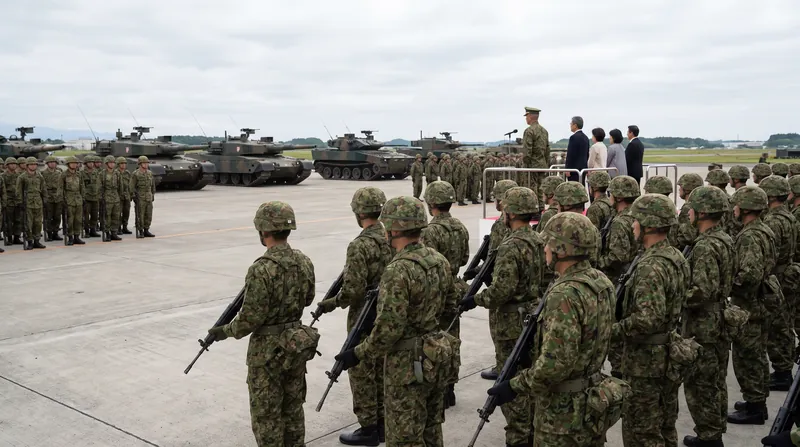
On August 4, 2026, the administration of Japanese Prime Minister Sanae Takaichi released the nation's annual Defense White Paper, a 600-page document that formally codifies a historic transformation in Tokyo's strategic posture.[4][5]
The document warns that the international community is entering a "new era of crisis," facing its most severe security environment since the end of World War II.[1][3]
At the center of this assessment is the deepening alignment between China, Russia, and North Korea, which the paper identifies as the primary catalysts for regional instability.[1][3]
Japanese defense planners explicitly draw parallels to the ongoing conflict in Europe, stating that a serious situation akin to the invasion of Ukraine could plausibly occur in East Asia.[1][3]
To address these perceived vulnerabilities, the 2026 white paper outlines a comprehensive overhaul of the Japan Self-Defense Forces, moving decisively beyond the strict pacifist constraints that defined the country's post-war era.[1][4]
A central pillar of this new doctrine is the acquisition and expansion of counterstrike capabilities, including the deployment of long-range standoff missiles capable of striking targets over 1,000 kilometers away.[2][6]
Beyond traditional munitions, the strategy places an unprecedented emphasis on emerging combat methods, dedicating a new chapter to the integration of artificial intelligence and unmanned systems.[1][3]
By fiscal year 2027, Tokyo aims to establish a network of low-cost, unmanned vehicles across air, sea, and underwater domains, a concept it refers to as the Synchronized, Hybrid, Integrated and Enhanced Littoral Defense (SHIELD).[1]
Perhaps the most significant structural shift detailed in the paper is the formal fusion of national security with economic policy and civilian industrial capacity.[4][6]
The government is actively encouraging private technology firms and startups to enter the defense sector, arguing that military production and dual-use technological innovation can serve as engines for broader economic prosperity.[2][4]
This industrial mobilization is backed by a record defense budget request of 8.9 trillion yen (approximately $56.1 billion) for the upcoming fiscal year, keeping Japan on track to reach its goal of spending 2 percent of its gross domestic product on defense by 2027.[1][6]
The strategic pivot has generated friction with neighboring countries, highlighting the complex diplomatic landscape Tokyo must navigate as it re-arms.[2][3]
In Beijing, the Chinese Defense Ministry strongly condemned the white paper, accusing Japan of exaggerating peripheral threats to justify military expansion and warning against a return to neo-militarism.[2][5]
Meanwhile, South Korea lodged formal protests over the document's continued inclusion of territorial claims to the Dokdo islands—known as Takeshima in Japan—which have appeared in the annual assessment for 22 consecutive years.[3]
Viewpoints in depth
Japanese Defense Planners
Argue that the deteriorating security environment necessitates a robust, tech-forward deterrence strategy.
Officials in Tokyo maintain that the deepening alignment of China, Russia, and North Korea represents an unprecedented strategic challenge. From this perspective, achieving a defense budget of 2 percent of GDP and acquiring long-range counterstrike capabilities are not aggressive moves, but necessary adaptations to prevent a conflict akin to the invasion of Ukraine from occurring in the Indo-Pacific.
Chinese Defense Officials
View the white paper as a pretext for unwarranted military expansion and a departure from post-war norms.
Beijing strongly rejects the 'China threat' narrative, characterizing its own military activities as routine and legitimate. Chinese officials argue that Japan is exaggerating peripheral security crises to loosen constitutional constraints, warning that Tokyo's fusion of economic policy with military production risks fueling a regional arms race and reviving neo-militarism.
Regional Allies and Partners
Acknowledge the need for a stronger Japanese security role while remaining sensitive to historical and territorial disputes.
While nations like the United States welcome Japan's transition into a more proactive security anchor, regional neighbors maintain a complex view. South Korea, for instance, shares Tokyo's concerns regarding North Korea but continues to formally protest the defense white paper over its persistent territorial claims to the disputed Dokdo islands, underscoring the delicate diplomacy required in East Asia.
Key points
- Japan's 2026 Defense White Paper warns that East Asia faces its greatest security test since World War II.
- The strategy formally links national defense to economic prosperity, encouraging civilian tech integration.
- Tokyo plans to deploy AI, unmanned systems, and long-range counterstrike capabilities by 2027.
- The defense budget targets 2 percent of GDP, representing a historic departure from decades of strict pacifism.
What we don’t know
- How effectively Japan can integrate its traditionally civilian-focused tech startups into the defense supply chain.
- Whether the planned 2 percent GDP defense budget can be sustained amid domestic economic pressures and demographic challenges.
- How the deployment of long-range counterstrike capabilities will alter the day-to-day tactical behavior of rival militaries in the region.
How we got here
December 2022
Prime Minister Fumio Kishida unveils a new National Security Strategy, committing to double defense spending to 2 percent of GDP.
July 2023
Japan's Defense White Paper first introduces the concept of a 'new era of crisis' in the global security environment.
November 2025
Prime Minister Sanae Takaichi takes office, accelerating the integration of economic and security policies.
August 2026
The 2026 Defense White Paper is approved by the Cabinet, formalizing the push for long-range missiles and unmanned systems.
- Deterrence Advocates
- Argue that Japan must rapidly modernize its military and integrate civilian tech to prevent a conflict in East Asia.
- Anti-Remilitarization Voices
- Warn that Japan's defense buildup and departure from pacifism threaten the post-war international order and escalate regional arms races.
- Economic Integrationists
- Focus on the fusion of national security and economic policy, viewing defense spending as a driver for domestic industrial innovation.
Perspectives this story doesn't cover
- Japanese domestic pacifist groups
- Civilian tech startups navigating defense contracts
Sources
Source coverage
6 outlets
3 viewpoints surfaced





- [1]Defense NewsDeterrence Advocates
Japan's 2026 defense white paper highlights 'new era of crisis' in Indo-Pacific
Read on Defense News → - [2]Global TimesAnti-Remilitarization Voices
Japan's latest defense white paper sets out a considerably harder security agenda
Read on Global Times → - [3]SBSDeterrence Advocates
Japan's Defense White Paper: 'Situation Like Ukraine Invasion Could Happen in East Asia'
Read on SBS → - [4]Modern DiplomacyEconomic Integrationists
The Defense White Paper and Four Key Priorities
Read on Modern Diplomacy → - [5]CGTNAnti-Remilitarization Voices
Japan's Defense Ministry on Tuesday released its annual defense white paper
Read on CGTN → - [6]China MilitaryAnti-Remilitarization Voices
Japan's 2026 Defense White Paper Heightens Security Fears to Justify Re-Militarization
Read on China Military →
More in World
See all →Dark Matter
East Asia Accelerates Underground Race to Detect Dark Matter
6 sources

South China Sea
The Geographic Incompatibility of the Nine-Dash Line and the UNCLOS Exclusive Economic Zone
6 sources

Climate Finance
How the Asian Development Bank's Energy Transition Mechanism Retires Coal Plants Early
3 sources

Child Rights
UN General Assembly Establishes November 27 as International Day to Eliminate Child Marriage
6 sources
Comments
Every angle. Every day.
Get World stories with full source coverage and perspective breakdowns, free every day.