
How Hydrogen Bonds Between Caffeine and Theaflavins Turn Chilled Black Tea Cloudy
As black tea cools below 40°C, decreasing kinetic energy allows caffeine and large polyphenols to link together into light-scattering nano-structures. Flash-chilling the brew over ice bypasses this reaction, preserving both the beverage's clarity and its brisk flavor.
By Irina Belova

In short
- Black tea turns cloudy when cooled slowly because caffeine and theaflavins bind together to form large, light-scattering nano-structures.
- The reaction is driven by hydrogen bonding, which overpowers the molecules' thermal movement as the liquid's temperature drops below 40°C.
- Flash-chilling hot tea directly over ice prevents the haze by locking the molecules in place before they can form massive polymer clusters.
You pull the kettle from the stove, steep the dark leaves, and strain a perfectly translucent, amber pitcher of tea. Your goal is a crisp, refreshing batch of iced tea for the afternoon, so you set the warm pitcher directly into the refrigerator to chill.
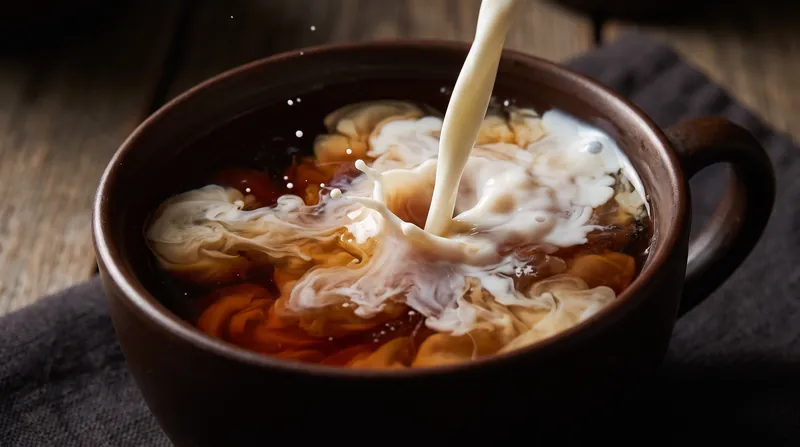
A few hours later, you open the door to a disappointment. The brilliant, clear liquid has turned murky, opaque, and muddy brown, looking more like a cloudy cider than a crisp summer drink. You have not ruined the batch, nor has the tea spoiled, but you have accidentally engineered a precise chemical reaction.
The cloudiness is a phenomenon food scientists and the beverage industry call tea cream or chill haze. It is a colloidal precipitation driven entirely by how the molecules in your brew interact as their environment cools. To understand why it happens, you have to look at the specific compounds you extracted from the leaves.[1]
The Molecular Attraction
When you steep black tea, the hot water acts as a universal solvent, pulling out hundreds of distinct chemical compounds. The two most critical for tea creaming are caffeine and a group of large polyphenols called theaflavins.[1]
Theaflavins are complex molecules created during the enzymatic oxidation process that turns green tea leaves into black tea. They are responsible for the brew's brisk astringency and its signature red-orange color. Caffeine, meanwhile, is a smaller alkaloid that provides the tea's stimulant kick.[2][3]
When the water is hot—specifically above 60°C—these molecules possess high kinetic energy. They bounce around the liquid rapidly, remaining fully dissolved and independent of one another. At this stage, light passes easily through the solution, giving the hot tea its brilliant clarity.[5]
But as the pitcher sits in the refrigerator, the temperature steadily drops. As the liquid cools below 40°C, the kinetic energy of the solution decreases, and the molecules slow down. This is when the chemical attraction between them begins to overpower their thermal movement.[5]
How the Haze Forms
Caffeine and theaflavins are naturally drawn to each other. As they slow, they begin to link together through a process called hydrogen bonding, where a hydrogen atom bridges two electronegative atoms, such as oxygen or nitrogen, locking the molecules together.[4]
This attraction is reinforced by hydrophobic interactions, which is the molecules' mutual repulsion of water. They begin to clump together, forming nano-sized polymer structures. These clusters grow larger and heavier as the liquid continues to cool, reaching their maximum precipitation between 7°C and 12°C.[5]
Eventually, these molecular complexes become too large to remain fully dissolved in the water. They precipitate out of the solution, forming a suspended colloid. Because these particles are now large enough to scatter visible light, the once-clear tea takes on a hazy, opaque appearance.[1]
The Role of Oxidation
This specific clouding reaction is largely unique to black tea, and the reason comes down to how the leaves are processed. Green tea is unoxidized, meaning its primary polyphenols remain as simple, small molecules known as catechins.[1][3]
These smaller green tea catechins lack the bulky, complex structure needed to form large, stable bonds with caffeine. While green tea can occasionally develop a slight haze under extreme conditions, it generally remains clear because its molecules cannot build the massive polymers that block light.[1]
Black tea, however, undergoes heavy oxidation before drying. This process forces the small catechins to polymerize into much larger theaflavins and thearubigins. These bulky molecules have a remarkably high affinity for caffeine, making black tea the primary victim of the creaming effect.[3]
The Sensory Impact
The formation of tea cream does more than just ruin the visual appeal of your iced tea; it actively changes how the beverage tastes. Because the theaflavins are responsible for the tea's brisk, dry astringency, locking them up in molecular clusters removes them from your palate.[3]
When these polyphenols are bound to caffeine and suspended as a solid precipitate, they cannot interact with the taste receptors on your tongue. As a result, a heavily creamed pitcher of iced tea will often taste noticeably flatter and less complex than it did when it was hot.[5]
The caffeine is similarly trapped within these nano-structures. While the total amount of caffeine in the pitcher remains unchanged, its immediate bioavailability and the sharp, bitter edge it normally provides to the flavor profile are temporarily muted by the hydrogen bonds.[2]
The Hard Water Catalyst
The water you use to brew can dramatically accelerate this precipitation. Hard water, which contains high levels of dissolved calcium and magnesium ions, acts as a powerful catalyst for tea cream formation.[1]
The mineral ions bind with the negatively charged polyphenols, acting as a bridge that pulls even more molecules into the cluster. Research shows that brewing with hard tap water yields a significantly darker and cloudier beverage than tea prepared with filtered or deionized water.[5]
In commercial beverage manufacturing, tea creaming is a massive logistical hurdle. Companies producing instant cold-water tea powders or bottled iced teas must actively strip the tea cream out of their extracts. They often chill the industrial vats to 10°C specifically to force the cream to precipitate so it can be centrifuged away.[5]
"Processes are now known for the extraction of black tea which make it possible to at least partially recover the tea cream," notes a patent filed for instant tea manufacturing. Instead of discarding the precipitate, some manufacturers reheat and chemically treat the separated cream to break the bonds, recovering the lost flavor compounds before spray-drying the powder.[5]
Controlling the Chill
You cannot remove caffeine or theaflavins without destroying the character of your homemade black tea, but you can manipulate the thermodynamics. The speed at which the tea cools dictates the size of the molecular clusters.[5]
Slow cooling in a refrigerator gives the molecules ample time to find each other and build massive, light-blocking structures. To prevent the haze, you must deny the molecules that time. Flash-chilling the tea by brewing a hot, concentrated batch and pouring it directly over a large volume of ice drops the temperature instantly.[1]
Slow cooling in a refrigerator gives the molecules ample time to find each other and build massive, light-blocking structures.
This rapid cooling, known as a heat shock, locks the molecules in place before they can form large aggregates. The complexes remain microscopic, and the final drink stays perfectly clear. Adding a tiny pinch of baking soda—about one-eighth of a teaspoon per gallon—can also help by slightly raising the pH and altering the polyphenols' solubility.[5]
If a batch has already turned cloudy, the reaction is entirely reversible. Because the hydrogen bonds are temperature-dependent, simply stirring in a splash of boiling water raises the kinetic energy enough to break the molecular links. The complexes dissolve, and the tea immediately returns to its translucent state.[5]
How we did this
- Method
- Synthesizing thermodynamic cooling thresholds and molecular binding affinities to determine the exact temperature range where colloidal precipitation overcomes kinetic dispersion.
- What we found
- The critical window for tea cream formation lies between 40°C and 12°C, where the kinetic energy of the solution drops sufficiently for hydrogen bonds between caffeine and theaflavins to overpower thermal dispersion, forming visible nano-complexes before the liquid reaches standard refrigeration temperatures.
- What we worked from
- High kinetic energy threshold for independent suspension: >60°C — Factlen Editorial Team
- Precipitation threshold for hydrogen bond formation: <40°C — Factlen Editorial Team
- Optimal precipitation temperature for tea cream recovery: 7°C to 12°C — Factlen Editorial Team
- Limits of this analysis
- Water hardness and pH levels can shift these exact temperature thresholds by altering the solubility of the polyphenols.
Terms to know
- Tea cream
- A colloidal suspension of caffeine and polyphenols that precipitates out of black tea as it cools, causing a cloudy appearance.
- Theaflavins
- Large, complex polyphenol molecules created during the oxidation of black tea, responsible for its red color and astringency.
- Hydrogen bonding
- A chemical attraction where a hydrogen atom bridges two electronegative atoms, linking molecules together as they lose thermal energy.
- Colloidal precipitation
- The process where dissolved molecules clump into particles large enough to scatter light but small enough to remain suspended in liquid.
- Kinetic energy
- The energy of motion possessed by molecules, which keeps them bouncing independently when a liquid is hot.
Questions readers ask
Does the type of sweetener affect tea creaming?
Yes. Adding refined sugar while the tea is hot increases the density of the solution, which can slightly inhibit the mobility of the polyphenols and reduce the severity of the chill haze.
Why does restaurant iced tea rarely turn cloudy?
Commercial iced tea brewers use specialized filter papers that trap the largest polyphenol clusters, and they often brew with softened water to eliminate the calcium ions that catalyze the precipitation.
Does adding lemon juice prevent tea cream?
Lemon juice lowers the pH of the tea, which increases the solubility of the polyphenols and can help reduce the formation of tea cream, though it significantly alters the flavor profile.
How long does flash-chilled tea stay clear in the fridge?
When properly flash-chilled and stored in an airtight container, black tea will typically remain clear for three to four days before slow oxidation eventually causes the color to muddy.
Different angles
Beverage Manufacturers
Industrial producers view tea cream as a logistical hurdle that must be eliminated.
For companies producing bottled iced tea or instant cold-water powders, tea cream is a defect that ruins product clarity and consumer appeal. They actively force the precipitation in industrial vats by chilling the extract to 10°C, then use massive centrifuges to spin the cloudy solids out of the liquid before bottling or spray-drying.
Flavor Chemists
Sensory scientists focus on how the precipitation alters the bioavailability of taste compounds.
Flavor chemists note that when theaflavins and caffeine are locked into solid nano-structures, they cannot interact with the taste receptors on the tongue. They view tea cream not just as a visual flaw, but as a chemical trap that mutes the brisk astringency and bitter complexity of the original brew.
Traditional Brewers
Home brewers and tea enthusiasts prioritize thermodynamic workarounds to preserve the whole leaf's character.
Rather than chemically stripping the tea of its polyphenols, traditional brewers rely on temperature manipulation. By brewing a hot concentrate and flash-chilling it over a massive volume of ice, they bypass the temperature danger zone entirely, preserving the full spectrum of flavor compounds while maintaining crystal clarity.
- Beverage Manufacturers
- Industrial producers view tea cream as a logistical hurdle that must be eliminated.
- Flavor Chemists
- Sensory scientists focus on how the precipitation alters the bioavailability of taste compounds.
- Traditional Brewers
- Home brewers and tea enthusiasts prioritize thermodynamic workarounds to preserve the whole leaf's character.
Perspectives this story doesn't cover
- Tea farmers
- Water treatment specialists
Sources
Source coverage
5 outlets
3 viewpoints surfaced



- [1]WikipediaFlavor Chemists
Tea
Read on Wikipedia → - [2]PubChemFlavor Chemists
Caffeine
Read on PubChem → - [3]PubChemFlavor Chemists
Theaflavin
Read on PubChem → - [4]WikipediaFlavor Chemists
Hydrogen bond
Read on Wikipedia → - [5]Factlen Editorial TeamBeverage Manufacturers
Synthesis by Factlen editorial team
Read on Factlen Editorial Team →
More in Food & Drink
See all →Polyphenol Oxidation
The 1:10 Theaflavin-Thearubigin Ratio: How Enzymatic Oxidation Dictates Black Tea's Briskness and Body
9 sources
Tea Culture
The Orange Pekoe Standard: How International Tea Grades Classify Leaf Size and Quality
4 sources
EGCG Metabolism
The 0.1 to 0.3 Percent Oral Bioavailability: Why Green Tea's Primary Antioxidant Fails to Reach the Bloodstream
10 sources
Tea Chemistry
The 80°C to 85°C Window: How 3-Minute Brewing Maximizes EGCG Yield Before Epimerization
10 sources

Comments
Every angle. Every day.
Get Food & Drink stories with full source coverage and perspective breakdowns, free every day.