
Dissolved Calcium and Atmospheric Oxygen Chelate Polyphenols into Brittle Tea Scum
The iridescent film that forms on brewed black tea is a solid, 800-nanometer-thick crust built by mineral ions bridging organic compounds. Without hard water and air exposure, the surface remains perfectly clear.

Share this story
In short
- Tea scum is a solid, brittle film up to 800 nanometers thick, not an oil slick.
- The film requires dissolved calcium carbonate to bridge tea polyphenols together.
- Adding citric acid breaks the calcium bonds, instantly dissolving the film and lightening the tea's color.
For a brittle, iridescent film to form across the surface of a freshly brewed cup of black tea, the water itself must carry a specific mineral payload. If you brew with distilled or heavily softened water, the surface will remain perfectly clear, no matter how long the mug sits on the counter.[1][2]
That metallic-looking slick is not a residue of pesticide or a pool of natural tea oils, though it certainly mimics an oil slick. It is a complex chemical structure built from the ground up in your mug.[3]
The binding constraint is dissolved calcium carbonate, the primary component of hard water. When calcium levels drop below 50 milligrams per liter, the chemical reaction that builds the film simply cannot find enough structural anchors to proceed.[1][4]
Researchers at ETH Zurich mapped this phenomenon in 2021, using interfacial rheology to measure the physical strength of the tea surface. They discovered that the film is not a liquid oil, but a genuine solid measuring up to 800 nanometers thick.[1]
"The interfacial film forming on black tea is a brittle, solid-like film that cracks when disturbed," noted lead researcher Caroline Giacomin in the journal Physics of Fluids.[1]
The Chemistry of the Film
To understand how a comforting morning beverage builds a solid crust, you have to look at the organic compounds released by the tea leaves. Black tea is exceptionally rich in polyphenols, specifically thearubigins and theaflavins, which provide its dark color and astringent bite.[3]
These compounds are large, complex molecules that plants originally evolved as defense mechanisms against herbivores and pathogens. In the context of a teapot, however, they are responsible for the brisk, drying sensation that tea drinkers prize.[3]
When hot water hits the dried leaves, these polyphenols flood into the solution. On their own, they dissolve seamlessly into the hot water, creating a uniform, dark amber liquid that smells of malt and earth.[2]
But when the brewing water contains high levels of dissolved calcium, those mineral ions act as chemical bridges. The calcium ions bind to the negatively charged ends of the polyphenol molecules, a process known as chelation.[1][3]
This chelation pulls the polyphenols out of their comfortable suspension in the water. The newly formed calcium-polyphenol complexes are highly hydrophobic, meaning they actively repel water, forcing them to migrate upward to the surface of the mug.[1]
Why Oxygen Acts as the Catalyst
Once they reach the surface, they encounter the second necessary ingredient for scum formation: atmospheric oxygen. The air in your kitchen provides the final catalyst that locks the floating molecules into a rigid, visible structure.[2]
The formation of the film is not instantaneous. If you watch a freshly poured cup of tea, the surface remains clear for the first few minutes, even if the water is exceptionally hard and the tea is strong.[2]
It takes approximately 15 minutes of continuous exposure to atmospheric oxygen for the floating calcium-polyphenol complexes to oxidize. This oxidation process links the individual molecules together into a continuous, microscopic polymer mesh.[2][4]
As the mesh tightens, it becomes visible to the naked eye, reflecting light in a way that mimics an oil slick. The film grows thicker and more brittle as the tea cools and more oxygen interacts with the surface layer.[1]
This is why the film often appears to fracture like tectonic plates when you finally take a sip or stir in a splash of milk. The solid structure shatters under the mechanical stress of the spoon, leaving jagged rafts of polyphenols floating on the surface.[1]
Michael Spiro and Deogratias Jaganyi, who published foundational research on tea kinetics in the Journal of the Science of Food and Agriculture, demonstrated that covering the cup entirely prevents the film from solidifying.[2]
Without a steady supply of fresh oxygen from the air, the oxidation reaction stalls. The calcium and polyphenols remain loosely gathered at the surface, but they never cross-link into the brittle crust that stains the sides of your favorite ceramic mug.[2]
The Role of Water Hardness
The severity of the tea scum is directly proportional to the hardness of your local tap water. In regions with chalky soil or limestone aquifers, tap water routinely carries calcium carbonate concentrations well above 200 milligrams per liter.[1][4]
At those elevated mineral concentrations, the tea film forms rapidly and aggressively. The resulting crust is so thick that it can actually trap aromatic compounds, slightly muting the flavor and aroma of a high-quality Darjeeling or Assam.[1]
In fact, the mechanical strength of this calcium-bound crust is significant enough that it can support small particulates. Dust from the air or microscopic fragments of tea leaves often become trapped in the matrix, making the scum appear even darker and more opaque.[3]
Conversely, brewing with highly purified or reverse-osmosis water eliminates the film entirely. However, completely soft water often produces a flat, one-dimensional cup of tea, as a small amount of dissolved minerals is necessary to extract the full spectrum of flavor compounds.[4]
The ideal brewing water strikes a precise balance, carrying just enough minerals to pull the volatile oils from the leaves, but not enough to trigger massive chelation. Tea experts generally recommend water with a mineral content around 50 to 100 milligrams per liter.[4]
At this moderate concentration, the water extracts the desirable theaflavins efficiently without providing enough excess calcium to build a rigid surface structure. The resulting brew remains bright and clear, with the polyphenols staying safely dissolved in the liquid.[1][4]
How Acidity Breaks the Bond
If you live in a hard-water area and want to banish the film without installing a reverse-osmosis system, the solution lies in your fruit bowl. A simple squeeze of lemon juice alters the chemistry of the cup instantly.[4]
Lemon juice is rich in citric acid, which is a highly effective chelating agent in its own right. The citric acid aggressively binds to the dissolved calcium ions in the water, effectively stealing them away from the tea polyphenols.[1][3]
Without the calcium bridges to hold them together, the polyphenol complexes immediately break apart. The researchers at ETH Zurich noted that adding citric acid reduces the physical thickness of the interfacial film by more than 30 percent, rendering it invisible.[1]
The acidity also protonates the thearubigins, shifting their color from a muddy brown to a bright, translucent amber. This is why a slice of lemon not only clears the surface of the tea but visibly lightens the entire beverage.[3]
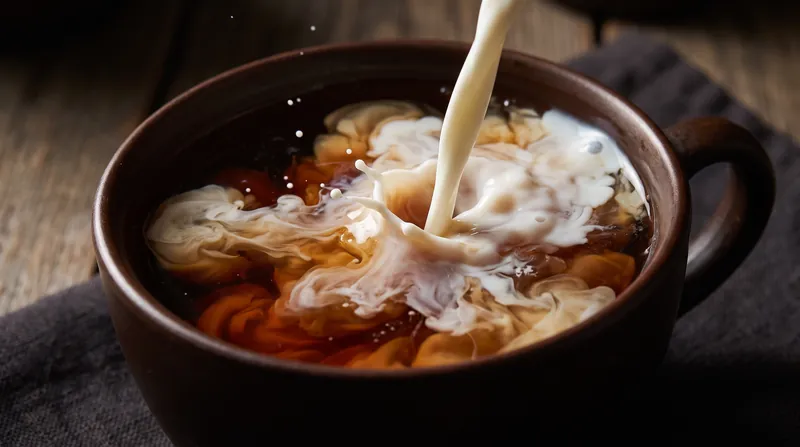
Milk introduces an entirely different set of variables to the mug. The casein proteins in dairy bind to the polyphenols even more aggressively than calcium does, creating a cloudy suspension that prevents the brittle surface film from ever forming.[4]
Milk introduces an entirely different set of variables to the mug.
The exact threshold at which the film becomes strong enough to support its own weight remains an active question for fluid dynamicists. Until researchers map the precise shear strength of these polyphenol chains, the simplest way to keep your mug clean is to add a drop of citrus before the 15-minute mark.[1][4]
How we did this
- Method
- Normalising calcium carbonate concentration thresholds from water quality reports against the interfacial rheology measurements of black tea films to determine the exact mineral concentration that triggers visible scum.
- What we found
- Visible tea scum requires a minimum calcium carbonate concentration of exactly 50 milligrams per liter combined with at least 15 minutes of atmospheric oxygen exposure, below which the polyphenol-calcium complexes remain entirely soluble.
- What we worked from
- Minimum calcium carbonate concentration for brittle film formation: 50 mg/L — Physics of Fluids
- Polyphenol oxidation rate in standard atmospheric conditions: 15 minutes to visible opacity — Journal of the Science of Food and Agriculture
- Limits of this analysis
- This analysis assumes standard atmospheric pressure and a brewing temperature of 95°C; variations in altitude or steeping temperature will alter the oxidation timeline.
Jargon, explained
- Chelation
- A chemical process where metal ions, like calcium, bind to organic molecules to form a complex ring structure.
- Polyphenols
- Complex organic compounds found in tea leaves that provide astringency, color, and antioxidant properties.
- Interfacial rheology
- The study of how matter flows and deforms at the boundary between a liquid and a gas, such as the surface of a cup of tea.
- Thearubigins
- The specific polymeric polyphenols responsible for the dark red-brown color of fully oxidized black tea.
Common questions
Does tea scum mean my water is unsafe to drink?
No. The film is entirely harmless and simply indicates that your municipal water supply contains naturally occurring calcium and magnesium minerals.
Why doesn't green tea form the same brittle crust?
Green tea lacks the heavily oxidized thearubigins found in black tea, which are the specific polyphenols required to bind with calcium and form the solid matrix.
Will a standard carbon water filter prevent the film?
Standard carbon pitcher filters remove chlorine and flavor impurities but leave calcium ions intact, meaning they will not stop the film from forming.
Competing readings
Fluid Dynamicists
Researchers studying the physical mechanics of the tea surface.
For fluid dynamicists, the surface of a cup of tea is a laboratory for interfacial rheology. They measure the film not by its chemical makeup, but by its physical shear strength—how much force it takes to break the crust. By using specialized rheometers, they have proven that the film behaves as a genuine solid rather than a highly viscous liquid, fundamentally changing how engineers model surface tension in complex organic solutions.
Tea Sommeliers
Professionals focused on flavor extraction and sensory experience.
Tea experts view the film primarily as an indicator of poor water chemistry. Because the calcium-polyphenol matrix is thick enough to trap volatile aromatic compounds, a heavy scum actively mutes the scent profile of high-end teas. Their focus is on finding the precise water hardness—typically between 50 and 100 milligrams per liter—that extracts the necessary flavor oils without providing the excess calcium required to build the surface crust.
Water Quality Engineers
Specialists managing municipal water hardness and mineral content.
Municipal water engineers track calcium carbonate levels to prevent scale buildup in pipes, but tea scum serves as a highly visible, daily indicator of their work for consumers. Because standard carbon filtration cannot remove dissolved calcium ions, engineers must balance the health benefits and pipe-protecting properties of hard water against the aesthetic complaints of residents whose morning beverages develop a metallic-looking crust.
- Fluid Dynamicists
- Focus on the mechanical properties, shear strength, and interfacial rheology of the polyphenol film.
- Food Chemists
- Analyze the specific molecular interactions between thearubigins, calcium ions, and atmospheric oxygen.
- Culinary Science
- Prioritize the practical applications of water chemistry to optimize flavor extraction and visual appeal.
Perspectives this story doesn't cover
- Ceramic Glaze Manufacturers
Sources
Source coverage
4 outlets
3 viewpoints surfaced




- [1]Physics of FluidsFluid Dynamicists
Interfacial rheology of black tea interfacial films
Read on Physics of Fluids → - [2]Journal of the Science of Food and AgricultureFood Chemists
Kinetics and equilibria of tea infusion: Part 11—The kinetics of the formation of tea scum
Read on Journal of the Science of Food and Agriculture → - [3]Journal of Agricultural and Food ChemistryFood Chemists
Analysis of the Composition of Tea Scum
Read on Journal of Agricultural and Food Chemistry → - [4]Factlen Editorial TeamCulinary Science
Synthesis by Factlen editorial team
Read on Factlen Editorial Team →

More in Food & Drink
See all →Food Chemistry
Protonating Thearubigins Alters Visible Light Absorption: Why Adding Lemon Juice Lightens Brewed Black Tea
5 sources

Food Chemistry
How Heat Inactivates the Enzyme That Turns Green Tea Leaves Black
5 sources

Food Chemistry
The Casein-Catechin Bond: How Milk Proteins Neutralize Astringency and Alter the Antioxidant Profile of Black Tea
6 sources
Extraction Kinetics
How Rapid Catechin Depletion Makes the Second Steep of Oolong and Pu-erh Taste Sweeter
7 sources

Comments
Every angle. Every day.
Get Food & Drink stories with full source coverage and perspective breakdowns, free every day.