
Glycol Dehydration Columns Strip Dissolved Reservoir Water to Stop Gas Pipeline Hydrate Plugs
Triethylene glycol systems continuously extract moisture from high-pressure natural gas streams before transmission. The chemical absorption process prevents water and methane from forming solid hydrate plugs that can catastrophically block pipelines.

Share this story
In short
- High-pressure natural gas must be dehydrated to less than seven pounds of water per million cubic feet to prevent solid hydrate plugs from blocking pipelines.
- Triethylene glycol acts as a liquid desiccant, aggressively absorbing water vapor in a contact tower while ignoring the surrounding hydrocarbon gases.
- The water-laden glycol is continuously regenerated in a 400-degree reboiler, which boils off the moisture alongside captured volatile organic compounds that must be combusted.
High-pressure natural gas transmission requires a strictly dry environment to function safely across long distances. If water vapor remains dissolved in the gas stream as it enters a cold subsea or overland pipeline, the entire transmission system crosses the thermodynamic threshold known as the hydrate stability curve.[1][3]
At operating pressures above 600 pounds per square inch and temperatures hovering near freezing, water and methane molecules lock together into a solid crystalline lattice. These ice-like structures, known chemically as methane clathrates or hydrates, rapidly agglomerate into solid masses that adhere to the pipe walls.[3][5]
A hydrate plug acts as a concrete barrier inside a pipeline, completely halting gas flow and creating severe pressure differentials that threaten the structural integrity of the infrastructure. Clearing a plug requires hazardous depressurization or heavy chemical injection, making absolute prevention the only viable operational strategy.[3][5]
To prevent hydrate formation, operators must strip the dissolved reservoir water from the gas stream immediately at the processing facility before transit begins. The industry standard mandates reducing the water content to a strict maximum of seven pounds per million standard cubic feet of natural gas.[1][4]
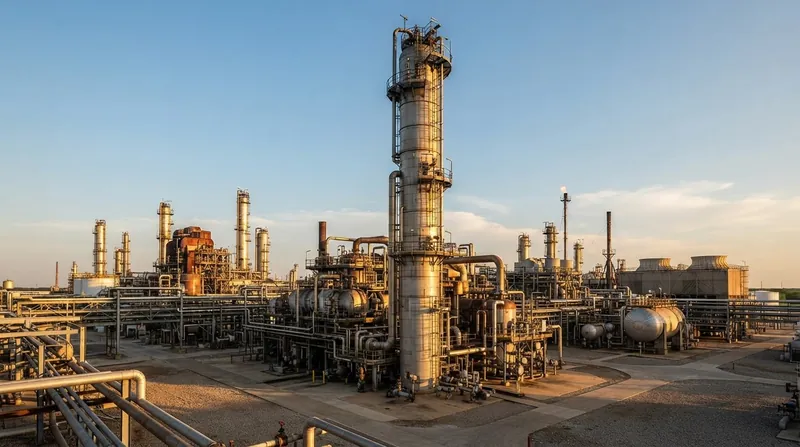
Achieving this precise pipeline specification relies on a continuous chemical absorption process executed before the gas ever leaves the plant. The dominant technology deployed across the global energy infrastructure to perform this extraction is the triethylene glycol dehydration unit, a robust liquid desiccant system.[1][2]
The Chemistry of Triethylene Glycol
Triethylene glycol serves as the ideal liquid desiccant due to its unique molecular structure and exceptional thermal stability. The compound features three ethylene oxide units terminated by hydroxyl groups, giving it an extreme chemical affinity for capturing and holding onto passing water molecules.[2]
The desiccant is highly hygroscopic, meaning it actively attracts and binds with water vapor while largely ignoring the surrounding hydrocarbon gases flowing past it. It also maintains a high boiling point of 550 degrees Fahrenheit, which becomes a crucial physical property during the system's regeneration phase.[1][2]
The dehydration process begins in a vertical pressure vessel known as the contact tower or the absorber column. Wet natural gas straight from the reservoir separators enters the bottom of the tower at pressures typically ranging from 600 to 1,200 pounds per square inch.[1][4]
As the pressurized wet gas flows upward through a series of internal trays or structured packing materials, lean glycol is pumped in at the top. The liquid desiccant cascades downward through the vessel, creating a turbulent countercurrent flow against the rapidly rising gas stream.[1]
This countercurrent design maximizes the surface area contact between the wet gas and the descending liquid desiccant. The heavy glycol aggressively absorbs the water vapor from the gas, physically stripping the moisture out of the hydrocarbon stream as it falls from tray to tray.[1]
By the time the gas reaches the top of the contact tower, it has been thoroughly dehydrated and conditioned for transport. The dry gas exits the vessel, safely meeting the stringent pipeline specification of under seven pounds of water per million standard cubic feet.[1][4]
Boiling Off the Captured Water
While the dry gas enters the transmission grid, the water-laden desiccant—now referred to in the industry as rich glycol—collects at the bottom of the contact tower. This rich glycol must be continuously regenerated and recycled to maintain the facility's uninterrupted dehydration cycle.[1]
The rich glycol flows out of the high-pressure contactor and passes through a dedicated flash separator vessel. This intermediate tank drops the fluid pressure to near atmospheric levels, allowing any inadvertently trapped methane or light hydrocarbons to flash off safely as a recoverable gas.[1][4]
After leaving the flash separator, the rich glycol enters the reboiler, which acts as the thermal heart of the entire regeneration system. The reboiler applies direct heat to separate the absorbed reservoir water from the glycol desiccant through a continuous distillation process.[1]
Precise temperature control in the reboiler dictates the efficiency and safety of the entire system. Because water boils at 212 degrees Fahrenheit and triethylene glycol boils at 550 degrees Fahrenheit, operators can easily exploit this wide thermal gap to drive off the moisture.[1][2]
The reboiler is typically maintained between 350 and 400 degrees Fahrenheit during standard daily operations. This temperature is hot enough to rapidly vaporize the trapped water, but safely below the critical 404-degree threshold where the glycol molecule itself begins to thermally degrade and break down.[1][2]
The vaporized water exits the reboiler through a vertical still column vent, carrying away the moisture originally extracted from the reservoir gas. The remaining liquid in the vessel is once again lean glycol, successfully restored to a working purity of 98.5 to 99.5 percent.[1]
Controlling Volatile Organic Compounds
The thermal regeneration process, while highly effective at restoring the glycol, introduces significant environmental and regulatory challenges for operators. Triethylene glycol does not just absorb water; it also exhibits a slight but problematic solubility for aromatic hydrocarbons present in the raw natural gas.[1][2]
During the absorption phase in the contact tower, the glycol absorbs small quantities of benzene, toluene, ethylbenzene, and xylenes. These hazardous air pollutants travel in solution with the rich glycol out of the high-pressure tower and directly into the heated reboiler vessel.[1][4]
When the reboiler heats the rich glycol to vaporize the water, it simultaneously boils off the trapped aromatic compounds and volatile organic gases. Historically, these concentrated pollutants were vented directly into the atmosphere alongside the harmless steam exiting the still column.[1]
Modern environmental regulations, including the Environmental Protection Agency's 2007 area source rules, strictly limit these atmospheric emissions. Facilities must now actively capture and destroy the vent gases rather than releasing them into the surrounding air, fundamentally changing how dehydration plants are designed.[1]
Operators route the still column vent stream through specialized condensers to recover the heavier liquid hydrocarbons for sale or disposal. The remaining non-condensable gases, including methane and lighter volatile compounds, are then directed via closed piping to a thermal oxidizer or enclosed combustor.[1][4]
These high-temperature combustion devices destroy up to 99 percent of the hazardous pollutants, converting them cleanly into carbon dioxide and water vapor. This dedicated emission control infrastructure is now a mandatory, heavily monitored component of any new dehydration facility built in 2026.[1]
Balancing Circulation and Heat Duty
Operating a dehydration unit requires a precise, continuous balance of fluid dynamics and thermodynamics. The most critical operational parameter is the glycol circulation rate, which engineers measure in gallons of liquid desiccant pumped for every pound of water removed from the gas.[1]
A standard field dehydrator circulates between two and six gallons of glycol for every pound of water extracted from the gas stream. Increasing the circulation rate removes more water, but it proportionally increases the thermal energy required to heat the reboiler.[1]
Higher circulation rates also lead to greater absorption of aromatic compounds, which places a heavier processing load on the facility's emission control systems. Operators must carefully tune the pump speeds to provide just enough dehydration without overloading the reboiler or the combustor.[1][4]
The temperature of the lean glycol entering the contact tower also heavily influences overall system performance. If the glycol is too hot, it vaporizes and is lost with the exiting dry gas; if it is too cold, the fluid viscosity increases, severely reducing absorption.[1][2]
Operators typically inject the lean glycol at a temperature 10 to 15 degrees Fahrenheit warmer than the incoming natural gas stream. This precise thermal buffer prevents the heavier hydrocarbons in the gas from condensing into troublesome liquids inside the contact tower.[1]
The Cost of Flow Assurance
The capital and operating costs of glycol dehydration represent a significant fraction of overall natural gas processing expenses. The reboiler alone consumes substantial volumes of valuable fuel gas just to maintain its 400-degree operating temperature around the clock, year after year.[1][4]
To minimize this massive energy penalty, modern facilities employ rich-lean heat exchangers within the plant's piping network. These units use the hot lean glycol exiting the reboiler to preheat the cold rich glycol coming from the contact tower before it reaches the burner.[1]
This standard heat integration reduces the reboiler's total fuel demand by up to 40 percent, significantly lowering both operating costs and combustion emissions. It also partially cools the lean glycol before it returns to the absorber, saving on dedicated chilling equipment.[1]
Despite the high energy costs, the fundamental economics heavily favor continuous dehydration over the alternative. A single hydrate plug in a deepwater subsea pipeline can halt millions of dollars of production and require weeks of hazardous, expensive intervention to safely clear.[3][5]
By stripping the dissolved reservoir water at the source, dehydration columns provide the fundamental flow assurance that makes long-distance gas transmission physically possible. The chemical affinity of triethylene glycol ensures the global energy grid remains clear, pressurized, and fully functional.[1][2]
How we did this
- Method
- Derivation of the parasitic thermal load in TEG regeneration by comparing the physical circulation volumes against the target water extraction mass.
- What we found
- Because operators must circulate and heat up to six gallons of heavy glycol just to extract one pound of water, the sensible heat required to raise the liquid desiccant to 400°F accounts for the vast majority of the reboiler's energy demand, making the actual vaporization of the water a secondary thermal load.
- What we worked from
- Limits of this analysis
- This derivation assumes standard field gas compositions and does not account for the varying latent heat of vaporization for co-absorbed volatile organic compounds.
Key terms
- Methane Hydrate
- A solid, ice-like crystalline structure formed when water and methane molecules combine under high pressure and low temperature.
- Triethylene Glycol (TEG)
- A highly hygroscopic liquid chemical used as a desiccant to absorb water vapor from natural gas streams.
- Reboiler
- A heated pressure vessel used to boil off absorbed water from rich glycol, regenerating the desiccant for reuse.
- Rich Glycol
- Glycol that has absorbed water vapor from the natural gas stream and is awaiting thermal regeneration.
- Lean Glycol
- Pure, dry glycol that has been thermally regenerated and is ready to absorb more water from the gas stream.
- BTEX
- An acronym for benzene, toluene, ethylbenzene, and xylenes—hazardous aromatic hydrocarbons often co-absorbed during the dehydration process.
Reader questions
What happens to the recovered liquid hydrocarbons from the condenser?
The heavier aromatic compounds and natural gas liquids recovered by the still column condenser are typically routed to a pressurized storage tank and sold as a secondary condensate product, offsetting some operational costs.
Can solid desiccants be used instead of liquid glycol?
Yes. For cryogenic processing where gas must be chilled to extremely low temperatures, operators use solid molecular sieves that can reduce water content to less than 0.1 parts per million, far below what glycol can achieve.
How long does the triethylene glycol last before it must be replaced?
While the system continuously recycles the desiccant, small amounts are lost to vaporization and degradation. Operators typically must add fresh makeup glycol every few months to replace the fluid carried away in the dry gas stream.
Are there alternatives to thermal oxidizers for handling the vent gas?
Some facilities route the non-condensable vent gases back into the plant's fuel gas system rather than combusting them, recovering the energy value of the methane while still preventing atmospheric emissions.
Where opinion splits
Flow Assurance Engineers
Prioritize strict moisture removal to prevent catastrophic pipeline blockages.
For flow assurance engineers, water is the primary enemy of high-pressure gas transmission. They view the 7 lbs/MMSCF specification not as a guideline, but as a hard physical boundary separating normal operations from catastrophic failure. Their models demonstrate that even minor excursions above this moisture limit can trigger rapid hydrate formation in cold subsea tiebacks, leading to solid plugs that act like concrete barriers. Consequently, they advocate for robust, oversized dehydration systems that can handle sudden surges in reservoir water production without compromising the dryness of the export gas.
Environmental Regulators
Focus on mitigating the hazardous air pollutants released during glycol regeneration.
Environmental agencies and regulators view TEG dehydration units as significant point sources for volatile organic compounds and hazardous air pollutants. Because triethylene glycol absorbs aromatic hydrocarbons alongside water, the regeneration process inherently boils off toxic compounds like benzene and toluene. Regulators have systematically tightened emission standards, such as the EPA's area source rules, to force the industry to install closed-vent systems, condensers, and thermal oxidizers. Their objective is to ensure that the chemical solution to pipeline hydrates does not become a secondary source of atmospheric pollution.
Plant Operators
Balance the thermal energy costs of dehydration against strict pipeline specifications.
Facility operators manage the daily economic and physical realities of the dehydration process. They must constantly balance the glycol circulation rate against the massive thermal energy required to keep the reboiler at 400 degrees Fahrenheit. Circulating too much glycol wastes valuable fuel gas and overloads the emission control systems, while circulating too little risks violating the pipeline moisture contract and triggering a shut-in. Operators focus heavily on heat integration and precise pump tuning to minimize the parasitic energy load of the regeneration cycle while maintaining compliance.
- Flow Assurance Engineers
- Prioritize strict moisture removal to prevent catastrophic pipeline blockages.
- Environmental Regulators
- Focus on mitigating the hazardous air pollutants released during glycol regeneration.
- Plant Operators
- Balance the thermal energy costs of dehydration against strict pipeline specifications.
Perspectives this story doesn't cover
- Cryogenic Processing Engineers
- Solid Desiccant Manufacturers
Sources
Source coverage
6 outlets
3 viewpoints surfaced


- [1]WikipediaEnvironmental Regulators
Glycol dehydration
Read on Wikipedia → - [2]WikipediaEnvironmental Regulators
Triethylene glycol
Read on Wikipedia → - [3]WikipediaEnvironmental Regulators
Clathrate hydrate
Read on Wikipedia → - [4]WikipediaEnvironmental Regulators
Natural gas processing
Read on Wikipedia → - [5]WikipediaEnvironmental Regulators
Flow assurance
Read on Wikipedia → - [6]Factlen Editorial TeamPlant Operators
Synthesis by Factlen editorial team
Read on Factlen Editorial Team →
More in Energy
See all →Wellbore Stability
Drilling Mud Density Must Stay Between Formation Pore Pressure and Rock Fracture Limits to Avert Deep Well Blowouts
3 sources
Thermodynamics
Latent Heat of Boil-Off Vaporization Maintains Minus 162°C: Why LNG Tankers Transport Liquid Methane Without Active Chillers
4 sources
Grid Economics
The Merit Order Effect That Determines Which Power Plants Run First
6 sources

Refining Economics
The 45 Gallons of Finished Product and Processing Gain That Come From a 42-Gallon Barrel of Crude Oil
7 sources
Comments
Every angle. Every day.
Get Energy stories with full source coverage and perspective breakdowns, free every day.