
First-Round Interviewers Settle Impressions Within Four Minutes: Why Rapport Outweighs Competence
Research reveals that hiring managers finalize their decisions during the initial rapport-building phase of an interview. This rapid cognitive sorting overrides subsequent technical answers, rendering much of the formal competency assessment mathematically redundant.
By Madison Lane

Share this story
In short
- Hiring managers finalize their decisions for the majority of candidates within the first four to five minutes of an interview.
- The initial rapport-building phase mathematically contaminates subsequent technical scoring, overriding up to three-quarters of the variance in structured rubrics.
- Verbal disclosures build rapport more effectively than nonverbal mimicry, but attempting to deploy multiple techniques simultaneously often backfires.
Inside a behavioral observation lab in 2016, researchers tracked 163 simulated job interviews, meticulously separating the opening pleasantries from the formal questioning phase. They instructed evaluators to score the candidates immediately after the initial small talk concluded, before a single competency question was asked.[1]
The resulting data dismantled the premise of the modern structured interview. The scores assigned after just a few minutes of casual rapport reliably predicted the final hiring outcomes. Candidates who established a strong initial connection secured significantly higher overall ratings, regardless of their subsequent technical answers.[1]
This phenomenon is not an isolated laboratory artifact. Across the corporate hiring landscape, the opening moments of an interview carry a disproportionate mathematical weight. The first four minutes of interaction routinely override the subsequent 45 minutes of carefully calibrated competency assessment.[1]
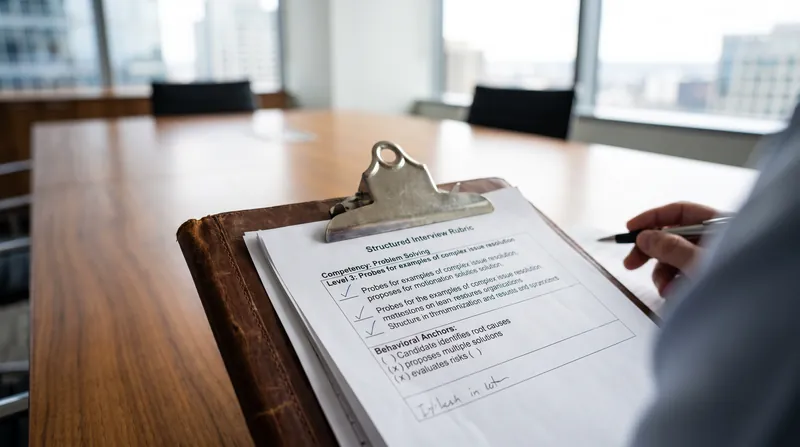
Human resources departments spend millions designing structured interview rubrics to eliminate bias and measure pure capability. Yet the human brain processes threat and affinity long before it evaluates technical proficiency. That rapid cognitive sorting renders much of the formal interview process mathematically redundant.[1]
The 90-Second Predictive Window
The speed at which these judgments crystallize challenges the utility of prolonged interview formats. Research from Harvard Business School demonstrates that the first 90 seconds of a professional encounter accurately predict the final hiring choice roughly 76 percent of the time.
That initial window contains no diagnostic information about a candidate's ability to perform the job. Instead, it consists entirely of posture, pace, eye contact, and the exchange of basic greetings. The interviewer's brain forms a preliminary verdict before the candidate even sits down.
Once that initial impression is locked in, the remainder of the interview functions largely as an exercise in confirmation bias. Interviewers subconsciously seek out evidence that validates their rapid initial assessment. A strong start creates a halo effect, while a weak introduction forces the candidate to spend the next hour attempting to undo a subconscious rejection.[1]
The durability of these rapid judgments is striking. Evaluators only significantly revise their initial impression of a candidate's leadership potential about 38 percent of the time. For the majority of applicants, the decision is effectively finalized before the formal questioning begins.
The Five-Minute Threshold
Corporate hiring managers openly acknowledge the brevity of their decision-making process. A nationwide CareerBuilder survey of more than 2,600 hiring and human resource managers quantified this rapid sorting. The data revealed that 51 percent of employers know within the first five minutes whether a candidate is a good fit.
That five-minute threshold aligns perfectly with the standard duration of the rapport-building phase. It encompasses the walk from the reception area, the initial handshake, and the obligatory small talk about the commute or the weather. Half of the candidate pool is effectively eliminated during this casual exchange.
"The best solution to minimize pre-interview anxiety is solid preparation," noted Rosemary Haefner, chief human resources officer for CareerBuilder, when the survey was released. Yet the survey data suggests that preparation must focus heavily on nonverbal cues rather than just technical answers.
The CareerBuilder data highlighted the specific physical missteps that trigger an immediate rejection. Failing to make eye contact was cited as a dealbreaker by 67 percent of hiring managers. Failing to smile disqualified candidates for 39 percent of the evaluators, while bad posture eliminated applicants for 31 percent.
Contaminating The Structured Rubric
The disproportionate weight of these early moments actively undermines the validity of structured interview scoring. A landmark study published in the Journal of Applied Psychology specifically measured how initial impressions contaminate subsequent evaluations. The researchers found a strong correlation of 0.42 between initial rapport scores and final interviewer ratings.[1]
This contamination means that interviewers allow their first impressions to misguide their ability to accurately rate technical responses. When interviewers formed a favorable initial impression, they consistently awarded higher scores on the subsequent, job-relevant questions. The effect was particularly pronounced during the early stages of the formal interview.[1]
"Initial evaluations of candidate competence extend beyond liking and similarity to influence subsequent interview outcomes," the researchers noted. This bias proved remarkably resilient, persisting even when different interviewers evaluated the same candidate later in the process.[1]
The contamination introduced by these first impressions is statistically distinct from other forms of image management, such as physical appearance or deliberate self-promotion. Rapport building contributes a unique, highly influential variable to the evaluative process. It measures social competence, but it simultaneously distorts the measurement of technical capability.[1]
The Virtual Setup Penalty
The shift to remote video interviews has only amplified the importance of these initial seconds. In a virtual setting, the traditional physical cues of a handshake and a walk to the conference room are replaced by lighting, camera angle, and audio clarity. Technical glitches during the first minute instantly signal a lack of preparation.[3]
Joining a call three minutes late or struggling with a muted microphone tells the interviewer that the candidate failed to manage the basic parameters of the meeting. That specific impression of incompetence sticks, establishing a negative lens for the entire call. The technical setup is not a warmup; it is the first test.[3]
The Mechanics Of Building Rapport
Given the mathematical dominance of the first four minutes, researchers have attempted to isolate the specific behaviors that successfully build rapport. A 2021 study from the University of Georgia examined the effectiveness of verbal versus nonverbal techniques in establishing a connection during an interview.
The researchers tested active listening, verbal disclosures of commonalities, and the nonverbal technique of mirroring body posture. They discovered that verbal interviewing techniques had a significantly greater impact on establishing rapport than nonverbal mimicry. Sharing a genuine commonality proved highly effective at bridging the initial social gap.
However, the study revealed a surprising penalty for candidates who attempted to deploy multiple rapport-building strategies simultaneously. Combining verbal disclosures with nonverbal mirroring actually backfired, damaging the connection. Evaluators perceived the combined approach as forced or manipulative, instantly wiping out any potential gains.
"It was a bit of a surprise to find that using verbal and nonverbal techniques together backfired," explained Eric Novotny, the lead researcher on the University of Georgia study. "In hindsight it was probably seen as forced or too much, making the interviewee feel that any rapport that resulted was fake."
The Illusion Of The Hour-Long Interview
The overwhelming evidence regarding the first four minutes forces a reevaluation of standard corporate hiring practices. If the decision is largely settled before the fifth minute, the remaining 55 minutes of a standard interview serve a different psychological function. They provide the illusion of a rigorous, meritocratic process.[1]
Prolonged interviews allow organizations to justify their hiring decisions with pages of structured rubric scores. Yet those scores are heavily anchored by the initial moments of social friction. The formal questions merely provide the vocabulary required to rationalize a rapid, subconscious judgment.[1][2]
Some organizational psychologists have proposed eliminating the rapport-building phase entirely to protect the integrity of the structured interview. By jumping immediately into standardized questions, companies could theoretically reduce the contamination of first impressions. However, this approach often creates an unnervingly sterile environment that suppresses candidate performance.[1][2]
The challenge for hiring committees is balancing the need for objective technical evaluation with the reality of human social dynamics. A completely sterile interview process fails to measure emotional intelligence, while an unstructured conversational approach devolves into a mere likability contest. Finding the exact midpoint remains a persistent structural challenge.[1][2]
Eliminating small talk also removes a genuine predictor of social competence. While rapport distorts technical scoring, it does provide valid information about how a candidate navigates novel social interactions. For roles requiring extensive client contact or team collaboration, that initial four-minute window may actually be the most diagnostic portion of the interview.[1][2]
Ultimately, candidates must recognize that the most critical phase of their evaluation occurs before they open their portfolio. The technical preparation remains necessary to pass the formal rubric, but it is entirely insufficient without a flawless introduction. The math of human perception is unforgiving.[1]
Ultimately, candidates must recognize that the most critical phase of their evaluation occurs before they open their portfolio.
The modern job interview is effectively a four-minute audition followed by a 45-minute confirmation exercise. Mastering the initial exchange of warmth and competence is not merely a polite formality. It is the primary mechanism by which employment is actually secured.[1]
Key terms
- Primacy Effect
- A cognitive bias where the information encountered first carries disproportionate weight in shaping a person's overall judgment.
- Halo Effect
- A psychological phenomenon where a positive initial impression in one area positively influences the evaluation of unrelated traits or abilities.
- Structured Interview
- A standardized evaluation method where every candidate is asked the exact same questions and scored against a predetermined rubric.
- Confirmation Bias
- The tendency to subconsciously seek out and favor information that validates a previously formed belief or initial impression.
Frequently asked
Can a strong technical answer overcome a bad first impression?
Statistically, it is highly unlikely. Evaluators only revise their initial impression about 38 percent of the time, meaning a weak introduction forces the candidate to spend the rest of the interview fighting a subconscious rejection.
Should I use mirroring techniques to build rapport?
No. Research from the University of Georgia found that combining verbal disclosures with nonverbal mirroring backfires, as interviewers perceive the combined approach as forced or manipulative.
Does the four-minute rule apply to remote video interviews?
Yes, and the penalty for a poor start is often harsher. Technical glitches, poor lighting, or joining late instantly signal a lack of preparation, locking in a negative impression before the conversation even begins.
Why do companies conduct hour-long interviews if the decision is made so quickly?
The prolonged format provides the illusion of a rigorous, meritocratic process. The formal questions supply the vocabulary and rubric scores required to rationalize the rapid, subconscious judgment made during the opening minutes.
Viewpoints in depth
Organizational Psychologists
Advocating for the elimination of unstructured rapport to protect rubric validity.
This camp views the initial four minutes as a source of dangerous contamination. They argue that unstructured small talk introduces demographic and affinity biases that structured interviews were explicitly designed to eliminate. By jumping straight into standardized competency questions, they believe organizations can measure pure capability rather than social fluency.
Corporate Hiring Managers
Defending the small talk as a crucial diagnostic tool for cultural fit.
Hiring managers frequently defend the rapid decision-making process, arguing that social competence is a genuine job requirement. They view the opening minutes not as a bias, but as a highly efficient test of how a candidate navigates novel social interactions. For client-facing or highly collaborative roles, they argue that a candidate who fails the rapport phase will likely fail the job.
Candidate Advocates
Urging transparency about the hidden mathematical weight of the introduction.
This perspective focuses on the practical reality facing job seekers. They argue that companies are fundamentally dishonest when they schedule 60-minute technical interviews but make the decision in the first four minutes. They advocate for better candidate preparation focused explicitly on nonverbal cues, virtual setups, and the mechanics of building immediate trust, rather than just rehearsing technical answers.
- Organizational Psychologists
- Advocating for the elimination of unstructured rapport to protect rubric validity.
- Corporate Hiring Managers
- Defending the small talk as a crucial diagnostic tool for cultural fit.
- Candidate Advocates
- Urging transparency about the hidden mathematical weight of the introduction.
Perspectives this story doesn't cover
- Neurodivergent Candidates
- Non-Native Speakers
Sources
Source coverage
3 outlets
3 viewpoints surfaced



- [1]Journal of Applied PsychologyOrganizational Psychologists
Initial Evaluations in the Interview: Relationships With Subsequent Interviewer Evaluations and Employment Offers
Read on Journal of Applied Psychology → - [2]Journal of Occupational and Organizational PsychologyOrganizational Psychologists
Candidate characteristics driving initial impressions during rapport building: Implications for employment interview validity
Read on Journal of Occupational and Organizational Psychology → - [3]Factlen Editorial TeamCandidate Advocates
Synthesis by Factlen editorial team
Read on Factlen Editorial Team →

More in Careers & Work
See all →Hiring Science
Impression Management Accounts for 22% of Interview Ratings but Only 2% of Job Performance
5 sources

Interview Bias
The 19% Distortion: How the Sequential Contrast Effect Biases Interview Scores Regardless of Candidate Quality
7 sources

Interview Scoring
The Calibration Gap: How Behaviorally Anchored Rating Scales Restructure Interview Scoring
3 sources
Hiring Science
The P-O Fit vs. P-J Fit Trade-Off: How Value Alignment Predicts Turnover While Skills Predict Satisfaction
7 sources

Comments
Every angle. Every day.
Get Careers & Work stories with full source coverage and perspective breakdowns, free every day.