
full timeline
Federal Reserve interest rate policy
Federal Reserve Bank of New York President John Williams stated that inflation remains too high and will likely not return to the central bank's 2% target until 2028.
Follow Federal Reserve interest rate policy in the Factlen app and get an alert when there is news. Get the app
Share this story
Latest report
New York Fed's Williams Backs December Rate Hike, Pushes 2% Inflation Target to 2028
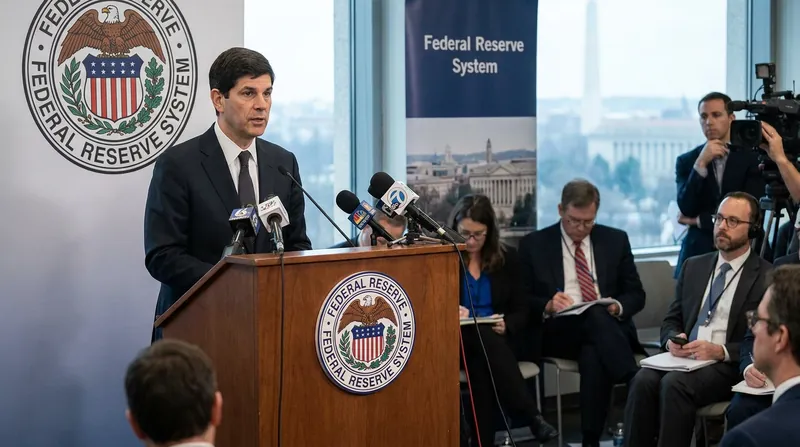
Federal Reserve Bank of New York President John Williams stated that inflation remains too high and will likely not return to the central bank's 2% target until 2028. His remarks solidify market expectations for another interest rate increase at the upcoming December policy meeting.
- New York Fed President John Williams expects U.S. inflation to end 2026 at 3.5% and not reach the 2% target until 2028.
- Williams indicated that the central bank must take further action over time, supporting expectations for a December rate hike.
- The U.S. economy remains resilient, with Williams forecasting 2.75% GDP growth in 2026 and 2027 alongside a stable labor market.
- Elevated energy prices and surging artificial intelligence investments are driving current price pressures, though broader spillover remains limited.
New York Fed President John Williams has publicly backed the case for further monetary tightening, stating that inflation remains "too high" and that the central bank must take action over time to return it to the 2% target.[1][4]
Speaking at the University of Mount Saint Vincent in the Bronx on November 23, Williams delivered a speech titled "The Economic Mixdown," where he outlined a delayed timeline for price stability. He now expects inflation to end 2026 at 3.5% and only reach the 2% goal in 2028.[3][4][6]
The remarks solidify market expectations for a quarter-point interest rate hike at the Federal Open Market Committee's upcoming December 8-9 meeting. The Fed's benchmark rate currently sits in a target range of 3.75% to 4.00%, following a quarter-point increase in September.[2][3]
"We must take actions over time that will ensure that we get inflation back to our 2 percent goal in a timely manner and on a sustained basis," Williams told the audience. "There is still work to do to get that done."[1][4]
The Drivers of Persistent Inflation
Williams attributed the recent stickiness in consumer prices to an unusual combination of macroeconomic shocks rather than an overheating domestic economy. He pointed specifically to elevated energy costs, which have been driven higher by the ongoing conflict in the Middle East and severe constraints in oil refining capacity.[3][4]
The New York Fed president noted that the energy outlook remains highly uncertain, making it a pivotal factor in how quickly inflation can be brought to heel. Brent crude currently trades around $92 a barrel, significantly above the levels seen earlier in the year before geopolitical tensions escalated.[3][4]
Another major factor complicating the inflation picture is the massive surge in artificial intelligence investment. Williams observed that the AI boom has created a race between supply and demand in certain goods categories, particularly semiconductors and specialized chips, where demand is currently outpacing available supply.[3][4]
However, he offered some reassurance regarding the breadth of these price pressures. Williams stated that there is little evidence that the inflationary effects from AI investments, geopolitical conflicts, or recent tariffs are spilling over into broader, more persistent inflation across the wider economy.[1][3]
"The encouraging news is that the effects of tariffs on inflation have largely abated and should not add significantly to inflation in goods prices in the future," Williams said in his prepared remarks. He added that prices for housing services have also decelerated.[4]
Economic Resilience and the Labor Market
Despite the challenges posed by inflation and elevated interest rates, Williams painted a picture of a fundamentally resilient U.S. economy. He forecast real gross domestic product growth of approximately 2.75% for both 2026 and 2027, driven by strong demand and robust productivity gains.[3][4][6]
The labor market, a key component of the Fed's dual mandate, remains remarkably stable according to Williams' assessment. He noted that the environment is currently characterized by low hiring and low firing, which has kept the employment picture broadly in balance without showing signs of significant reacceleration.[4]
Williams expects the national unemployment rate, which currently stands at 4.1%, to edge down slightly to around 4% over the course of the next year. During a question-and-answer session following his speech, he added a note of caution, observing that while companies are eager to hire, they remain hesitant to commit.[3][4]
The combination of solid economic growth and a stable labor market provides the Federal Reserve with the runway to maintain a restrictive monetary policy stance. Without a sharp deterioration in employment, policymakers face less pressure to pivot toward rate cuts to stimulate the economy.[3]
"On balance, there's resilience in economic growth and demand, and that's also translated into a stable labor market," Williams explained. He emphasized that this ongoing momentum gives the central bank the flexibility it needs to focus squarely on its price stability mandate.[4]
Market Reaction and Future Policy Path
Financial markets absorbed Williams' hawkish tone with relative calm, largely because the expectation of a December rate hike had already been priced into asset valuations. According to market pricing, traders assign a roughly 95% probability to a 25-basis-point increase next month.[2][3]
The remarks coincided with a sharp rally in U.S. equities, spurred by Nvidia's announcement that it had reinstated Jensen Huang as chief executive officer. The tech-led surge underscored how heavily broader market sentiment currently relies on the performance of major artificial intelligence firms.[1][3]
When asked about recent market volatility, Williams told reporters that the swings had not diminished his optimism about the economic outlook. He suggested that the fluctuations reflected a reassessment of specific sectors rather than a fundamental deterioration in the broader U.S. economy.[1][3]
Looking beyond December, Williams declined to commit to a specific cadence for future rate adjustments, emphasizing that the central bank's path will remain strictly data-dependent. He noted that policymakers will have to learn along the way as more economic indicators become available.[1][2]
"I don't have in my mind a particular timing," Williams told the press. "I'm not excluding options," he added, explicitly stating that he would not rule out raising interest rates at consecutive meetings if the economic data demonstrated that such a move was necessary.[1][2]
The Long Road to Two Percent
The revised timeline for reaching the 2% inflation target represents a significant acknowledgment of the challenges facing the Federal Reserve. By pushing the expected date of compliance out to 2028, Williams signaled that the central bank is prepared for a protracted battle against price pressures.[3][6]
Inflation has now run above the Fed's official target for more than five years, a duration that has raised concerns among some officials about the anchoring of long-term consumer expectations. If the public begins to expect higher inflation as a permanent feature, it can become a self-fulfilling prophecy.[1][3]
Williams addressed this concern directly, stating that getting inflation back to 2% is "100 percent essential" to maintaining the credibility of the central bank. He reiterated that while the 2% target is a policy choice rather than a law of economics, it remains the foundational anchor of the Fed's strategy.[3][4]
The upcoming December meeting will provide the next formal opportunity for the Federal Open Market Committee to update its Summary of Economic Projections. Those forecasts will reveal whether Williams' extended timeline for price stability is shared by the broader consensus of central bank policymakers.[2][3]
Until then, the New York Fed president's remarks stand as a clear warning that the era of restrictive monetary policy is far from over. The central bank appears willing to tolerate higher borrowing costs for an extended period to ensure that the current inflationary episode is definitively concluded.[1][5]
Sources
- [1]The Star — Fed's Williams says inflation still too high, signals more rate hikes possible Read on The Star →
- [2]Investing.com — NY Fed's Williams says high inflation necessitates more rate hikes Read on Investing.com →
- [3]investingLive — Williams keeps December Fed hike in play as inflation seen above 2% until 2028 Read on investingLive →
- [4]Federal Reserve Bank of New York — The Economic Mixdown Read on Federal Reserve Bank of New York →
- [5]The Jakarta Post — Fed's Williams says inflation still too high, signals more rate hikes Read on The Jakarta Post →
- [6]MLQ.ai — New York Fed's Williams says the Fed must act 'over time' to bring inflation back to 2%, which he sees in 2028 Read on MLQ.ai →
What to watch
- The Federal Reserve is scheduled to hold its next policy meeting on December 8-9.
- Financial markets are monitoring whether the central bank will implement a 25-basis-point or 50-basis-point interest rate hike in December.
- The White House committee is evaluating potential legal grounds for the dismissal of Federal Reserve Governor Lisa Cook.
- The Federal Open Market Committee will transition to a seven-meeting schedule in 2027, with the October session focusing exclusively on long-term strategy.
Earlier updates
2 updates
Two Fed Officials Dissent in 10-2 Vote, Backing Quarter-Point Rate Hike
Key point: Two Federal Reserve officials dissented from the central bank's decision to hold interest rates steady, advocating instead for a quarter-point hike.
The Federal Reserve's decision to keep its benchmark interest rate steady was not unanimous. Two of the 12 Federal Open Market Committee voters dissented from the hold, favoring a quarter-point rate hike instead.
Governor Lisa Cook and Cleveland Fed President Beth Hammack cast the dissenting votes in the 10-2 decision. The split vote highlights internal divisions as the central bank navigates persistent inflation concerns.
Fed Chair Warsh Trims 2027 Meeting Schedule, Vows Price Stability
Key point: Fed Chair Kevin Warsh announced that one 2027 policy meeting will not include an interest rate vote, while reiterating the central bank's commitment to curbing high inflation.
AIChair Kevin Warsh initially proposed reducing the annual schedule to six meetings before settling on seven.From: Federal Reserve to Hold Seven Rate Meetings in 2027, Dropping October Vote Under Warsh Federal Reserve Chairman Kevin Warsh announced on Wednesday that the central bank will adjust its calendar, planning one meeting in 2027 that will feature no interest rate vote and no policy statement. Warsh added that the schedule could be further modified in 2028 to include two strategy-focused meetings.
The scheduling changes were detailed during a press conference following the Federal Open Market Committee's split decision to hold benchmark interest rates steady at 3.75% to 4%. Addressing the broader economic picture, Warsh stressed that inflation remains too high and vowed that policymakers will continue working to deliver price stability.
Charts, maps and images
Timeline
November 2026
New York Fed's Williams Backs December Rate Hike, Pushes 2% Inflation Target to 2028
US Dollar Hits 19-Month High as Solid Economic Data Fuels Federal Reserve Rate-Hike Bets
AIAISan Francisco Fed President Mary Daly Signals Further Rate Hikes to Combat Persistent Inflation
AIAIBoston Fed President Susan Collins Backs Gradual Rate Hikes Amid Two-Sided Economic Risks
AIAIFederal Reserve to Hold Seven Rate Meetings in 2027, Dropping October Vote Under Warsh
Fed Governor Waller Signals Support for Half-Point December Rate Hike if Inflation Persists
AIAIUS Economy Adds 165,000 Jobs in October, Prompting Traders to Bet on December Fed Rate Hike


October 2026
Fed Chair Warsh Cuts 2027 Rate-Setting Meetings to Six, Rejects AI Inflation Fears
Federal Reserve Holds Benchmark Interest Rate Steady at 3.75 to 4 Percent Ahead of Midterms
AI- Two Fed Officials Dissent in 10-2 Vote, Backing Quarter-Point Rate HikeKey point: Two Federal Reserve officials dissented from the central bank's decision to hold interest rates steady, advocating instead for a quarter-point hike.
- Fed Chair Warsh Trims 2027 Meeting Schedule, Vows Price StabilityKey point: Fed Chair Kevin Warsh announced that one 2027 policy meeting will not include an interest rate vote, while reiterating the central bank's commitment to curbing high inflation.
Fed Expected to Hold Rates Steady at October Meeting as Inflation Rebounds to 3.7%
US Dollar Softens as Fed Chairman Warsh Deflects Rate Hike Speculation
How the story developed
The Federal Reserve held its benchmark interest rate at 3.50 to 3.75 percent in June, though nine officials projected at least one increase before the end of the year. Under new Chairman Kevin Warsh, the central bank introduced a strategy of strategic ambiguity, removing forward guidance from policy statements. On August 26, the Federal Reserve maintained the rate in a 9-3 decision, with regional presidents Beth Hammack, Neel Kashkari, and Lorie Logan dissenting in favor of an immediate 25-basis-point hike. Warsh described the internal debate as a good family fight. Meanwhile, the 30-year Treasury yield spiked above 5.3 percent in August, and Treasury Secretary Scott Bessent attempted to lower yields by doubling a bond buyback program, though the market quickly reversed the effects.
Tensions between the central bank and the White House escalated when the Trump administration set an August 26 deadline in an effort to fire Federal Reserve Governor Lisa Cook over alleged mortgage paperwork errors. Cook's legal team rebutted the charges, claiming the firing attempt was a pretext to secure a Trump-appointed majority. On September 16, the Federal Reserve raised its benchmark interest rate by 25 basis points to a target range of 3.75 to 4.0 percent, marking the first rate increase since 2023. The decision defied political pressure from Donald Trump to hold or lower rates. Policymakers revised their core PCE inflation forecast upward to 3.4 percent for the year and projected it would not reach the 2 percent target until 2029.
On October 12, Trump established a formal White House committee to investigate Cook, seeking legal grounds for her removal under the Federal Reserve Act. Shortly after, data showed the US Consumer Price Index rose 3.7 percent annually in September, driven by a 9.1 percent surge in gasoline prices. Despite the hotter inflation data, the Federal Reserve held its benchmark interest rate steady at 3.75 to 4.0 percent on October 28, just days before the US midterm elections. The decision passed in a 10-2 vote, with two officials dissenting in favor of a quarter-point hike.
Alongside the October rate decision, Warsh announced structural changes to the central bank's calendar. On October 29, he stated the Federal Open Market Committee would reduce its annual rate-setting meetings from eight to six beginning in the fall of 2027. By November 12, this was adjusted to a seven-meeting schedule, with the October 2027 gathering shifted to a nonvoting strategy session. Economic data released in early November showed the US economy added 165,000 jobs in October, pushing the unemployment rate down to 4.1 percent.
On November 10, data revealed US consumer prices increased by 0.4 percent in October, with core inflation advancing by 0.3 percent. A government funding lapse in October 2025 prevented the Bureau of Labor Statistics from publishing most annual inflation rates. Following the data release, Federal Reserve Governor Christopher Waller indicated support for a rate hike at the December meeting, warning that a 50-basis-point increase should be considered. Waller cited geopolitical tensions in the Strait of Hormuz and the artificial intelligence infrastructure buildout as key inflationary drivers, contradicting White House demands for lower borrowing costs following the midterm elections.