
CPSC Mandates Dynamic Tip-Over Testing for Children's Furniture, Reshaping Global Supply Chain Compliance
The implementation of the STURDY Act forces furniture manufacturers to abandon static weight tests in favor of dynamic physics simulations, fundamentally redesigning how dressers are built to protect climbing children.
By Hui Lin

In short
- The STURDY Act mandates dynamic tip-over testing for all new clothing storage units sold in the United States.
- Furniture must withstand a 60-pound cantilevered force, simulating the weight of a 72-month-old child climbing on open drawers.
- The rule applies strictly to freestanding units at least 27 inches tall, weighing 30 pounds or more, with 3.2 cubic feet of storage.
For decades, the safety of children's bedroom furniture relied on a fundamental flaw: the assumption that a dresser's dead weight was enough to keep it upright. That assumption ended with the implementation of the STURDY Act and its accompanying mandatory safety standard, ASTM F2057-23. The new federal rule fundamentally reshapes how clothing storage units are engineered, tested, and sold in the United States.
By replacing a weak voluntary guideline with rigorous dynamic testing, the mandate forces manufacturers to account for the real-world physics of a climbing child. For consumers, the shift means that any compliant dresser purchased today is engineered to withstand forces that would have easily toppled legacy furniture.[1][5]
The regulatory overhaul was driven by a stark evidentiary record compiled by the U.S. Consumer Product Safety Commission (CPSC). Between 2000 and 2022, the agency recorded 234 fatalities associated with clothing storage unit tip-overs, with children under the age of six accounting for the vast majority of the victims.
The legacy voluntary standard only required furniture to remain upright when a static 50-pound weight was applied to a single open drawer. This static test failed to replicate the dynamic momentum of a toddler pulling on multiple drawers simultaneously or the destabilizing effect of placing a heavy dresser on thick bedroom carpeting.[1][4]
To close this safety gap, ASTM F2057-23 introduces dynamic tip-over testing that simulates actual use conditions. Under the new mandate, a clothing storage unit must remain upright when subjected to a 60-pound cantilevered force, representing the 95th percentile weight of a 72-month-old child.
The testing protocol requires the unit to maintain its stability with all doors open and all extendable elements fully extended. Crucially, the standard also mandates that the drawers be loaded with a simulated clothing weight of 8.5 pounds per cubic foot, and the entire unit must be tested on an angled block that replicates the forward tilt caused by standard residential carpeting.[1][2]
Meeting these rigorous physical thresholds requires more than just adding weight to the back of a dresser. Manufacturers are increasingly adopting structural redesigns to alter the furniture's center of gravity. One of the most common compliance mechanisms is the implementation of interlocking drawer systems—hardware that physically prevents more than one drawer from being opened at a time.
By restricting the outward shift of mass, interlocks ensure the center of gravity remains safely over the furniture's base. Other engineering solutions include widened base footprints and integrated counterweights, shifting the industry away from purely aesthetic designs toward utility-first safety architecture.[2][5]
The mandate applies strictly to free-standing clothing storage units that meet specific dimensional thresholds. To fall under the rule, a unit must be at least 27 inches tall, weigh 30 pounds or more, and contain a minimum of 3.2 cubic feet of enclosed storage volume.
This precise definition captures the dressers, armoires, and wardrobes most likely to pose a hazard, while explicitly excluding bookcases, office furniture, and under-bed storage. For the global supply chain, compliance is absolute. Overseas manufacturers and domestic importers must secure a General Certificate of Conformity (GCC) or a Children's Product Certificate (CPC) from a CPSC-accepted third-party laboratory before their products can enter the U.S. market.[2][3]
While the STURDY Act represents a monumental leap in baseline safety, it does not eliminate all tip-over risks in the home. The standard applies exclusively to newly manufactured clothing storage units, leaving millions of legacy, non-compliant dressers currently in use. Furthermore, the regulation does not cover televisions or the stands they rest on, which remain a significant source of tip-over injuries.
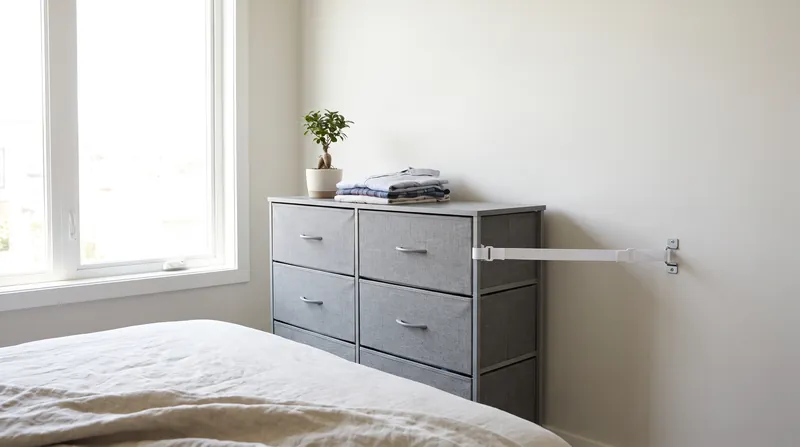
Because no freestanding design can completely defy physics under every conceivable load, safety advocates and the CPSC continue to stress that the new engineering standards are a baseline, not a substitute. Anchoring furniture directly to wall studs remains the only definitive method to prevent a tip-over, even for units that pass the new dynamic testing.[4][5]
The transition to ASTM F2057-23 demonstrates how targeted federal regulation can force a global supply chain to prioritize consumer safety over manufacturing convenience. Shoppers navigating the furniture market can now look for STURDY Act compliance as a non-negotiable baseline for quality, knowing that the product has survived rigorous third-party laboratory testing.
By mandating that dressers survive the chaotic, dynamic forces of a child's bedroom, the rule ensures that the burden of safety no longer rests entirely on a parent's ability to install a wall anchor perfectly. It represents a structural shift from reactive hazard mitigation to proactive engineering.[1][5]
The transition to ASTM F2057-23 demonstrates how targeted federal regulation can force a global supply chain to prioritize consumer safety over manufacturing convenience. Shoppers navigating the furniture market can now look for STURDY Act compliance as a non-negotiable baseline for quality, knowing that the product has survived rigorous third-party laboratory testing.
By mandating that dressers survive the chaotic, dynamic forces of a child's bedroom, the rule ensures that the burden of safety no longer rests entirely on a parent's ability to install a wall anchor perfectly. It represents a structural shift from reactive hazard mitigation to proactive engineering.[1][5]
Definitions
- STURDY Act
- The Stop Tip-overs of Unstable, Risky Dressers on Youth Act, a federal law mandating rigorous stability testing for clothing storage units.
- ASTM F2057-23
- The specific mandatory safety standard adopted by the CPSC that outlines the dynamic testing protocols furniture must pass.
- Dynamic Tip-Over Testing
- A testing method that simulates real-world physical forces, such as a 60-pound child climbing on open drawers, rather than just applying static weight.
- Interlocking Drawer System
- A mechanical hardware feature that prevents more than one drawer from being opened simultaneously, maintaining the furniture's center of gravity.
- General Certificate of Conformity (GCC)
- A required document proving that a manufactured product has been tested by a third-party laboratory and meets all applicable U.S. safety standards.
Questions & answers
What furniture is covered by the STURDY Act?
The mandate applies to free-standing clothing storage units—such as dressers and armoires—that are at least 27 inches tall, weigh 30 pounds or more, and have a storage volume of at least 3.2 cubic feet.
Does the new rule mean I no longer need to anchor my dresser?
No. While compliant furniture is significantly more stable and engineered to withstand the weight of a climbing child, safety advocates and regulators still strongly recommend anchoring all heavy furniture to wall studs as a definitive fail-safe.
How are manufacturers changing their designs to comply?
Many manufacturers are incorporating interlocking drawer systems that only allow one drawer to open at a time, widening the base of the furniture, or adding counterweights to shift the center of gravity backward.
Are televisions and TV stands covered by this new safety standard?
No. The ASTM F2057-23 standard applies exclusively to clothing storage units. Televisions and entertainment consoles are subject to different guidelines and remain a significant tip-over hazard if not properly anchored.
Analysis by camp
Federal Regulators' View
The CPSC emphasizes that mandatory, dynamic testing is the only way to ensure baseline safety for children.
The U.S. Consumer Product Safety Commission views the STURDY Act as a necessary correction to decades of inadequate voluntary standards. By mandating tests that account for real-world variables—such as carpeted floors, loaded drawers, and the dynamic weight of a climbing child—regulators aim to eliminate the structural vulnerabilities that led to hundreds of fatalities. The agency maintains a strict enforcement posture, requiring third-party laboratory certification for all imported and domestically manufactured units to ensure that unsafe furniture never reaches the showroom floor.
Furniture Industry's View
Manufacturers focus on the engineering realities of compliance and the shift toward utility-first design.
For the furniture industry, the transition to ASTM F2057-23 represents a fundamental shift in product architecture. Industry representatives highlight the logistical and engineering challenges of meeting the new dynamic force requirements, which often necessitate heavier base materials, wider footprints, or the integration of interlocking drawer hardware. While acknowledging the necessity of the safety upgrades, the industry emphasizes that these structural redesigns require significant supply chain adjustments and rigorous pre-market testing to achieve the required General Certificate of Conformity.
Consumer Safety Advocates' View
Advocates celebrate the regulatory victory but warn that legacy furniture and unanchored units still pose risks.
Safety organizations view the implementation of the STURDY Act as a hard-won victory that will definitively save lives. However, they caution against consumer complacency. Because the mandate only applies to newly manufactured clothing storage units, millions of older, non-compliant dressers remain in homes. Advocates stress that while the new engineering standards provide a robust baseline of protection, the physical anchoring of all heavy furniture to wall studs remains the ultimate defense against tip-over accidents.
- Federal Regulators
- The CPSC emphasizes that mandatory, dynamic testing is the only way to ensure baseline safety for children.
- Consumer Safety Advocates
- Advocates celebrate the regulatory victory but warn that legacy furniture and unanchored units still pose risks.
- Supply Chain & Compliance Auditors
- Focus on the technical execution of the standard, emphasizing third-party testing and dimensional thresholds.
- Furniture Industry Representatives
- Highlight the engineering challenges and the successful collaboration with regulators to create a clear pathway to compliance.
- Analytical Synthesis
- Provides an overarching view of how the regulation forces structural redesigns across the global supply chain.
Perspectives this story doesn't cover
- Small-scale boutique furniture makers
- Parents of tip-over victims
Sources
Source coverage
5 outlets
5 viewpoints surfaced





- [1]U.S. Consumer Product Safety CommissionFederal Regulators
CPSC Adopts ASTM F2057-23 as Mandatory Safety Standard for Clothing Storage Units
Read on U.S. Consumer Product Safety Commission → - [2]American Home Furnishings AllianceFurniture Industry Representatives
CPSC Adopts ASTM F2057-23 As Mandatory Federal Standard
Read on American Home Furnishings Alliance → - [3]TÜV RheinlandSupply Chain & Compliance Auditors
US STURDY Act: ASTM F2057-23 Standard Safety Specification
Read on TÜV Rheinland → - [4]Consumer Federation of AmericaConsumer Safety Advocates
CPSC Adopts Mandatory Furniture Stability Standard
Read on Consumer Federation of America → - [5]Factlen Editorial TeamAnalytical Synthesis
Synthesis by Factlen editorial team
Read on Factlen Editorial Team →
More in Shopping & Reviews
See all →Mattress Recall
Regfear Recalls 818 BedsPick Mattresses Over Federal Flammability Standard Violations
7 sources
Wood Composites
Screw Withdrawal Resistance and Modulus of Rupture: How Two Numbers Dictate Plywood, MDF, and Particleboard Strength
6 sources
Leather Upholstery
Aniline, Semi-Aniline, and Pigmented Leather: How Surface Treatment Dictates Durability and Cost
9 sources

Textile Standards
The Mechanics of Upholstery Durability: Understanding the Martindale and Wyzenbeek Abrasion Tests for Furniture Fabric
5 sources

Comments
Every angle. Every day.
Get Shopping & Reviews stories with full source coverage and perspective breakdowns, free every day.