
CPSC Finalizes New Mandatory Safety Standards for All Infant Cribs, Swings, and Mattresses
The U.S. Consumer Product Safety Commission has issued a sweeping set of direct final rules updating the mandatory safety standards for full-size cribs, crib mattresses, and infant swings. The 2026 regulations introduce strict new entrapment tests for mesh-sided cribs and mandate immediate-removal sleep warnings for swings.

In short
- The CPSC finalized new mandatory safety standards for cribs, mattresses, and swings taking effect in mid-2026.
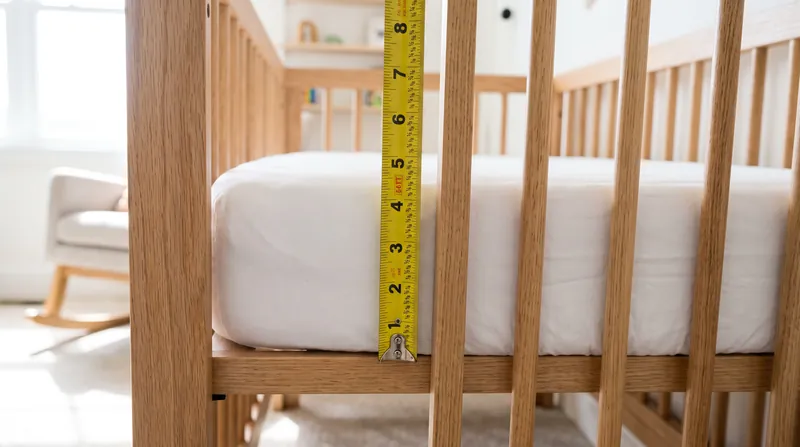
- Full-size cribs face new entrapment tests for mesh sides and mattresses thinner than 2.5 inches.
- Crib mattresses must pass updated corner gap and cyclic impact testing to prevent suffocation.
The U.S. Consumer Product Safety Commission (CPSC) has finalized a comprehensive overhaul of mandatory safety standards for infant nursery gear, targeting full-size cribs, crib mattresses, and infant swings. The new rules, which take effect between May and August 2026, adopt the latest ASTM International voluntary standards as federal law, forcing manufacturers to implement stricter engineering and labeling protocols.[1][2][3]
The regulatory updates draw a sharp, federally mandated line between dedicated sleep surfaces and supervised soothing devices. For cribs and mattresses, the CPSC's focus is on structural integrity and the elimination of entrapment hazards. For infant swings, the agency is targeting behavioral use, specifically addressing the suffocation risks that occur when babies are allowed to sleep in inclined soothing devices.[1][3][4]
Under the new full-size crib standard (ASTM F1169-25), effective August 1, 2026, the CPSC has introduced rigorous performance requirements for mesh and fabric-sided cribs. These products must now pass severe tension and strength testing to ensure the mesh cannot tear or separate from the frame. Additionally, if a crib includes a mattress thinner than 2.5 inches, it must pass new entrapment tests to ensure an infant's fingers or toes cannot get caught in the rigid materials beneath the sleep surface.[1][4]
Crib mattresses are also subject to updated regulations (ASTM F2933-25), effective May 3, 2026. The new rule modifies the fitted test procedure, specifically measuring corner gaps to prevent suffocation. It also alters cyclic impact testing to better simulate years of wear and tear, ensuring mattresses maintain their firmness and do not develop hazardous depressions over time.[2][4]
Perhaps the most significant behavioral shift for parents involves infant and cradle swings. The updated swing standard (ASTM F2088-25), effective July 25, 2026, overhauls warning labels to address sleep-related fatalities. Previous labels instructed caregivers to remove a sleeping baby "as soon as possible." The 2026 standard deletes that phrase, mandating immediate removal to a firm, flat sleep surface like a crib or bassinet.[3][4]
The swing update also introduces a new suffocation hazard visibility test. Required warning statements—including a new label explicitly stating "NOT SAFE FOR SLEEP" and prohibiting the use of blankets or swaddles—must remain clearly visible to a caregiver standing in front of the product, even when accessories or toys are attached to the swing's frame.[3][4]
For parents and caregivers, the 2026 standards offer a clearer framework for nursery safety. While the new rules force manufacturers to engineer safer products, they also place a renewed emphasis on parental compliance, particularly regarding the strict awake-only use of infant swings and the proper assembly of mesh-sided cribs.[4]
As these newly compliant products hit retail shelves, shoppers will see bolder, capitalized restraint warnings and more durable mesh assemblies. The CPSC's coordinated rollout ensures that whether a family is buying a traditional wooden crib, a modern mesh-sided model, or a motorized swing, the baseline for infant safety has been significantly elevated.[1][3][4]
Different angles
Approach A: Full 2026 Standard Compliance (Replacing Gear)
Purchasing entirely new cribs, mattresses, and swings that meet the 2026 ASTM standards.
For: Guarantees compliance with the latest federal safety engineering, including the new ASTM F1169-25 mesh entrapment barriers and the ASTM F2933-25 mattress firmness tests. It eliminates the need for parents to manually measure corner gaps or second-guess the structural integrity of older fabric seams. Against: High upfront cost, as replacing a crib, mattress, and swing simultaneously requires a significant budget. Older gear may still be structurally sound if rigorously monitored. Evidence: The CPSC notes that the 2026 standards address specific mechanical failures—such as mesh-to-mattress entrapment and swing suffocation visibility—that older models physically cannot pass without redesign. Fits well when: Setting up a first nursery, or when existing hand-me-down gear is pre-2022. Does not fit when: Budget is highly constrained and parents can rigorously enforce the new manual protocols themselves.
Approach B: Sleep-Surface Only Upgrade (Targeted Retrofit)
Replacing the crib and mattress for sleep safety, while retaining older swings with strict manual compliance.
For: Highly cost-effective. It focuses the purchasing budget on the dedicated sleep environment (the crib and mattress) where the infant spends unsupervised time, while relying on behavioral changes to manage the risks of older soothing devices. Against: Leaves physical hazards unmitigated on the retained gear. Older swings lack the 2026 suffocation visibility labels and the explicit 'NOT SAFE FOR SLEEP' front-facing warnings, requiring caregivers to memorize the new rules. Evidence: ASTM F2088-25 specifically changed the swing warning from 'remove as soon as possible' to immediate removal because behavioral delays and ambiguous instructions were linked to fatalities. Fits well when: Parents have 2022-2025 era swings that already meet the previous major CPSC overhaul, and can strictly enforce awake-only, supervised swing time. Does not fit when: Using secondary caregivers (grandparents, nannies) who rely heavily on physical product warnings rather than memorized household rules.
- Safety Regulators
- Focus on eliminating physical hazards and ambiguous instructions that lead to infant fatalities.
- Consumer Advocates
- Prioritize clear, front-facing warning labels and strict engineering standards to protect infants during unsupervised sleep.
- Industry Analysts
- Evaluate the manufacturing impact of new testing protocols and the timeline for retail compliance.
Perspectives this story doesn't cover
- Secondary Market Retailers
- Childcare Facility Operators
Sources
Source coverage
4 outlets
3 viewpoints surfaced




- [1]Federal RegisterSafety Regulators
Safety Standard for Full-Size Baby Cribs
Read on Federal Register → - [2]GovInfoSafety Regulators
Safety Standard for Crib Mattresses
Read on GovInfo → - [3]Regulations.govSafety Regulators
Safety Standard for Infant and Cradle Swings
Read on Regulations.gov → - [4]Factlen Editorial TeamIndustry Analysts
Synthesis by Factlen editorial team
Read on Factlen Editorial Team →
More in Shopping & Reviews
See all →Infant Nutrition
How Soy and Hydrolyzed Formulas Raise Osmotic Load Compared to Standard Cow's Milk
5 sources
Car Seat Safety
The Science of Car Seat Safety: Comparing LATCH vs. Seatbelt Installation and Expiration Standards
9 sources
Baby Food Safety
The Transparency Redesign: How California's Mandatory QR Code Disclosure for Heavy Metals Is Reshaping All US Baby Food Labeling
8 sources

Product Safety
The Compliance Redesign: How CPSC Revokes Obsolete 1971 Rules for Infant Bouncer Seats and Activity Centers to Improve Clarity
7 sources
Comments
Every angle. Every day.
Get Shopping & Reviews stories with full source coverage and perspective breakdowns, free every day.