
Why Car Seat Weight Limits Force a Switch From LATCH to Seatbelt Installation
While LATCH and seatbelt installations offer identical crash protection when used correctly, strict weight limits and evolving side-impact testing standards mean parents must transition installation methods as their child grows.
By Ivan Smirnov

Share this story
In short
- LATCH and seatbelt installations are equally safe when installed correctly; neither is inherently superior in a crash.
- LATCH systems have a strict 65-pound combined weight limit (child plus seat), requiring a transition to seatbelts for heavier toddlers.
- Car seat expiration dates reflect the physical degradation of plastic subjected to extreme temperature fluctuations inside vehicles.
The short version is this: neither LATCH nor a vehicle seatbelt is inherently safer than the other. When installed correctly—meaning the seat moves less than one inch at the belt path—both methods provide identical crash protection. The critical difference lies in the math. LATCH has a strict, federally mandated weight limit, meaning every parent who uses it must eventually abandon it and switch to a seatbelt installation as their child grows.[1][2]
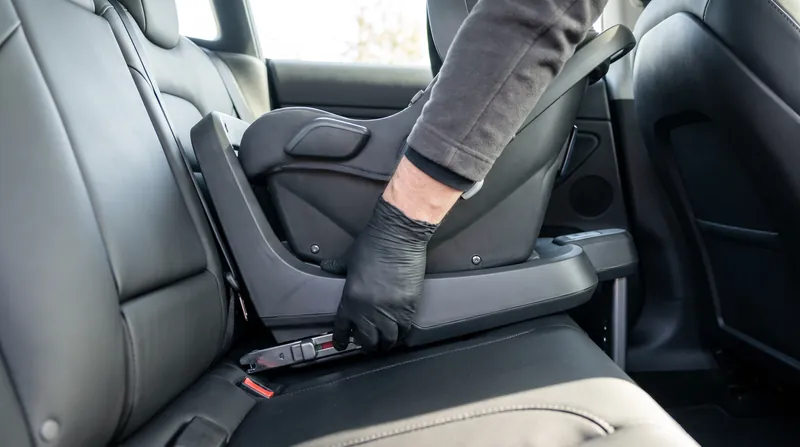
LATCH (Lower Anchors and Tethers for Children) was introduced to solve a specific problem: human error. Before its standardization, parents struggled to lock vehicle seatbelts correctly, leading to loose installations that failed during collisions. LATCH bypassed the seatbelt entirely, providing dedicated metal anchors welded directly to the vehicle's chassis. It is exceptionally straightforward, but it is not magic, and it is not infinitely strong.[2][6]
The federal safety standard caps the total weight a LATCH anchor can safely restrain at 65 pounds. Crucially, this is the combined weight of the child and the car seat itself. Because modern convertible car seats often weigh between 20 and 30 pounds due to steel reinforcement, a child will typically hit the LATCH limit when they weigh just 35 to 40 pounds.[1][2]
Once that 65-pound combined threshold is crossed, the lower anchors are no longer certified to withstand the immense G-forces of a crash. At this exact moment, parents must uninstall the LATCH straps and reinstall the seat using the vehicle's standard seatbelt. The seatbelt, designed to restrain a 200-pound adult, has no functional weight limit for a child seat.[2][9]
Seatbelt installation requires engaging the vehicle's Automatic Locking Retractor (ALR). By pulling the shoulder belt all the way out until it clicks, the belt switches from its standard free-spooling mode into a ratcheting mode. As the belt feeds back in, it locks permanently, allowing the parent to press their weight into the car seat and pull the belt drum-tight.[1][2]
Regardless of the method chosen, the universal metric for success is the "one-inch rule." When grasped at the belt path—the exact spot where the LATCH strap or seatbelt routes through the plastic shell—the car seat should not move more than one inch side-to-side or front-to-back. If it moves more than an inch, the installation has failed and must be tightened.[1]
Beyond installation methods, the physical hardware of the seat itself operates on a ticking clock. Car seat expiration dates are frequently dismissed as a manufacturer conspiracy to force new purchases, but the engineering reality is entirely different. Car seats are constructed primarily from polypropylene plastic, a material that degrades under environmental stress.[7][8]
A car seat lives in a brutally hostile environment. Over a standard six-to-ten-year lifespan, a seat parked in a vehicle will experience thousands of thermal cycles, baking in 140-degree summer heat and freezing in sub-zero winter temperatures. This constant expansion and contraction, combined with UV radiation through the windows, causes the plastic to become brittle.[7][8]
In a severe collision, a car seat is designed to flex slightly, absorbing the kinetic energy of the crash before it reaches the child's body. If the plastic has become brittle from a decade of thermal cycling, it loses this elasticity. Instead of flexing, the shell can shatter upon impact, catastrophically failing to protect the occupant.[8][9]
Expiration dates also serve as a hard stop for missing components. Over six years of use, instruction manuals are lost, warning labels fade into illegibility, and crucial parts like harness clips or tether anchors can be misplaced. An expired seat is highly likely to be an incomplete seat, making it impossible for a second owner to verify its integrity.[7]
However, material degradation is only half of the expiration equation. The other half is the relentless evolution of federal safety standards. The National Highway Traffic Safety Administration (NHTSA) governs car seat design through Federal Motor Vehicle Safety Standard (FMVSS) No. 213, a living document that is periodically updated to reflect new crash data and biomechanical research.[4][6]
For decades, FMVSS 213 primarily focused on frontal sled tests. But in recent years, regulators finalized FMVSS No. 213a, a sweeping new mandate that introduced rigorous side-impact protection requirements. This standard forces manufacturers to redesign shells and energy-absorbing foam to protect a child's head and thorax during a T-bone collision.[4][5]
This regulatory shift highlights the hidden danger of the secondhand market. Because car seats remain physically viable for up to a decade, millions of unexpired seats currently in circulation predate the FMVSS 213a side-impact testing requirements. A seat manufactured in 2021 might not expire until 2031, but it was engineered to a baseline that is no longer considered sufficient by modern federal standards.[4][9]
Therefore, a seat's "unexpired" status does not guarantee it meets current safety benchmarks. It simply means the plastic is likely still flexible enough to survive a crash. Parents relying on older, hand-me-down seats are unknowingly accepting a lower standard of side-impact protection than they would get from a budget model purchased new today.[5][9]
The actionable takeaway for parents is twofold. First, weigh your child regularly and know the exact weight of your car seat shell to ensure you do not inadvertently exceed the 65-pound LATCH limit. Second, treat expiration dates not as a suggestion, but as the absolute maximum lifespan of the product—and recognize that buying new is the only way to guarantee compliance with the latest side-impact crash standards.[1][7][9]
How we did this
- Method
- Timeline intersection analysis comparing the implementation dates of new federal side-impact testing standards against the standard physical lifespan of car seats.
- What we found
- Because car seats remain physically viable for up to 10 years, millions of unexpired seats currently in circulation or being sold secondhand predate the FMVSS 213a side-impact testing requirements, meaning a seat's 'unexpired' status does not guarantee it meets current federal crash baselines.
- What we worked from
- FMVSS 213a side-impact protection standard finalization: October 2024 — Federal Register
- Standard car seat expiration lifespan: 6 to 10 years — Graco Baby
- Limits of this analysis
- This analysis cannot determine the exact side-impact performance of older seats, as many manufacturers voluntarily tested for side impacts before the federal mandate.
Viewpoints in depth
LATCH Installation (Lower Anchors and Tethers)
The standardized anchor system designed for ease of use and reduced installation errors.
For: Exceptionally straightforward in modern vehicles, LATCH significantly reduces the risk of a loose installation by bypassing the vehicle's seatbelt retractor entirely and providing a rigid connection point to the chassis. Against: Subject to strict weight limits (65 pounds combined weight of seat and child), requiring parents to monitor growth and eventually switch methods. Evidence: NHTSA data shows LATCH reduces initial installation errors, but the 65-pound federal limit is a hard mathematical ceiling. Fits well when: The child is an infant or light toddler. Does not fit when: The combined weight exceeds 65 pounds or the vehicle's lower anchors are deeply buried and difficult to access.
Seatbelt Installation (with Locking Retractor)
The universal installation method utilizing the vehicle's standard seatbelt system.
For: There is no upper weight limit for the installation hardware itself, it is universally compatible with all passenger vehicles, and it allows for flexible placement (such as the center seat where LATCH anchors are often absent). Against: Higher risk of user error (forgetting to lock the retractor or route the belt correctly) and can be physically difficult to tighten sufficiently. Evidence: Federal Motor Vehicle Safety Standards (FMVSS 213) test all seats using standard lap/shoulder belts, proving their efficacy at higher weights. Fits well when: The child outgrows the LATCH weight limit or the seat needs to be installed in a center seating position. Does not fit when: The installer cannot physically pull the belt tight enough to pass the one-inch movement test.
- Child Passenger Safety Technicians
- Prioritizes correct, tight installation over the specific method used, emphasizing the one-inch rule.
- Federal Regulators
- Focuses on standardized testing, strict weight limits, and evolving crash standards like FMVSS 213a.
- Car Seat Manufacturers
- Highlights material lifespan, expiration dates, and proprietary safety features that exceed federal baselines.
Perspectives this story doesn't cover
- Secondhand Market Buyers
- Vehicle Manufacturers
Sources
Source coverage
9 outlets
3 viewpoints surfaced








- [1]NHTSAFederal Regulators
Car Seat & Booster Seat Safety, Ratings, Guidelines
Read on NHTSA → - [2]HealthyChildren.orgChild Passenger Safety Technicians
Car Seat Installation Information: Seat Belts & LATCH
Read on HealthyChildren.org → - [3]NHTSA InterpretationFederal Regulators
Interpretation ID: 09-004697 213
Read on NHTSA Interpretation → - [4]Federal RegisterFederal Regulators
Federal Motor Vehicle Safety Standards; FMVSS No. 213, “Child Restraint Systems,” FMVSS No. 213a, “Child Restraint Systems-Side Impact Protection,” and FMVSS No. 213b, “Child Restraint Systems”-Response to Petitions for Reconsideration
Read on Federal Register → - [5]Regulations.govFederal Regulators
Federal Motor Vehicle Safety Standards: Child Restraint Systems
Read on Regulations.gov → - [6]Indiana University
NHTSA and Federal Safety Standards - Automotive Safety Program
Read on Indiana University → - [7]Graco BabyCar Seat Manufacturers
When Do Car Seats Expire?
Read on Graco Baby → - [8]Safe Ride 4 KidsChild Passenger Safety Technicians
Why do Car Seats Expire? (Is it a conspiracy?)
Read on Safe Ride 4 Kids → - [9]Factlen Editorial Team
Synthesis by Factlen editorial team
Read on Factlen Editorial Team →

More in Shopping & Reviews
See all →Car Seat Safety
How Rigid LATCH Cuts Car Seat Installation Errors by 25 Percentage Points
2 sources
Infant Nutrition
How Soy and Hydrolyzed Formulas Raise Osmotic Load Compared to Standard Cow's Milk
5 sources

Nursery Safety
CPSC Finalizes New Mandatory Safety Standards for All Infant Cribs, Swings, and Mattresses
4 sources

Baby Food Safety
The Transparency Redesign: How California's Mandatory QR Code Disclosure for Heavy Metals Is Reshaping All US Baby Food Labeling
8 sources

Comments
Every angle. Every day.
Get Shopping & Reviews stories with full source coverage and perspective breakdowns, free every day.