
full timeline
Zoox commercial robotaxi deployment
The Amazon-owned autonomous vehicle developer has integrated its steering-wheel-free carriages into the Uber network, marking its first third-party dispatch partnership.
Follow Zoox commercial robotaxi deployment in the Factlen app and get an alert when there is news. Get the app
Share this story
Latest report
Amazon's Zoox Launches Purpose-Built Robotaxi Rides on Uber in Las Vegas
The Amazon-owned autonomous vehicle developer has integrated its steering-wheel-free carriages into the Uber network, marking its first third-party dispatch partnership.
- Amazon-owned Zoox has integrated its purpose-built robotaxis into the Uber app in Las Vegas, marking its first third-party dispatch partnership.
- Riders cannot directly request the driverless vehicles; they are randomly matched when booking standard UberX or electric rides.
- The companies signed a multi-year deal with MGM Resorts to improve autonomous pickup and drop-off infrastructure across casino properties.
- Uber and Zoox plan to expand their commercial partnership to Los Angeles in 2027 following initial employee testing.
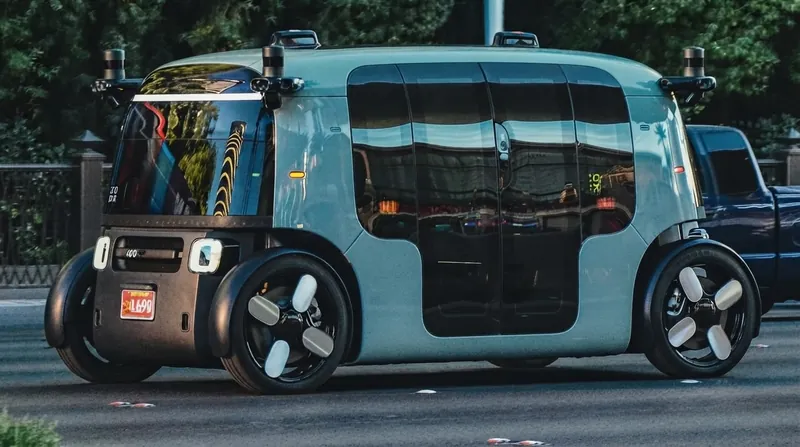
Amazon-owned autonomous vehicle developer Zoox has officially launched its purpose-built robotaxis on the Uber network in Las Vegas. The integration, which went live on Monday, marks the first time Zoox has offered rides through a third-party platform. It also introduces the first vehicle without a steering wheel to Uber's commercial fleet.[1][2]
Despite the launch, the actual capability remains tightly controlled. Uber users cannot directly request a Zoox vehicle on demand. Instead, riders who hail standard tiers like UberX, Uber Comfort, or Wait & Save might be randomly matched with the autonomous toaster-shaped car.[1][3]
To increase the odds of a match, passengers must manually enable an autonomous rides setting within their Uber app preferences. If dispatched, the app gives the rider a chance to accept the driverless vehicle or request a conventional car before it arrives.[1][3]
The hardware itself delivers a radically different passenger environment than retrofitted sedans. Zoox vehicles lack traditional driver controls entirely, featuring no pedals or steering wheel. The carriage doors open sideways to reveal two face-to-face benches that can accommodate up to four passengers.[2][3]
Inside the cabin, the floor space holds up to four bags, while an integrated touch screen allows riders to start their trip and control the music. A central charging pad provides wireless power for mobile devices. If a passenger encounters an issue, 24/7 human support remains accessible through both the vehicle's screen and the Uber app.[3]
Navigating the Casino Corridor
The initial service area covers the Las Vegas Strip, the Downtown area, and the Arts District. To manage the notorious complexity of casino pickups, Uber and Zoox have established a multi-year partnership with MGM Resorts International. The agreement designates both companies as official robotaxi partners for MGM properties.[1][3][4]
That hospitality deal aims to solve practical deployment hurdles rather than just marketing the service. The companies plan to implement dedicated infrastructure improvements, clearer in-app guidance, and better physical signage to help riders locate their autonomous rides across sprawling resort complexes.[1][4]
Zoox has been operating its vehicles in Las Vegas for over a year, having launched commercial rides through its proprietary app in August. The company secured federal approval for commercial operations in July. Uber riders can now access the same fleet without downloading a separate application.[3]
Uber's integration of Zoox represents a critical step in its broader strategy to aggregate autonomous technology. Rather than building its own self-driving cars, the ride-hailing giant has partnered with more than 30 companies developing autonomous systems for deliveries, drones, and robotaxis.[1]
The Aggregation Strategy
Las Vegas now serves as a primary proving ground for Uber's multi-fleet approach. The city is the first U.S. market where Uber users can access two distinct fully driverless partners through a single app. The company previously deployed Hyundai-backed Motional vehicles in Clark County.[1][2]
Earlier this year, the Nevada Transportation Authority unanimously approved a permit allowing Uber to deploy up to 1,000 robotaxis across Clark County. That regulatory clearance covers both the Motional and Zoox fleets. Uber CEO Dara Khosrowshahi noted that the company plans to introduce a dedicated autonomous booking option as reliability improves.[1][2]
"Las Vegas will become the first U.S. city where riders can access two fully driverless partners through the Uber app," Khosrowshahi told investors during the company's third-quarter earnings call. He emphasized that Uber will begin with limited fleets and expand supply over the coming months.[1][2]
However, the operational arrangement with Zoox differs from Uber's other autonomous partnerships. While Uber often provides fleet maintenance and logistical support for its AV partners, it will not service Zoox vehicles in Las Vegas. Zoox retains complete control over its hardware upkeep and depot operations.[1][2]
Chasing the Market Leader
For Zoox, the Uber integration provides immediate access to a massive customer base that might otherwise ignore a standalone robotaxi app. The Amazon subsidiary needs that exposure as it trails significantly behind market leaders like Alphabet's Waymo, which currently operates roughly 4,000 vehicles nationwide.[1][2]
Waymo opened its own driverless rides to the Las Vegas public in September. While Waymo maintains an exclusive partnership with Uber in Austin and Atlanta, that agreement is scheduled to expire in January 2028. Waymo increasingly pushes users toward its proprietary application in established markets.[1][2]
Uber has committed more than $10 billion toward its autonomous vehicle partnerships, hoping to field over 2,000 driverless taxis by 2027. By aggregating competitors like Zoox, Motional, and Waymo, Uber positions itself as the indispensable distribution network for whatever hardware ultimately wins the autonomy race.[2]
"Zoox has built something truly unique, and by bringing its purpose-built robotaxis to Uber, we're introducing an entirely new riding experience to more people in Las Vegas," said Samarth Kejriwal, Uber's global head of autonomous mobility. He confirmed that Los Angeles is the next target market.[2][4]
Future Expansion Promises
The companies have heavily promoted their upcoming Los Angeles expansion, though commercial operations remain distant. Zoox plans to begin initial robotaxi operations in Los Angeles by the end of 2026, but those early rides will be strictly limited to employees, family, and friends.[1][2]
Commercial service on the Uber network in Los Angeles is not slated to begin until 2027. This phased approach highlights the persistent gap between autonomous vehicle announcements and actual public availability, as developers navigate complex municipal regulations and safety validation.[1][2]
Zoox is also expanding its testing footprint to the East Coast. The company recently began driving its robotaxis in Atlanta, its newest testing market. Similar to the upcoming Los Angeles rollout, the Atlanta vehicles are currently restricted to employee testing rather than public use.[2]
"As we continue to meaningfully expand our service in Las Vegas, we're seeing more riders choosing to ride with Zoox," said Jesse Levinson, Zoox's co-founder and chief technology officer. He argued the Uber partnership will capture riders who are curious about autonomy but hesitant to download new software.[2][4]
The Airport Exception
While Uber handles the casino corridor, Zoox maintains exclusive routes on its own platform. Passengers looking to travel to and from Harry Reid International Airport must still use the proprietary Zoox application, as those specific routes are not currently integrated into the Uber dispatch system.[3]
The dual-app strategy allows Zoox to leverage Uber's massive liquidity for general city transit while keeping high-value airport runs within its own ecosystem. It also ensures the Amazon subsidiary maintains a direct billing relationship with its most dedicated early adopters.[3]
As the Las Vegas rollout scales, the industry will watch closely to see how consumers react to a vehicle with no manual override options. The success of the Zoox integration could determine whether future robotaxis adopt the face-to-face carriage design or stick to retrofitted traditional cars.[1][3]
The Nevada deployment also tests the durability of the hardware in extreme environments. Las Vegas presents unique challenges for autonomous systems, from intense summer heat that strains battery cooling systems to unpredictable pedestrian behavior along the densely packed entertainment corridors.[1][3]
To mitigate these risks, Zoox designed its vehicles with four-wheel steering and bidirectional driving capabilities. The symmetric robotaxi never actually has to reverse; it simply changes direction, allowing it to navigate tight casino drop-off zones and congested resort driveways more efficiently than a standard sedan.[3]
A Shift in the Ride-Hailing Economics
For Uber, the integration of purpose-built autonomous vehicles alters the fundamental economics of its platform. Without a human driver taking a percentage of the fare, the revenue split shifts entirely to a negotiation between the software network and the hardware operator.[1][2]
Neither Uber nor Zoox has disclosed the financial terms of their revenue-sharing agreement for the Las Vegas market. However, Uber's willingness to forgo its usual fleet maintenance revenue suggests the company prioritized securing the exclusive third-party dispatch rights for the unique Zoox hardware.[1][2]
As the holiday season approaches, the MGM Resorts partnership will face its first major stress test. The influx of tourists will provide crucial data on how quickly the Zoox vehicles can cycle through complex resort queues while relying entirely on automated navigation and remote human support.[1][4]
Sources
- [1]TechCrunch — Zoox robotaxis are now on the Uber app in Las Vegas Read on TechCrunch →
- [2]The Next Web — Amazon's Zoox robotaxis are now on Uber in Las Vegas, a first for both Read on The Next Web →
- [3]PCMag — Zoox Robotaxis Are Now Available Via Uber in Las Vegas Read on PCMag →
- [4]Uber — Zoox Is Now Available on Uber in Las Vegas Read on Uber →
- [5]Transport Topics — Uber Starts Offering Amazon's Driverless Zoox Rides in Las Vegas Read on Transport Topics →
- [6]EVwire — EVwire brief: Zoox robotaxis are now available on Uber in Las Vegas Read on EVwire →
- [7]Superpower Daily — The Uber integration makes Zoox rides available through eligible Las Vegas ride types Read on Superpower Daily →
- [8]AI Weekly — Amazon-owned Zoox went live inside the Uber app in Las Vegas Read on AI Weekly →
What to watch
- Uber and Zoox plan to expand their commercial partnership to Los Angeles in 2027 following initial employee testing.
Timeline
November 2026
Amazon's Zoox Launches Purpose-Built Robotaxi Rides on Uber in Las Vegas
August 2026
NHTSA Grants First Commercial Robotaxi Exemption to Zoox, Launches Effort for National AV Safety Standard
How the story developed
The path to commercial deployment reached a milestone on August 6 when federal regulators cleared Zoox to deploy its purpose-built robotaxis for paid rides. The National Highway Traffic Safety Administration granted the company the first commercial exemption for a passenger vehicle operating without a steering wheel or pedals.
To secure this regulatory clearance, Zoox demonstrated that its autonomous vehicle provides an equivalent level of safety to traditional cars. The exemption permits the company to deploy up to 2,500 of these purpose-built robotaxis annually for a duration of two years.
Alongside the Zoox exemption, the National Highway Traffic Safety Administration launched a broader regulatory initiative. The agency began an effort to develop a single national safety standard for autonomous vehicles.
Following the federal clearance, Zoox prepared to initiate its paid commercial ride-hailing service in Las Vegas, setting the stage for its subsequent integration into third-party dispatch networks.