full timeline
US–Saudi F-35 arms deal
A Defense Intelligence Agency assessment warning that Saudi Arabia's reliance on Chinese telecommunications infrastructure could compromise F-35 stealth technology has triggered congressional…
Follow US–Saudi F-35 arms deal in the Factlen app and get an alert when there is news. Get the app
Share this story
Latest report
US Intelligence Warning on Chinese Telecoms Complicates $24.3 Billion Saudi F-35 Sale as Turkey Pitches Alternative
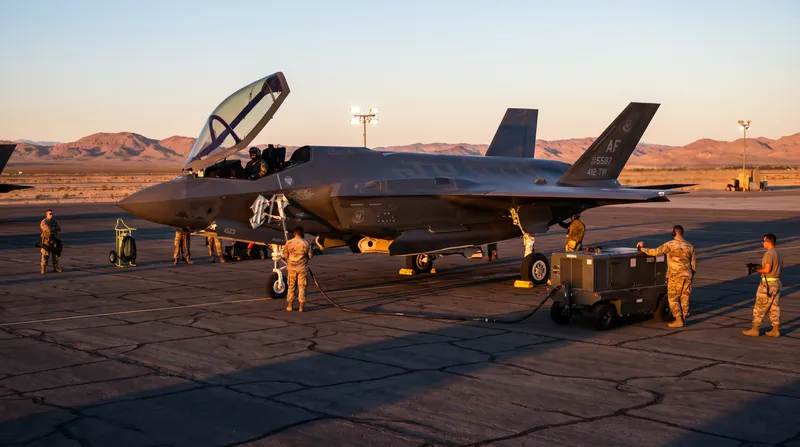
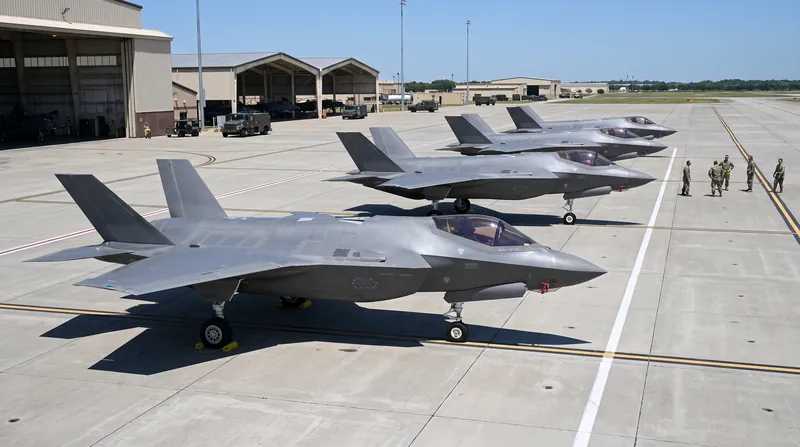
A Defense Intelligence Agency assessment warning that Saudi Arabia's reliance on Chinese telecommunications infrastructure could compromise F-35 stealth technology has triggered congressional opposition to a $24.3 billion fighter sale. As Washington debates the security risks, Turkey has formally offered Riyadh its domestically produced KAAN fighter as a replacement.
- A Defense Intelligence Agency report warns that Saudi Arabia's Chinese-built telecom networks could expose F-35 data to Beijing.
- Representative Raja Krishnamoorthi has formally opposed the $24.3 billion sale based on the intelligence assessment.
- The F-35's logistics and maintenance systems require secure, high-bandwidth data transmission to operate safely.
- Turkey has offered its indigenous KAAN fifth-generation fighter to Riyadh as a restriction-free alternative.
- The dispute forces Washington to weigh protecting stealth technology against losing a major defense partner to alternative suppliers.
The Biden administration has maintained that the $24.3 billion sale of 48 F-35 stealth fighters to Saudi Arabia will proceed as a cornerstone of regional security cooperation. However, a newly circulated Defense Intelligence Agency (DIA) assessment directly contradicts that assurance, warning that Riyadh’s deep integration of Chinese telecommunications infrastructure creates an unacceptable risk of exposing the aircraft's sensitive electronic warfare and sensor data to Beijing.[2][4][6]
The intelligence warning has immediately fractured political consensus in Washington. Representative Raja Krishnamoorthi, ranking member of the House Select Committee on the Strategic Competition Between the United States and the Chinese Communist Party, formally announced his opposition to the transfer on September 17. Krishnamoorthi's office cited the DIA's specific concerns regarding data exfiltration, though the press release and subsequent reporting did not include direct verbatim quotations from the congressman or the classified assessment.[5]
The core vulnerability lies in the F-35's Autonomic Logistics Information System (ALIS) and its successor, the Operational Data Integrated Network (ODIN). These systems require continuous, high-bandwidth data transmission to manage maintenance, mission planning, and threat libraries. U.S. intelligence officials fear that routing this classified telemetry through Saudi networks built with Huawei and ZTE components could allow Chinese intelligence services to map the F-35's radar cross-section and electronic emissions.[3][4]
As the U.S. sale faces potential congressional hurdles, regional competitors are moving to fill the vacuum. On September 25, Turkish defense officials formally offered Riyadh their domestically developed KAAN fifth-generation fighter as a direct alternative to the F-35. Turkey, which was itself expelled from the F-35 program in 2019 after purchasing Russian S-400 air defense systems, has positioned the KAAN as a platform free from Washington's end-user restrictions and data security mandates.[1]
The Turkish proposal leverages existing defense industrial ties between Ankara and Riyadh. The KAAN, which completed its maiden flight earlier in 2024, is designed to match the F-35's low-observable characteristics and sensor fusion capabilities, though it currently relies on American-made F110 engines. By offering the KAAN, Turkey aims to offset the immense development costs of its indigenous fighter program while establishing itself as a primary arms supplier to the Gulf.[1]
The strategic dilemma for the Pentagon extends beyond a single arms transaction. Denying the F-35 sale would protect the immediate technological edge of the aircraft but could accelerate Saudi Arabia's pivot toward non-U.S. defense suppliers, eroding decades of interoperability between the Royal Saudi Air Force and U.S. Central Command. Conversely, approving the sale without forcing Riyadh to replace its Chinese telecom infrastructure establishes a precedent that U.S. technologies can operate in compromised digital environments.[2][3][6]
The administration now faces a statutory 30-day congressional review period for the Foreign Military Sale. Lawmakers aligned with Krishnamoorthi are drafting joint resolutions of disapproval, demanding that the State Department secure binding commitments from Riyadh to phase out Chinese 5G networks before any F-35 airframes are delivered.[4][5]
The outcome of this standoff will dictate the future architecture of Gulf air defense. If the U.S. insists on a strict digital quarantine that Riyadh refuses to implement, the Saudi government has demonstrated it is willing to evaluate the KAAN, or potentially Chinese platforms like the FC-31, fundamentally altering the balance of aerospace power in the Middle East.[1][2]
Sources
- [1]House of Saud — Turkey Lost the F-35 and Offered Riyadh the Replacement Read on House of Saud →
- [2]Military Watch Magazine — U.S. Intel Warns F-35 Sale to Saudi Arabia Could Compromise Sensitive Technologies to China Read on Military Watch Magazine →
- [3]The Times of Israel — US intelligence repeats warning F-35 sale to Saudis could expose tech to China -- report Read on The Times of Israel →
- [4]Ynet Global — Report: US intelligence fears China could access F-35 technology in $24B Saudi deal Read on Ynet Global →
- [5]Congressman Raja Krishnamoorthi — Krishnamoorthi Opposes F-35 Sale to Saudi Arabia After U.S. Intelligence Warns China Could Obtain Sensitive Technology Read on Congressman Raja Krishnamoorthi →
- [6]i24NEWS — US Moves Ahead With $24.3 Billion F-35 Sale To Saudi Arabia Despite China Concerns Read on i24NEWS →
Charts, maps and images
Timeline
September 2026
US Intelligence Warning on Chinese Telecoms Complicates $24.3 Billion Saudi F-35 Sale as Turkey Pitches Alternative
AIUS Approves $24.3 Billion Sale of 48 F-35 Stealth Fighters to Saudi Arabia