
full timeline
UN Secretary-General selection
With less than two months remaining in António Guterres's tenure, the United Nations Security Council has failed to agree on a new secretary-general after eight rounds of voting.
Follow UN Secretary-General selection in the Factlen app and get an alert when there is news. Get the app
Share this story
Latest report
UN Faces Unprecedented Leadership Vacuum as Security Council Deadlocks on Guterres Successor
With less than two months remaining in António Guterres's tenure, the United Nations Security Council has failed to agree on a new secretary-general after eight rounds of voting. The stalemate among veto-wielding powers has prompted officials to draft contingency plans for an empty executive office on January 1.
- The UN Security Council has failed to agree on a successor to António Guterres after eight rounds of voting.
- Officials are drafting unprecedented contingency plans in case the executive office is vacant on January 1, 2027.
- Costa Rica's Rebeca Grynspan leads the current polling, but faces potential vetoes from permanent members.
- The deadlock reflects deepening geopolitical divisions among the veto-wielding powers over global conflicts.
The United Nations is preparing for the unprecedented possibility of entering 2027 without a secretary-general, as the Security Council remains deadlocked over who will succeed António Guterres. With his second five-year term ending on December 31, 2026, eight rounds of closed-door voting have failed to produce a consensus candidate.[3][4]
The 15-member Security Council has been meeting since July 30 to assess candidates through informal straw polls. The most recent ballot, held on November 5, saw Rebeca Grynspan of Costa Rica emerge as the frontrunner with 12 encourage votes and three discourage votes.[1]
However, the identity of those casting the negative votes remains the critical obstacle. Any discourage vote from the five permanent members—China, France, Russia, the United Kingdom, and the United States—acts as a veto, effectively blocking a candidate from advancing to the General Assembly.[1]
"We don't have a sense yet of how significant the deadlock is between them, or whether there is even a deadlock at all," said Daniel Forti, head of UN affairs at the International Crisis Group. He noted that observers are currently relying on limited data from a single colored ballot.
The voting mechanics rely on a series of secret ballots where members mark each candidate with encourage, discourage, or no opinion. In later rounds, the permanent members use red ballots, revealing exactly where the veto-wielding powers stand on the remaining contenders.[1][4]
Contingency Plans for a Vacancy
The UN Charter does not outline procedures for handling a leadership vacancy, leaving the organization in uncharted territory if no agreement is reached by the end of the year. Officials are currently scrambling to draft contingency plans in case the executive office is empty on January 1, 2027.[2][4]
A September 2026 briefing by the advocacy group 1 for 8 Billion mapped out potential routes, including the Security Council naming an acting chief or the General Assembly unilaterally extending Guterres's term. Both options face significant political and legal hurdles.[4]
The UN Charter makes no provision for an interim leader if the post falls vacant. A secretary-general has never ended their term without a replacement, making the current situation entirely unprecedented in the organization's 81-year history.[4]
"As far as I can tell, on January 1, if there's no secretary-general, no one is in charge," noted Daniel Safran-Hon, a former UN official. While the lights would stay on and the General Assembly could continue meeting, essential diplomatic functions would be paralyzed.[4]
The situation is further complicated by the posture of the United States administration, which has increasingly sidelined the UN and withdrawn from dozens of its agencies. Washington's reported opposition to Guterres remaining in office, even temporarily, removes one of the most straightforward interim solutions.[2][4]
Russia is one of the few permanent members to address the December 31 deadline publicly. Kirill Logvinov, a senior Russian Foreign Ministry official, recently stated that options under consideration include temporarily extending Guterres's term or naming another official to the post.[4]
The Contender Field
Beyond Grynspan, the field includes several prominent diplomats vying to become the first female leader in the UN's 81-year history. Lana Nusseibeh, a senior United Arab Emirates diplomat, currently sits in fourth place with seven encourage votes and six discourage votes.[1]
Argentina's Rafael Grossi, director-general of the International Atomic Energy Agency, placed second in the November 5 poll with nine encourage votes. Guyana's UN ambassador, Carolyn Rodrigues-Birkett, secured eight encourage votes, reflecting a strong push for a candidate from the Global South.
The newest candidate is Feridun Sinirlioğlu, Turkey's former foreign minister, who was nominated on November 1. Despite his experience running the Organization for Security and Co-operation in Europe, his debut poll yielded only three votes of encouragement against eight of discouragement.[1]
The push for a female secretary-general has gained unprecedented momentum, with five women remaining among the eight active candidates. A September 2025 General Assembly resolution formally encouraged member states to strongly consider nominating women for the role.[1]
The deadlock also intersects with informal conventions regarding regional rotation. Many member states argue it is Latin America's turn to hold the position, a sentiment explicitly echoed in the New Delhi Declaration adopted at the BRICS Leaders' Summit in September 2026.[1]
Geopolitical Fragmentation
Analysts attribute the stalemate to a broader decline in the willingness of veto-wielding powers to compromise. The selection process is unfolding against a backdrop of severe geopolitical fragmentation, with the permanent members deeply divided over ongoing conflicts in Ukraine, Sudan, and the Middle East.[1][2]
"What is worrying is how late in the year this is and what it means for pulling together a team," said Shamala Kandiah Thompson, executive director of Security Council Report. She noted that the council required six rounds to select Guterres in 2016, but the current gridlock is more entrenched.[2][4]
Richard Gowan, a UN expert at the International Crisis Group, warned that reaching the end of the year without a selected leader would be highly damaging. He noted it would provide ammunition to member states who argue the permanent members no longer possess the credibility to run the organization.[4]
Historically, the final choice is often not the initial frontrunner but the candidate who can successfully navigate the competing red lines of Washington, Beijing, and Moscow. A candidate needs at least nine of the 15 votes and no veto to secure the Security Council's recommendation.[1]
The opaque nature of the selection process has drawn renewed criticism from member states and civil society groups. In an era defined by rapid technological change and demands for institutional transparency, the reliance on secret ballots is increasingly viewed as a vestige of an earlier age.[2][4]
The General Assembly formally appoints the secretary-general upon the Security Council's recommendation, and it has never rejected the council's choice. However, any attempt by the assembly to break the current deadlock by unilaterally extending Guterres's term would likely trigger a severe constitutional dispute over institutional authority.[1][4]
A Test of UN Credibility
Whoever eventually assumes the office will inherit an organization facing severe structural and financial constraints. The United Nations is grappling with significant funding shortfalls, compounded by the withdrawal of the United States from dozens of crucial international agencies.[1][4]
The next secretary-general will also be forced to navigate a landscape where the UN's political relevance is increasingly questioned. The organization has struggled to exert meaningful influence over major ongoing wars, leading to mounting pressure to make the body leaner and more accountable.[2][4]
The next secretary-general will face the difficult task of rebuilding confidence among member states while navigating disagreements between powerful countries. If the UN cannot help address their fundamental security concerns, it will struggle to secure their cooperation on humanitarian relief and development.
The leadership vacuum arrives just as the organization is being asked to manage unprecedented global challenges. Beyond traditional conflicts, the next secretary-general must coordinate international responses to the rapid deployment of artificial intelligence, escalating tariff wars, and the accelerating impacts of climate change.[1]
Sources
- [1]Observer Research Foundation — Deadlock at the Top: The Search for the Next UN Secretary-General Read on Observer Research Foundation →
- [2]Modern Diplomacy — Stalled UN Race Raises Leaderless Fears Read on Modern Diplomacy →
- [3]The Japan Times — U.N. could soon be leaderless as race to succeed Guterres stalls Read on The Japan Times →
- [4]Internazionale — Analysis-UN could soon be leaderless as race to succeed Guterres stalls Read on Internazionale →
What to watch
- Whether the UN executive office will be vacant on January 1, 2027.
- The Security Council's final recommendation to the General Assembly.
Charts, maps and images
Timeline
November 2026
UN Faces Unprecedented Leadership Vacuum as Security Council Deadlocks on Guterres Successor
October 2026
UN Rights Monitors Challenge UAE Diplomat Lana Nusseibeh's Bid for Secretary-General
August 2026
Costa Rican Diplomat Emerges as Strong Contender to Be First Female UN Secretary-General
How the story developed
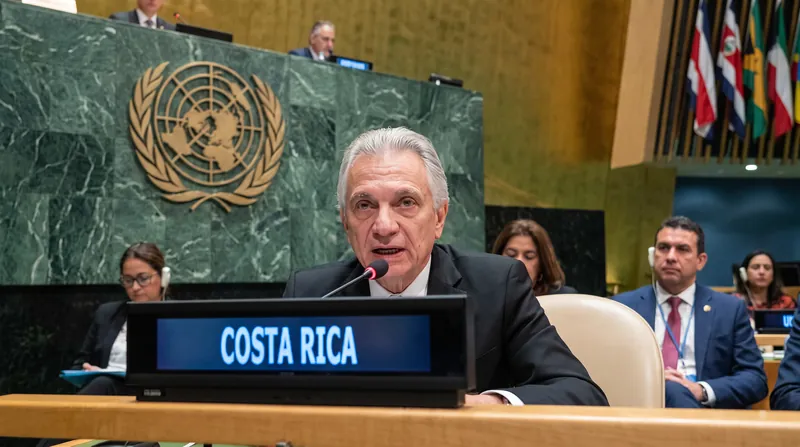
The selection process to succeed Guterres began with a field of seven formal candidates. By 13:48 UTC on August 9, 2026, Costa Rican diplomat Rebeca Grynspan secured 10 'encourage' votes in the UN Security Council's first informal straw poll. If elected, she would become the first female Secretary-General in the UN's 80-year history.
To secure the nomination, a candidate must avoid a veto from any of the five permanent Security Council members, with the 15-member body holding multiple polls before making a final recommendation to the General Assembly.
By 22:54 UTC on October 28, 2026, human rights organizations were actively campaigning against the candidacy of Emirati diplomat Lana Nusseibeh. Critics argued her consistent defense of the United Arab Emirates against allegations that it is arming the Rapid Support Forces in Sudan's civil war disqualified her from the position.
While UN investigators had previously found credible evidence that the Emirati government was supplying weapons to the Rapid Support Forces via Chad, Nusseibeh defended her record before the General Assembly and pledged to make the Sudan crisis her top priority if elected.