
full timeline
MLB labor negotiations
Major League Baseball owners dropped a controversial proposal to bar teenagers from the domestic draft, shifting bargaining dynamics as the union counters with an international draft framework amid…
Follow MLB labor negotiations in the Factlen app and get an alert when there is news. Get the app
Share this story
Latest report
MLB Owners Concede on Domestic Draft Age as Labor Standoff Intensifies Over Salary Cap
Major League Baseball owners dropped a controversial proposal to bar teenagers from the domestic draft, shifting bargaining dynamics as the union counters with an international draft framework amid an escalating dispute over payroll caps.
- MLB owners withdrew their proposal to ban high school players from the domestic draft, preserving the traditional 18-year-old talent pipeline.
- The MLBPA countered with a framework for an international draft, seeking larger bonus pools and incentives for small-market franchises.
- Negotiations remain deadlocked over the league's demand for a $258.3 million salary cap and a $180.2 million payroll floor.
- A failure to reach an agreement by the December 1 expiration of the current CBA is expected to trigger a league-wide lockout.
Major League Baseball owners have formally withdrawn their controversial proposal to ban high school players from the domestic draft. The major concession removes a massive roadblock in collective bargaining negotiations just days before the sport's labor agreement expires, shifting the focus to other contested economic issues.[3][4]
In response to the owners' retreat, the Major League Baseball Players Association presented a counter-framework for an international draft. The exchange shifts the bargaining dynamics toward amateur acquisition, even as a bitter, multi-billion-dollar dispute over a hard salary cap threatens to shut down the sport entirely.[3]
The current collective bargaining agreement is set to expire at 11:59 p.m. EST on December 1. A failure to reach a comprehensive deal by that deadline is widely expected to trigger a league-wide lockout, immediately freezing all offseason transactions, free agency, and club facility access.[1][3]
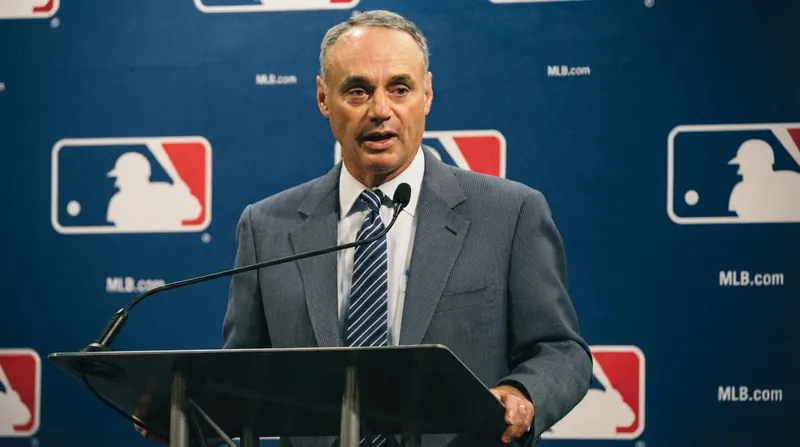
Commissioner Rob Manfred has maintained a firm stance on the league's core economic demands as the deadline approaches, insisting that the thirty club owners remain completely unified in their pursuit of a capped economic system.[2]
"There's plenty of room for compromise, but there's one thing that I will not compromise... They want a salary cap and floor," Manfred told reporters following the owners' meetings in New York, referencing the league's fanbase.[2]
Preserving the Domestic Pipeline
The owners' original June proposal would have radically altered the domestic draft landscape. It sought to require all draftees to be at least 20 years old by September 1 of their signing year and two years removed from high school graduation, fundamentally changing the talent pipeline.[4][6]
That framework would have effectively eliminated high school seniors and junior college freshmen from the draft pool. The league argued that expanded scholarships and NIL opportunities had made college baseball a superior development environment that produces major-league-ready talent at a much faster and more reliable rate.[4][6]
The MLBPA fiercely rejected the age restriction, arguing it would destroy fundamental player rights and delay earning potential for top prospects. The union estimated the league's combined draft proposals would eliminate more than a billion dollars in player compensation over the next five years alone.[1][5]
By dropping the age limit, owners preserve a pipeline that has existed since the draft's inception in 1965. The concession ensures that 18-year-old prospects can continue to begin their professional careers and start their service-time clocks immediately after high school, maintaining a crucial route to early free agency.[4]
A Global Draft Compromise
With the domestic age limit off the table, the union signaled a willingness to negotiate the international amateur system. Management has tried unsuccessfully for more than two decades to implement an international draft, facing repeated rejections from players who viewed it as an artificial restriction on global talent.[3]
The league's initial offer called for a 12-round international draft starting in 2027, featuring a hard-slotted $200 million signing bonus pool. It also sought to raise the minimum international signing age from 17 to 18 to keep prospects in school longer and curb early exploitation by independent trainers.[3][5]
The MLBPA's counter-framework rejects the rigid hard slots but asks for larger signing bonus pools under a modified, regulated system. The union proposed raising the limit of bonuses that do not count against a team's pool to $75,000 through 2029, and increasing it to $100,000 thereafter.[3]
The players are also seeking additional rewards for small-market franchises to incentivize spending on amateur talent. Under their proposal, teams receiving revenue-sharing money could increase their bonus pool by $1 million in a single signing period over the course of the five-year collective bargaining agreement.[3]
MLBPA interim executive director Bruce Meyer emphasized the union's priorities following the bargaining session in Manhattan, pushing back against the league's most restrictive frameworks while offering a path forward on international scouting.[3]
"We are committed to negotiating a system that preserves opportunities for future generations of players, protects young prospects from exploitation, and provides flexibility without further burdening international players with new artificial restrictions," Meyer said in a statement.[3]
The Salary Cap Chasm
While the amateur acquisition landscape shows signs of compromise, the central economic battle remains completely deadlocked. Owners are pushing for a system that fundamentally alters how teams construct their major-league rosters, demanding fixed labor costs to regulate what they view as runaway spending by top-market clubs.[1][2]
The league recently proposed a $258.3 million salary cap and a $180.2 million payroll floor. To ease the transition for franchises with existing long-term commitments, MLB suggested delaying the implementation of the cap and floor until the 2028 season, leaving the current luxury tax in place for 2027.[1][2]
The financial implications of the proposal are massive across the sport. Based on end-of-season payrolls from 2026, 12 clubs would be required to increase their spending by a combined $636 million to meet the new $180.2 million floor, forcing small-market teams to invest heavily in major-league talent.[2]
Conversely, eight high-spending franchises would be forced to slash their payrolls by a combined $528 million to comply with the cap. The union views any cap as an artificial restrictor on player earning potential and a direct violation of the free-market principles they have defended for decades.[2]
Racing the Expiration Clock
The MLBPA has historically refused to entertain a salary cap, and union leadership maintains that position has not changed. Meyer recently accused the league of wasting months of time trying to court public opinion rather than negotiating in good faith on core economic issues.[1]
Both sides appear to be preparing for an extended impasse as the December deadline approaches. The players' union has amassed a substantial war chest, funded by licensing fees from video games and merchandise, to help non-star players weather a work stoppage that could stretch into the spring.[7]
The sport's last labor dispute resulted in a 99-day lockout spanning the 2021 and 2022 offseasons. While that stoppage ended in time to preserve a full 162-game schedule, the inclusion of a hard salary cap demand makes the current negotiations significantly more volatile and harder to resolve.[2]
Negotiators are scheduled to meet daily at the league's Manhattan offices through the Thanksgiving holiday. While the domestic draft concession provides a rare moment of agreement, the path to a comprehensive labor deal remains blocked by billions of dollars in disputed revenue and fundamentally opposed economic philosophies.[1][3]
Key numbers
Sources
- [1]CBS Sports — MLB proposes phase-in period for salary cap/floor Read on CBS Sports →
- [2]MLB.com — Manfred says no room for compromise on cap Read on MLB.com →
- [3]Newsday — Players reject MLB's international draft proposal; ask for higher bonus pools, aid to small markets Read on Newsday →
- [4]Fox Sports — Baseball owners proposed banning high school players from signing Read on Fox Sports →
- [5]Sports Illustrated — Major League Baseball commissioner Rob Manfred and the owners proposed sweeping changes Read on Sports Illustrated →
- [6]Forbes — MLB owners are proposing drastic changes to the amateur draft system Read on Forbes →
- [7]SoxProspects — MLB owners contemplate salary cap Read on SoxProspects →
What to watch
- A failure to reach an agreement by the December 1 expiration of the current collective bargaining agreement is expected to trigger a league-wide lockout.
- Major League Baseball has proposed reducing the domestic draft from 20 rounds to 12 rounds starting in 2027.
- The league has offered to delay the implementation of its proposed salary cap system until the 2028 season.
Charts, maps and images
Timeline
November 2026
MLB Owners Concede on Domestic Draft Age as Labor Standoff Intensifies Over Salary Cap
AIMLB Commissioner Rob Manfred Draws Hard Line on Salary Cap as Lockout Looms
MLB Proposes Higher Cap and Floor Targets While Delaying Salary Cap Plan to 2028

July 2026
MLB Owners Propose Banning High School Players From Draft in Sweeping Development Overhaul
AI
How the story developed
On July 7, Major League Baseball proposed raising the domestic draft age to 20, which would have barred high schoolers from signing and effectively ended the century-old practice of drafting players directly out of high school. MLB cited that 75 percent of high school draftees from 2012 to 2019 never reached the majors.
The July 7 plan also sought to create an identical 12-round international draft and raise the international signing age to 18. The MLBPA strongly opposed the plan, claiming it would cut $1 billion in amateur compensation.
On November 4, Major League Baseball offered a revised economic package featuring higher spending ceilings, elevated minimum payroll floors, a $1 million league minimum salary, and a five-year path to free agency.
The MLBPA swiftly rejected the November 4 proposal, setting the stage for the current standoff over the league's economic demands.