full timeline
Global shipping emissions regulations
U.S.
Follow Global shipping emissions regulations in the Factlen app and get an alert when there is news. Get the app
Share this story
Latest report
US President Attacks Global Shipping Carbon Tax at UN as Decarbonization Target Slips
U.S. President Donald Trump renewed his opposition to the IMO's Net-Zero Framework at the UN General Assembly, warning the proposed emissions pricing system would inflate global freight costs.
- U.S. President Donald Trump used his UN General Assembly address to attack the IMO's proposed Net-Zero Framework, calling it a "global carbon tax."
- The framework would impose a $100-per-ton levy on excess shipping emissions starting in 2028, generating up to $15 billion annually for green fuel development.
- The U.S. previously delayed the framework's adoption in April 2025 by threatening economic retaliation against countries that supported the measure.
- A coalition of 63 countries supports the pricing mechanism, arguing it is necessary to decarbonize an industry responsible for 3 percent of global emissions.
- Member states will attempt to finalize the rules at an extraordinary IMO session scheduled for December 4, 2026.
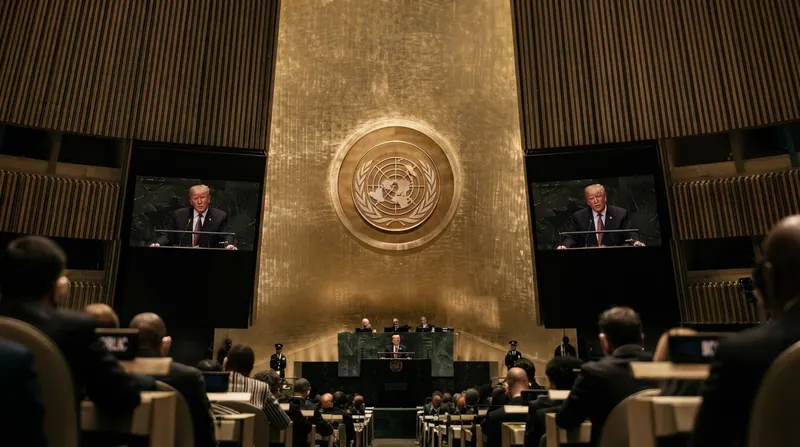
The binding constraint for a global carbon pricing mechanism on maritime shipping is unanimous or near-unanimous consent among the world's major economies—a condition that currently does not hold. Addressing the United Nations General Assembly on September 22, 2026, U.S. President Donald Trump renewed his administration's opposition to the International Maritime Organization's (IMO) Net-Zero Framework, describing the proposed emissions pricing system as a "global carbon tax" that would drive up transportation costs.
The remarks cement the U.S. position ahead of critical IMO negotiations scheduled for December, where member states will attempt to finalize rules that were originally slated for adoption in October 2025.[1][3][5]
The IMO, the UN agency responsible for regulating international shipping, began addressing the sector's climate impact in 1997 when member states first voted on a resolution to curb carbon dioxide emissions. The organization eventually introduced the Energy Efficiency Design Index in 2011 to set mandatory efficiency standards for new ships. Following an initial greenhouse gas strategy in 2018, the IMO adopted a more ambitious mandate in 2023, calling for international shipping to reach net-zero emissions by or around 2050, with interim targets set for 2030 and 2040.[2][4]
To meet those targets, the IMO drafted the Net-Zero Framework, which applies to vessels above 5,000 gross tonnage—a class that accounts for 85 percent of the maritime industry's emissions. The framework pairs a progressively tightening greenhouse gas fuel standard with an economic measure. Under this system, ships that exceed specified emissions-intensity thresholds would be required to acquire remedial units to cover their shortfall, effectively creating a global pricing mechanism for marine pollution.[2][3][5]
The financial mechanics of the framework are substantial. The Tier 1 remedial unit price was set at $100 per metric ton of CO2 equivalent for the 2028 to 2030 period. Ships failing to meet both the base and direct compliance targets would face an additional Tier 2 deficit, which could require purchasing surplus units from other ships or buying additional remedial units at a higher price of $380 per metric ton.
In total, the system is expected to generate a net revenue stream of $10 billion to $15 billion per year, which would flow into a proposed IMO Net-Zero Fund to subsidize the development of green marine fuels.[2][3][4]
For a local retailer importing inventory or a manufacturer sourcing raw materials, the debate at the UN is not an abstract climate discussion—it is a fight over the future baseline cost of freight.
If the IMO implements the $100-per-ton carbon price, shipping companies are expected to pass those compliance costs down the supply chain, directly affecting the landed price of goods. International shipping currently accounts for 2 to 3 percent of global greenhouse gas emissions, and zero-carbon fuels remain prohibitively expensive compared to the heavy fuel oil that powers most of the global fleet.[2][4][5]
The U.S. administration argues that the framework would severely inflate those supply chain costs. During his UN address, Trump claimed the measure would raise international shipping costs by "10 to 20 percent, and maybe even more than that," declaring that "while I'm president, there will be no global taxes." The administration has consistently framed the IMO's economic measure as an activist-driven tax that threatens national sovereignty and economic growth, rejecting the organization's characterization of it as a performance-based pricing mechanism.[1][2][4]
This stance reflects a broader U.S. strategy that successfully delayed the framework's formal adoption at the IMO's Marine Environment Protection Committee (MEPC) meeting in April 2025. Ahead of that vote, U.S. Secretary of State Marco Rubio and then-Transportation Secretary Sean Duffy warned foreign governments that backing the framework could bring economic retaliation. In a joint letter, they threatened to impose sanctions, tariffs, additional port fees, or visa restrictions on countries and individual foreign officials who supported the plan, prompting the committee to postpone the final decision.[1][2][4]
Despite the U.S. withdrawal from the April 2025 negotiations, the shipping industry itself faces a fractured regulatory landscape if the IMO fails to establish a unified standard. A coalition of 63 countries—including the European Union, Brazil, India, and Pacific island states—voted in favor of the draft framework, while 16 nations, including Saudi Arabia and Russia, opposed it.
Proponents argue that a global pricing mechanism is the only equitable way to fund the transition, ensuring that all shipping companies operate on a level playing field regardless of where their vessels are flagged.[2][3]
In the absence of consensus, alternative proposals have emerged that would strip the framework of its financial teeth. A coalition led by Liberia, Panama, and Argentina proposed dropping both the greenhouse gas pricing mechanism and the associated Net-Zero Fund entirely. Meanwhile, the U.S. has advocated for an "energy-all" approach that would not restrict the use of conventional crude, diesel, or liquefied natural gas, arguing that economic measures will never secure the necessary consensus among member states.[2][3]
If the framework collapses, businesses face a different risk: a fragmented landscape where individual regions impose their own overlapping carbon tariffs. Proponents of the IMO framework have repeatedly warned that without a centralized global standard, the shipping industry will be subjected to a patchwork of local regulations. For fleet operators, navigating different emissions rules in every jurisdiction would create logistical bottlenecks, complicate route planning, and lead to unpredictable shipping rates that ultimately trickle down to the consumer.[2][4]
The timeline for a resolution is rapidly closing. The next round of technical negotiations is scheduled for November 23 to 27, 2026, followed by the MEPC 85 session. The Net-Zero Framework is then expected to return for possible adoption at an extraordinary MEPC session on December 4. The outcome of that vote will dictate whether the global supply chain adopts a unified emissions pricing model or continues to operate without a central economic mechanism for carbon reduction.[1]
Sources
- [1]gCaptain — Trump Takes Aim at Shipping's Net-Zero Plan at UN Read on gCaptain →
- [2]Hindustan Times — Trump boasted of stopping an 'obscure' UN agency's 'carbon tax': What the IMO plan for shipping industry involves Read on Hindustan Times →
- [3]engine.online — Trump renews attacks on IMO Net-Zero Framework Read on engine.online →
- [4]The Maritime Executive — Trump Takes Aim at IMO and the Net Zero Framework at the UN Read on The Maritime Executive →
- [5]Wikipedia — IMO Net-Zero Framework Read on Wikipedia →
Charts, maps and images
Timeline
September 2026
US President Attacks Global Shipping Carbon Tax at UN as Decarbonization Target Slips
August 2026
The New Global Shipping Reality: A Guide to the IMO Net-Zero Framework, the Global Emissions Price, and the 2027 Fuel Standard
AI