
full timeline
ESA Hera asteroid mission
The European Space Agency's Hera mission has officially entered its close-proximity observation phase around the Didymos binary asteroid system.
Follow ESA Hera asteroid mission in the Factlen app and get an alert when there is news. Get the app
Share this story
Latest report
Europe's Hera Spacecraft Begins Close Inspection of Asteroid Rammed by NASA
The European Space Agency's Hera mission has officially entered its close-proximity observation phase around the Didymos binary asteroid system. The spacecraft will map the crater left by NASA's 2022 kinetic impact test to refine planetary defense strategies.
- Hera has commenced its detailed survey of the Didymos and Dimorphos asteroid system.
- The probe is operating in a specialized "rectangular orbit" to safely navigate the low-gravity environment.
- Instruments will measure the exact mass, composition, and internal structure of the impacted moonlet.
- Data gathered over the coming weeks will reveal the precise mechanics of the 2022 DART collision.
The European Space Agency's Hera probe has officially commenced its close-proximity inspection of the Didymos binary asteroid system. Operating millions of miles from Earth, the spacecraft is now maneuvering around the 780-meter primary body and its smaller moonlet, Dimorphos. This marks the beginning of a critical data-gathering phase for planetary defense.[1][2]
The primary objective is to survey the aftermath of a deliberate cosmic collision. In September 2022, NASA's Double Asteroid Redirection Test (DART) intentionally slammed into Dimorphos at roughly 14,000 miles per hour. That impact successfully altered the moonlet's orbital period, proving that kinetic deflection is a viable strategy.[3][4]
However, the DART spacecraft was destroyed in the process, leaving scientists with an incomplete picture of the event. Ground-based telescopes could measure the orbital shift, but they could not resolve the physical damage. Hera has arrived to serve as the dedicated investigator for this historic planetary defense test.[5]
To safely navigate the extremely weak gravitational field of the binary system, Hera is employing a highly specialized flight path. Flight dynamics engineers at the European Space Agency have placed the spacecraft into what they describe as a "rectangular orbit." This trajectory relies on a series of precise thruster burns rather than continuous gravitational capture.[1]
Navigating a microgravity environment
In a standard orbit around a massive body like Earth, gravity provides the continuous centripetal force needed to keep a satellite in a circular or elliptical path. Didymos and Dimorphos possess a combined mass so low that traditional orbital mechanics break down. A conventional orbit would be dangerously unstable.[1]
Instead, Hera flies in straight lines relative to the asteroids. When it reaches a designated waypoint, the spacecraft fires its thrusters to execute a sharp turn, effectively flying a box-like pattern around the system. This approach ensures the probe remains at a safe distance while maintaining continuous observational coverage.[1]
The current inspection phase brings Hera to within 30 kilometers of the binary pair. From this vantage point, the spacecraft's suite of high-resolution cameras and thermal imagers can begin mapping the surface features in unprecedented detail. The initial images are expected to reveal the exact location of the DART impact.[5]
Researchers are particularly interested in the morphology of the impact site. While the initial operational updates from the European Space Agency do not include direct statements from mission directors, the agency confirmed the probe is now actively targeting the crater left by the collision. The difference between a localized crater and global deformation depends entirely on the asteroid's internal structure.[1][2]
The physics of a rubble pile
Prior to the DART mission, planetary scientists debated whether Dimorphos was a solid monolith or a loosely aggregated "rubble pile" held together by weak gravity. The sheer volume of debris ejected during the 2022 collision strongly suggested the latter. Hera's instruments are designed to definitively answer this structural question.[3]
The spacecraft carries a compact laser altimeter that will measure the precise topography of both Didymos and Dimorphos. By bouncing laser pulses off the surface and timing their return, the instrument builds a three-dimensional model of the asteroids. This topographical map will allow scientists to calculate the exact volume of the moonlet.[2][5]
Volume is only half of the equation required to understand the asteroid's composition. To determine the mass of Dimorphos, Hera will track minute shifts in its own radio signal as it flies past the moonlet. The slight gravitational tug exerted by the asteroid alters the frequency of the transmission back to Earth.[1]
Combining the volume from the laser altimeter with the mass derived from the radio tracking yields the asteroid's bulk density. If the density is significantly lower than that of solid rock, it confirms that Dimorphos is highly porous. A porous, rubble-pile structure absorbs impact energy very differently than a solid object.[4]
Refining planetary defense models
Understanding this energy absorption is the ultimate goal of the joint US-European planetary defense initiative. When DART struck Dimorphos, the resulting plume of ejected material acted like a rocket exhaust, providing an additional thrust that pushed the asteroid further than the kinetic impact alone would have achieved.[3][4]
To accurately model this momentum transfer, physicists need to know exactly how much mass was ejected and at what velocity. Hera's detailed survey of the crater volume will provide the missing variable in these complex equations. This data is essential for scaling the kinetic impactor technique to larger, potentially hazardous objects.[5]
If astronomers ever detect a near-Earth object on a genuine collision course, the response will rely entirely on the models validated by Hera. Mission planners will need to calculate the exact mass and velocity required for a deflection spacecraft to successfully alter the incoming asteroid's trajectory.[2]
An inaccurate model could result in a mission that fails to push the asteroid far enough, or conversely, one that shatters a fragile rubble pile into multiple dangerous fragments. The close-proximity data currently being gathered by Hera ensures that future deflection attempts will be based on empirical evidence rather than theoretical estimates.[3]
Deploying the deep-space CubeSats
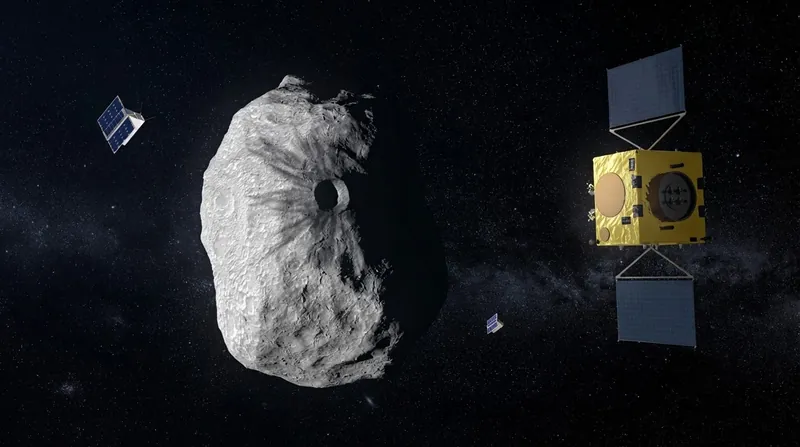
Hera is not conducting this investigation alone. The main spacecraft serves as a mothership for two briefcase-sized CubeSats, named Juventas and Milani. These secondary probes will eventually be deployed to perform even closer passes of the asteroid system, carrying specialized instruments that the larger vehicle cannot safely operate.[1][5]
Juventas is equipped with a low-frequency radar instrument designed to peer beneath the surface of Dimorphos. This will be the first time a radar sounding experiment has been conducted on an asteroid. The radar echoes will reveal the internal layering and void spaces within the moonlet, confirming its structural integrity.[1]
Milani, the second CubeSat, carries a multispectral imager to map the mineralogical composition of the binary system. By analyzing the specific wavelengths of light reflected off the surface, scientists can determine the exact types of silicates and organic compounds present. This chemical analysis helps trace the evolutionary history of the asteroids.[1]
At the conclusion of their respective observation campaigns, both CubeSats will attempt to land on Dimorphos. These daring maneuvers will provide the highest-resolution surface data of the entire mission, capturing the microscopic texture of the regolith before the small probes finally power down.[5]
A milestone in international cooperation
The commencement of Hera's inspection phase represents the culmination of more than a decade of international planning. The Asteroid Impact and Deflection Assessment collaboration was conceived as a two-part endeavor, requiring seamless coordination between NASA's initial strike and the European Space Agency's subsequent survey.[2][3]
While the DART impact captured global attention with its spectacular, real-time destruction, the rigorous scientific validation was always dependent on Hera's arrival. The current operations in the Didymos system demonstrate the capability of international space agencies to execute complex, multi-generational missions across vast interplanetary distances.[4]
Over the next several weeks, Hera will gradually tighten its rectangular orbit, moving closer to the binary pair to increase the resolution of its mapping instruments. Each successive pass will strip away another layer of uncertainty regarding the mechanics of kinetic deflection.[1][5]
In addition to the visual and radar mapping, Hera utilizes a thermal infrared imager to monitor how the asteroids absorb and radiate solar heat. Because solid rock retains heat differently than porous dust, these temperature fluctuations provide an independent method for assessing the surface composition and density of Dimorphos.[1]
The thermal data will also help scientists understand the Yarkovsky effect, a phenomenon where the uneven emission of heat generates a minuscule but constant thrust. Over millions of years, this thermal thrust can significantly alter an asteroid's orbit, making it a crucial factor in predicting long-term collision risks for near-Earth objects.[5]
The data transmitted back to Earth will keep planetary scientists occupied for years, fundamentally rewriting the textbooks on asteroid dynamics. As the spacecraft continues its silent vigil around the battered moonlet, it transforms a successful engineering test into a comprehensive, operational planetary defense strategy.[2][3]
Sources
- [1]European Space Agency — Hera spacecraft in 'rectangular orbit' around target asteroids Read on European Space Agency →
- [2]Euronews — Europe's Hera spacecraft begins close inspections of asteroid in planetary defence mission Read on Euronews →
- [3]The Independent — Europe's Hera spacecraft begins close inspections of an asteroid rammed by NASA in a 2022 test Read on The Independent →
- [4]The Manila Times — Europe's Hera spacecraft begins close inspection of asteroid struck by NASA in 2022 test Read on The Manila Times →
- [5]Astronomy Now — Hera closes in on the asteroid DART impacted Read on Astronomy Now →
What to watch
- Data gathered over the coming weeks will reveal the precise mechanics of the 2022 DART collision.
- The mission will deploy two CubeSats to map the asteroid's interior and dust field.
- Detailed images from the CubeSats are scheduled to be released on November 25.
Charts, maps and images
Timeline
November 2026
Europe's Hera Spacecraft Begins Close Inspection of Asteroid Rammed by NASA
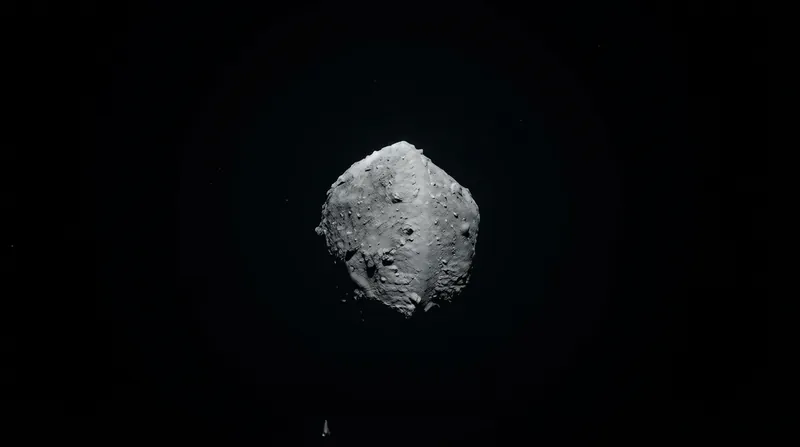
October 2026
ESA's Hera Spacecraft Resolves Binary Asteroid System for the First Time Ahead of Impact Survey
How the story developed
The mission follows NASA's 2022 DART kinetic impact experiment. During that test, a spacecraft collided with the smaller asteroid of the Didymos and Dimorphos binary system, successfully altering the smaller asteroid's orbit by 33 minutes.
The European Space Agency subsequently directed the Hera probe to survey the aftermath of the NASA collision. The spacecraft was designed to travel to the binary system and assess the physical results of the kinetic impact.
On October 28, the Hera spacecraft executed precise braking maneuvers. These operations successfully slowed the probe to a speed of 20 meters per second relative to its targets.
Following the braking maneuvers, by 17:38 UTC on October 28, Hera captured its first image resolving the Didymos and Dimorphos asteroids. Taken from a distance of 1,280 kilometers away, this visual milestone confirmed the spacecraft's trajectory as it approached the system.