full timeline
Brazilian Amazon deforestation
Satellite data confirms the destruction of the Brazilian Amazon has fallen by nearly half over the past year, marking the lowest clearance rate since modern tracking began.
Follow Brazilian Amazon deforestation in the Factlen app and get an alert when there is news. Get the app
Share this story
Latest report
Brazilian Amazon Deforestation Plunges 42 Percent to Lowest Rate on Record
Satellite data confirms the destruction of the Brazilian Amazon has fallen by nearly half over the past year, marking the lowest clearance rate since modern tracking began. The sharp decline follows aggressive federal enforcement campaigns ahead of critical municipal elections.
- Deforestation in the Brazilian Amazon dropped by 42 percent between August 2025 and July 2026 compared to the previous 12-month cycle.
- Brazil's space research agency recorded the lowest total area of forest cleared since the DETER satellite monitoring system launched.
- Federal environmental agencies ramped up raids on illegal logging and mining operations, issuing record fines and seizing equipment.
- The enforcement success arrives just weeks before nationwide municipal elections, where the ruling coalition faces strong opposition from agribusiness-aligned candidates.
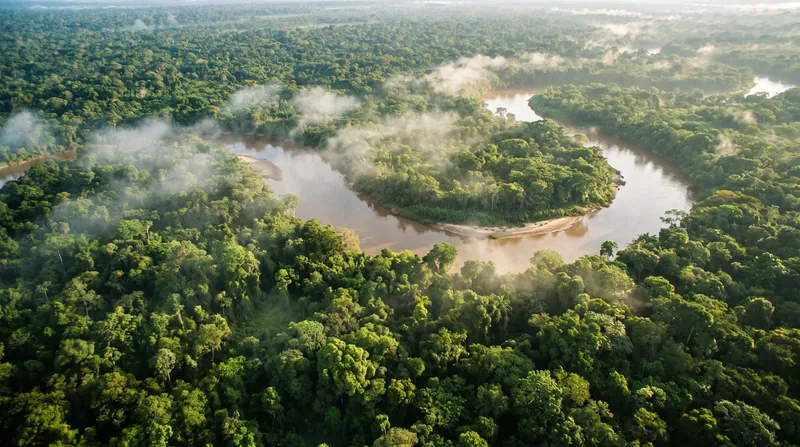
The physical footprint of the Amazon rainforest is stabilizing after a 42 percent year-over-year collapse in illegal land clearing. Satellite monitoring confirms that the rate of destruction has reached its lowest point since modern tracking began, fundamentally altering the trajectory of the world's largest carbon sink.[1][2][3]
Brazil's National Institute for Space Research, or INPE, recorded the unprecedented drop during the official monitoring cycle that ran from August 2025 through July 2026. The agency's DETER satellite system detected clearing across roughly 4,300 square kilometers, down from over 7,400 square kilometers the previous year.[4]
The reduction removes millions of tons of projected carbon emissions from the atmosphere and signals a structural shift in South American land management. Federal authorities achieved the decline through a coordinated, militarized crackdown on the logistical networks that fund illegal logging and wildcat mining.[1][3]
Environmental enforcement agents from IBAMA, backed by federal police and military units, spent the past year dismantling unauthorized airstrips and seizing heavy excavation equipment. The operations targeted the remote frontiers of Pará and Amazonas states, where organized crime syndicates had previously operated with impunity.[1][2]
Enforcement drives the decline
"This is not a statistical anomaly, but the direct result of reasserting state control over territories that were surrendered to environmental criminals," said Marina Silva, Brazil's Environment Minister, during a press briefing in Brasília.[3]
The federal government has issued more than $350 million in environmental fines over the past 12 months, a 60 percent increase from the prior cycle. Authorities also embargoed thousands of hectares of illegally cleared land, legally barring the sale of cattle or soy produced on those specific tracts.[1][4]
The aggressive enforcement campaign arrives at a politically sensitive moment, just weeks before Brazil holds nationwide municipal elections. The ruling coalition is attempting to leverage the environmental victory to secure international funding, while facing fierce pushback from rural constituencies whose economies rely on agricultural expansion.[1][3]
Agribusiness leaders argue that the sweeping embargoes and equipment seizures have paralyzed legitimate rural development and cost thousands of local jobs. Representatives from the powerful rural caucus in Congress warn that the government's approach alienates the sector responsible for nearly a third of Brazil's gross domestic product.
"The administration treats every farmer like a criminal, deploying helicopters and armed agents to resolve administrative land disputes," said Pedro Lupion, a leading lawmaker in the agricultural bloc, speaking to Folha de S.Paulo.
Displacement to the savanna
While the Amazon basin sees historic preservation, environmental researchers warn that the destruction has simply migrated south to the Cerrado. The vast, biodiverse savanna borders the rainforest and lacks the same strict legal protections, making it an easier target for rapid agricultural conversion.[2][5]
Data from the Imazon research institute indicates that deforestation in the Cerrado increased by 14 percent during the same 12-month period. The biome is now the primary expansion frontier for Brazil's massive soy and cattle industries, absorbing the pressure deflected from the heavily policed Amazon.[5]
"We are squeezing a balloon, and the pressure is blowing out the Cerrado," said Carlos Souza Jr., a senior researcher at Imazon. "If the government does not apply the same rigorous enforcement to the savanna, the net carbon emissions for the country will remain dangerously high."[5]
The shifting geography of deforestation complicates Brazil's diplomatic efforts to unlock the Amazon Fund, a billion-dollar conservation mechanism financed primarily by Norway and Germany. European donors have demanded sustained, nationwide reductions in greenhouse gas emissions before releasing the next tranche of frozen capital.[2]
The European Union's impending deforestation regulation, which bans the import of commodities grown on recently cleared land, has also forced the Brazilian agricultural sector to adapt. Major trading houses are increasingly relying on satellite tracking to prove their supply chains are free of environmental violations.
Electoral stakes and international funding
The upcoming municipal elections will test the durability of the federal government's environmental strategy, as mayors control the local permitting processes that often facilitate land grabs. Candidates aligned with the rural caucus are campaigning heavily on promises to resist federal environmental mandates and protect local agricultural interests.[1][3]
A strong showing by the opposition could undermine the enforcement network, as federal agencies rely on municipal police and local infrastructure to sustain their remote operations. The political tension highlights the fragility of the 42 percent drop, which depends entirely on continuous federal funding and political will.
International observers view the current data as a critical milestone ahead of the COP30 climate summit, which Brazil will host in the Amazonian city of Belém in 2025. The host nation intends to use the record reduction to pressure wealthy countries into fulfilling their outstanding climate finance pledges.[1][2]
To maintain the downward trajectory, the federal government plans to deploy an additional 2,000 environmental agents and launch a new fleet of surveillance drones by December. The ultimate test will be whether these structural investments can survive the shifting political winds of the next electoral cycle.[4]
Targeting financial networks
The economic incentives driving illegal clearance remain potent, with global demand for beef and soy keeping commodity prices elevated. Federal prosecutors have begun targeting the financial networks that launder these products, using money-laundering statutes to freeze the bank accounts of suspected land grabbers.[2]
This financial approach represents a shift from purely physical enforcement, aiming to dismantle the syndicates before they can deploy chainsaws and tractors. By tracking the capital that funds the destruction, authorities hope to make illegal deforestation economically unviable regardless of who holds local political office.[2]
Sources
- [1]The Guardian — Brazilian Amazon deforestation falls to lowest on record as pivotal vote looms Read on The Guardian →
- [2]Deutsche Welle — Brazil: Amazon deforestation lowest in nearly 40 years Read on Deutsche Welle →
- [3]BBC — Brazil sees record fall in Amazon deforestation as key election looms Read on BBC →
- [4]INPE — DETER alerts show 42% reduction in Amazon deforestation for 2025-2026 cycle Read on INPE →
- [5]Imazon — Deforestation drops, but Cerrado biome faces increased pressure Read on Imazon →
Charts, maps and images
Timeline
October 2026
Brazilian Amazon Deforestation Plunges 42 Percent to Lowest Rate on Record
August 2026
Brazil's Amazon Deforestation Plunges to Lowest Rate in a Decade