full timeline
Berlin housing expropriation dispute
Die Linke candidate Elif Eralp won Berlin's state election on a promise to socialize corporate-owned apartments, setting up a major legal clash with the German federal government.
Follow Berlin housing expropriation dispute in the Factlen app and get an alert when there is news. Get the app
Share this story
Latest report
Berlin's Far-Left Mayor-Elect Pledges to Expropriate 200,000 Housing Units From Corporate Landlords
Die Linke candidate Elif Eralp won Berlin's state election on a promise to socialize corporate-owned apartments, setting up a major legal clash with the German federal government.
- Far-left candidate Elif Eralp won Berlin's state election with over 25 percent of the vote.
- Eralp pledged to expropriate 200,000 apartments from corporate landlords to lower rents.
- The center-left SPD estimates the compulsory purchases will cost the city €20 billion.
- German Chancellor Friedrich Merz has threatened federal legislation to block the seizures.
- Die Linke must now negotiate a coalition government with the SPD and the Greens.
The incoming administration of Germany's capital intends to forcibly purchase 200,000 privately owned apartments to halt a decade of surging housing costs, while the federal government insists it will pass immediate legislation to block the seizures and protect foreign investment.
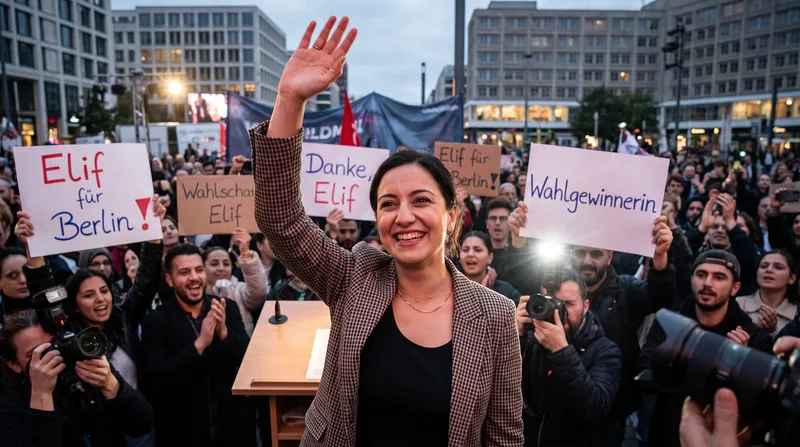
That collision course was set on September 20, 2026, when the far-left Die Linke party captured over 25 percent of the vote in Berlin's state election, positioning 45-year-old lawyer Elif Eralp to become the city's first mayor of immigrant descent. Eralp campaigned explicitly on executing a stalled 2021 public referendum that demanded the socialization of housing portfolios held by corporate landlords like Vonovia and Deutsche Wohnen.[1][2][3][5]
For Berlin's renters, who make up the vast majority of the city's population, the proposed policy would freeze rents on state-owned apartments for one year, followed by a strict one percent annual cap on increases. The expropriation plan targets landlords owning more than 3,000 units, transferring their properties into a democratically controlled public body.
The center-left Social Democrats (SPD), whose support Eralp needs to form a governing coalition, estimate the compulsory purchases would cost the city €20 billion ($22.9 billion) in compensation. Eralp has maintained her commitment to the policy despite the financing questions, arguing that housing must be treated as a human right rather than a speculative asset.[1][3][4][5]
The mandate for radical intervention stems from a severe affordability crisis in a city once famously described by former mayor Klaus Wowereit as "poor but sexy." Advertised rents in Berlin have climbed from €9 per square meter in 2016 to nearly €16 in 2025, squeezing out low- and middle-income residents.
In 2021, nearly 60 percent of Berlin voters backed a non-binding referendum to socialize large housing stocks, but subsequent governments declined to implement it. Eralp, the daughter of Turkish socialists who fled a 1980 military coup, revived the mandate by making it the centerpiece of her campaign, wearing a gold "Mietendeckel" (rent freeze) necklace and mobilizing younger voters and marginalized communities.[1][2][3][4][5]
The expropriation pledge has triggered an immediate backlash from federal leaders and corporate executives. German Chancellor Friedrich Merz of the conservative Christian Democratic Union (CDU) declared that "there will be no expropriations in Germany," warning that seizing private assets would have devastating effects on the country's reputation as a safe destination for foreign capital.
Merz indicated he expects swift federal legislation to preempt Berlin's municipal plans. Luka Mucic, Chief Executive of the real estate giant Vonovia, stated that the company is open to discussing the housing shortage but argued that socialization "doesn't create any new housing."[1][2]
To take control of the Rotes Rathaus (Red City Hall), Die Linke must now negotiate a "red-red-green" coalition with the Greens and the SPD, which would collectively hold a comfortable majority of the parliament's 130 seats. While the Greens broadly support the housing referendum's goals, SPD lead candidate Steffen Krach has publicly opposed the expropriation strategy, setting up a contentious negotiation period.
Eralp also faces pressure to address controversies within local Die Linke branches regarding anti-Israel rhetoric, which coalition partners have cited as a stumbling block. If she succeeds in forming a government, the resulting legal battle over the €20 billion housing seizure will likely end up in the Federal Constitutional Court, which previously struck down Berlin's 2020 rent cap law.[3][4][5]
The outcome of these coalition talks will determine whether Berlin becomes a global test case for municipal housing socialization or if the expropriation pledge remains an unfulfilled campaign promise. With federal elections looming and housing affordability dominating domestic politics across Europe, Eralp's victory has already shifted the baseline of what policies are considered viable in major metropolitan centers.[3][5]
For now, the city's real estate market remains in a state of suspended animation. Corporate landlords are halting new acquisitions while tenant unions prepare to hold the incoming administration to its central promise. The next formal step requires Die Linke to secure a binding coalition agreement by late October, at which point the drafting of the expropriation legislation would officially begin.[1][4]
The financial mechanics of the buyout remain the most significant hurdle. While the SPD's €20 billion estimate represents a massive municipal debt burden, Die Linke has proposed compensating landlords at rates well below current market value, arguing that the German constitution allows for socialization at "fair" rather than speculative prices. That interpretation of constitutional law has never been tested at this scale.[1][2]
Sources
- [1]Internazionale — Far-left leader pushing to lead Berlin says city has voted for change Read on Internazionale →
- [2]Reason — Far-left wins Berlin's election on the promise of seizing private apartments Read on Reason →
- [3]The Guardian — Elif Eralp: 'Germany's Zohran Mamdani' who vows to be a mayor for all Berliners Read on The Guardian →
- [4]The Local Germany — What does Die Linke's election win mean for foreigners in Berlin? Read on The Local Germany →
- [5]Turkish Minute — Die Linke wins Berlin election, putting Elif Eralp in contention for mayor Read on Turkish Minute →
Charts, maps and images
Timeline
September 2026
Berlin's Far-Left Mayor-Elect Pledges to Expropriate 200,000 Housing Units From Corporate Landlords
AI
August 2026
German Federal Government Blocks Berlin's Housing Expropriation Law, Stabilizing Residential Market