full timeline
Agility Robotics public listing
The Oregon-based manufacturer behind the Digit bipedal robot began trading Thursday after a $465 million SPAC merger.
Follow Agility Robotics public listing in the Factlen app and get an alert when there is news. Get the app
Share this story
Latest report
Agility Robotics Debuts on Nasdaq as First Publicly Listed Pure-Play Humanoid Robot Maker
The Oregon-based manufacturer behind the Digit bipedal robot began trading Thursday after a $465 million SPAC merger. The listing provides a rare look at the steep financial costs of scaling physical AI for commercial warehouses.
- Agility Robotics became the first pure-play humanoid robot manufacturer to trade publicly in the U.S., debuting on the Nasdaq under the ticker AGLT.
- The company raised $465 million through a SPAC merger with Churchill Capital Corp XI, providing capital to scale its manufacturing operations.
- Financial disclosures reveal stark industry realities, with Agility reporting $174,000 in revenue against a $362 million loss in the first half of 2026.
- The company plans to charge $8,500 per month for a robot subscription, pitching the cost as half the equivalent expense of human warehouse labor.
Agility Robotics began trading on the Nasdaq on Thursday, November 5, 2026, testing Wall Street’s appetite for the capital-intensive humanoid robot sector. The Oregon-based manufacturer debuted under the ticker symbol AGLT after completing a merger with a special-purpose acquisition company.[2][4]
The transaction with Churchill Capital Corp XI generated approximately $465 million in gross capital before expenses. That funding provides a vital runway for a company attempting to scale manufacturing of its bipedal warehouse robot, Digit, amid mounting operating losses.[3][4][5]
Agility’s public listing marks the first time a pure-play humanoid robotics developer has opened its books to public market scrutiny in the United States. The disclosures offer a stark look at the financial realities behind the industry’s polished demonstration videos.[4][7]
The company reported just $1.8 million in revenue for 2025, while absorbing a $140 million operating loss. The financial strain accelerated in the first half of 2026, with Agility generating $174,000 in revenue against $362 million in losses.[6][7]
The cost of physical AI
Building machines that can balance, navigate, and manipulate objects in human environments requires immense capital. Agility’s merger filings acknowledge that the company has lost money since its inception and expects those operating deficits to continue for the foreseeable future.[6]
The $465 million capital injection was structured in three tranches to ensure the company entered the public markets with minimal debt. The total includes $164 million from the Churchill XI trust account and $100 million in equity funding secured earlier in the year.[3][5]
The largest single component is a $201 million private investment in public equity, or PIPE, led by Taiwanese manufacturing giant Foxconn. The original transaction terms, announced in June, had valued Agility at a $2.5 billion pre-money equity value.[3][5]
“Becoming a public company gives us access to more resources to help accelerate that progress, bring intelligent robots to more workplaces and help build a future where people and robots accomplish more together,” Agility CEO Peggy Johnson said in a statement.[4]
Unlike competitors that have focused on viral social media demonstrations, Agility has prioritized putting hardware into actual commercial facilities. The company says its robots have accumulated more than 65,000 hours of operation in real-world settings.[4][7]
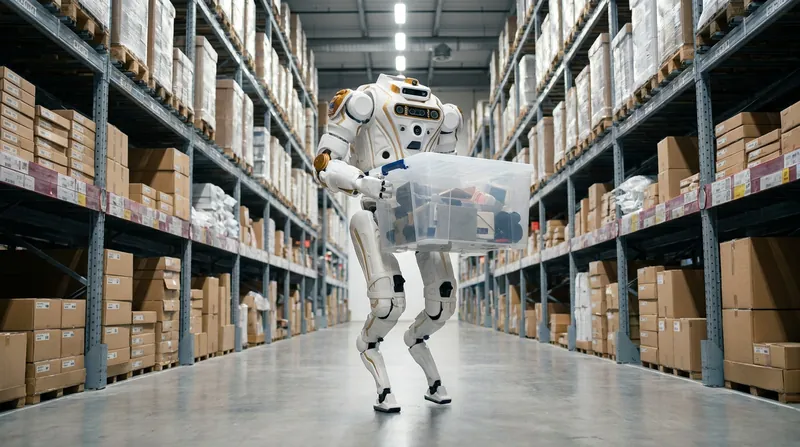
Digit is currently deployed at logistics provider GXO, automotive supplier Schaeffler, and Toyota Motor Manufacturing Canada. At a GXO facility in Georgia, the bipedal robots have moved more than 100,000 totes, working alongside existing warehouse automation systems.[4][6]
The robots are designed to handle repetitive, physically demanding tasks that suffer from high human turnover. At the GXO site, Digit identifies, grasps, and moves plastic totes from autonomous mobile robots onto conveyor belts, operating within a defined workflow rather than navigating unstructured environments.[4][5]
Pricing the robotic worker
The public filings provide the first concrete look at how a humanoid robot manufacturer intends to price its hardware. Agility’s September registration statement outlined two distinct commercial models for customers acquiring the upcoming Digit 5 platform, which is slated for 2027.[6]
Under a subscription model, customers would pay approximately $25,000 per robot for delivery and deployment, followed by an $8,500 monthly fee for software and maintenance. This robots-as-a-service approach lowers the initial capital expenditure for warehouse operators.[6]
Customers choosing to purchase the hardware outright face a steeper upfront cost. The outright ownership model requires $200,000 for the robot itself, a $20,000 deployment fee, and an ongoing $36,000 annual charge for software and maintenance.[6]
Agility is explicitly pitching these figures against human labor rates. During an October investor presentation, Chief Financial Officer Michael Beer argued that a $100,000 annual subscription cost could replace $200,000 in equivalent human labor spending.[6]
Converting those economic arguments into recognized revenue remains the company’s primary challenge. Agility claims to have secured more than $300 million in committed multi-year orders for the Digit 5 model, which was unveiled in September 2026.[4][5][7]
However, those commitments are heavily conditional. The orders depend on Agility meeting specific contractual milestones, product features, and performance specifications before the hardware is delivered and the revenue can be recognized.[4][5]
The financial disclosures reveal that more than half of Agility's $1.8 million revenue in 2025 came from just five robots purchased by a single investor. This concentration underscores the early-stage nature of the commercial humanoid market, where pilot programs have yet to yield massive fleet deployments.[6]
Manufacturing and market pressures
Fulfilling those conditional orders requires scaling production far beyond the company’s current output. Agility has established a manufacturing facility in Salem, Oregon, dubbed RoboFab, which is designed for an eventual annual capacity of 10,000 robots.[4]
Design capacity does not equal immediate production volume. The newly raised $465 million will largely fund the transition from building robots in small batches to operating a continuous assembly line capable of supplying enterprise fleets.[4][5]
The company is also testing its hardware outside of traditional logistics environments. Agricultural equipment manufacturer AGCO has signed an agreement for a factory pilot program in Kansas, which is scheduled to begin next year to evaluate Digit's utility in heavy manufacturing.[4]
Agility currently reports having more than 30 prospective customers in its commercial pipeline. These span the automotive, aerospace, defense, and consumer products sectors, reflecting a broad industrial interest in automating tasks that remain difficult for fixed robotic arms to address.[4]
The U.S. listing arrives as geopolitical tensions reshape the global robotics market. In July 2026, the Federal Communications Commission restricted new foreign-made advanced robotic devices, creating a potential domestic advantage for U.S.-manufactured platforms like Digit.[7]
Chinese manufacturers currently dominate the broader humanoid sector by volume. Unitree, a prominent Chinese robotics firm, went public on the Shanghai stock exchange earlier in the summer and achieved a market valuation of roughly $40 billion.[7]
Agility’s domestic manufacturing footprint offers a hedge against those trade restrictions. GXO Logistics has already agreed to expand its Digit deployments into two additional U.S. facilities, with operations expected to begin in early 2027.[4][5]
The SPAC revival
The mechanism of Agility’s public debut marks a notable return for the special-purpose acquisition company model. Shareholders of Churchill XI overwhelmingly approved the Agility merger during a special meeting on November 2, with more than 84 percent of votes cast supporting the transaction.[3][5]
Existing Agility shareholders rolled 100 percent of their equity into the combined company rather than cashing out. Those shares, along with the sponsor’s holdings, are subject to a standard 180-day lock-up period restricting immediate sales.
The market’s reception of AGLT will likely serve as a bellwether for other robotics startups currently relying on private venture capital. Competitors like Figure AI have raised massive private rounds but have yet to face the quarterly reporting requirements of public markets.[7]
For now, Agility must prove that its 65,000 hours of operational data can translate into a sustainable business. The transition from a research-driven startup to a publicly traded manufacturer requires delivering reliable hardware on schedule, a milestone the humanoid industry has yet to achieve at scale.[4]
Sources
- [1]Traders Union — Agility Robotics goes public on Nasdaq, entering the U.S. humanoid robotics market after a SPAC merger with $465 million in funding Read on Traders Union →
- [2]The AI Insider — Agility Robotics Completes SPAC Merger Ahead of Nasdaq Debut Read on The AI Insider →
- [3]Manufacturing Dive — Agility Robotics clears shareholder vote, expected to go public this week Read on Manufacturing Dive →
- [4]GlobeNewswire — Agility Becomes First U.S. Publicly Listed Pure-Play Humanoid Robotics Company, Begins Trading Today on Nasdaq as AGLT Read on GlobeNewswire →
- [5]The Robot Report — Agility Robotics has cleared a major hurdle in its planned initial public offering Read on The Robot Report →
- [6]Superpower Daily — Agility Robotics became publicly traded on Nasdaq on November 5, 2026 Read on Superpower Daily →
- [7]Emergent — Agility Robotics becomes first pure humanoid robot company to go public, raising $465 million through SPAC merger Read on Emergent →
Charts, maps and images
Timeline
November 2026
Agility Robotics Debuts on Nasdaq as First Publicly Listed Pure-Play Humanoid Robot Maker

June 2026
Humanoid Robot Maker Agility Robotics Goes Public at $2.5 Billion Valuation