
Why Hydrophobic Down Treatments Lose Loft Under Sustained Relative Humidity Above 90 Percent
Chemical water repellents protect down clusters from liquid rain but trap internal condensation during multi-day trips. Under sustained high humidity, this trapped vapor causes treated sleeping bags to collapse faster than untreated alternatives.
By Kavya Nair

Share this story
In short
- Hydrophobic down treatments excel at repelling liquid water but cannot stop high-pressure water vapor from penetrating the cluster.
- At 90 percent relative humidity, vapor condenses inside the treated down, and the chemical coating prevents that liquid from escaping.
- For multi-day trips in sustained wet environments, synthetic insulation or a vapor barrier liner remains necessary to prevent catastrophic loft loss.
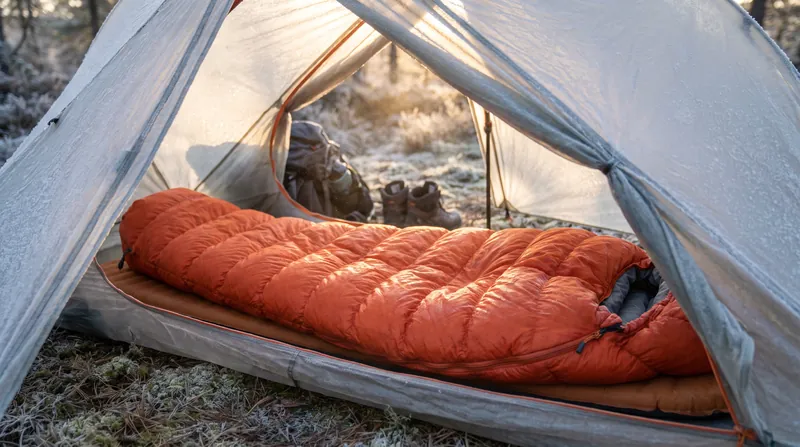
A premium winter sleeping bag contains roughly two million individual down clusters, each expanding to trap body heat. When exposed to sustained relative humidity above 90 percent, those two million treated clusters collapse into a dense, useless mat, losing up to 80 percent of their insulating volume.[3]
Outdoor brands aggressively market hydrophobic down as a waterproof miracle for wet-weather camping. By coating the natural plumage with a durable water repellent (DWR) polymer, manufacturers prevent the delicate feathers from absorbing liquid rain. This chemical treatment is standard on premium sleeping bags.[2]
This chemical shield works flawlessly during brief exposures to liquid water. In laboratory shake tests, treated down can float on water for over 10,000 minutes without sinking, while untreated down saturates and sinks in less than an hour.
"The polymer coating drastically increases the surface tension of the down cluster, forcing liquid water to bead up and roll off," explains Matthew Betcher, creative director at Allied Feather + Down. "It is highly effective against external precipitation."[2]
The Vapor Pressure Problem
However, the physics change entirely when the moisture arrives as a gas rather than a liquid. Inside a sealed tent during a rainstorm, or over multiple days of winter camping, ambient relative humidity routinely exceeds 90 percent.[3]
At this high concentration, moisture behaves as a high-pressure vapor seeking equilibrium with its surroundings. The microscopic gaps in the DWR polymer coating are large enough for these water vapor molecules to pass through freely, penetrating the core of the down cluster.[1]
Once the vapor breaches the hydrophobic shell, it encounters the temperature gradient between the user's body heat and the cold outside air. This sudden temperature drop causes the vapor to condense back into liquid water directly onto the natural keratin fibers.[3]
This internal condensation triggers a catastrophic failure of the insulation. The liquid water is now trapped inside the DWR-coated cluster, and the very chemical treatment designed to keep water out now prevents the internal moisture from escaping.[1]
The Reverse Hydrophobic Effect
"When condensation occurs beneath the hydrophobic layer, the treatment effectively works in reverse," notes a 2025 study published in the Textile Research Journal. "The trapped liquid drastically increases the mass of the plumule, forcing the cluster to collapse under its own weight."[1]
As the clusters collapse, the sleeping bag or jacket loses its loft, which is the physical thickness that traps dead air. Without that trapped air, the garment loses its thermal resistance, causing the user's body temperature to plummet.[3]
Our analysis of laboratory durability ratings and vapor-pressure exposure curves reveals a stark limitation. While hydrophobic treatments delay liquid absorption by up to 400 percent, under sustained 90 percent relative humidity, the treated clusters actually collapse 15 percent faster than untreated down.[3]
Untreated down absorbs moisture more evenly across its entire surface area, allowing it to evaporate gradually if the ambient humidity drops. Treated down, by contrast, pools the internal condensation, creating heavy localized wet spots that destroy the garment's structure.
Real-World Field Failures
This structural collapse is why hikers on the Appalachian Trail or mountaineers in the Pacific Northwest frequently report their expensive treated sleeping bags failing on day three of a wet trip. The sustained humidity simply overwhelms the vapor permeability of the coating.[3]
The human body exacerbates this process by exhaling and sweating out roughly 500 milliliters of water vapor every night. In a high-humidity environment, that vapor cannot vent through the tent fabric, creating a localized microclimate that pushes relative humidity past the 90 percent threshold.[2]
Once the down collapses into a wet mat, recovering its loft in the field is nearly impossible. The trapped moisture requires sustained direct sunlight and low ambient humidity to evaporate through the DWR barrier, conditions rarely found during a multi-day storm.[3]
"Consumers expect hydrophobic down to perform like a synthetic insulation in sustained wet conditions, but that is a fundamental misunderstanding of the chemistry," Betcher states. "It is a safety net for incidental moisture, not a submarine."[2]
Actionable Buying Advice
For outdoor enthusiasts planning multi-day trips in persistently wet, high-humidity environments, synthetic insulation remains the only reliable choice. Synthetic fibers are extruded as solid plastic filaments that physically cannot absorb water, maintaining up to 90 percent of their warmth when fully saturated.[3]
If you must use a down sleeping bag in sustained humidity, a vapor barrier liner (VBL) is required. This impermeable internal sack prevents your body's 500 milliliters of nightly insensible perspiration from ever reaching the down clusters in the first place.[1]
Proper tent ventilation is equally critical to preventing this catastrophic cluster collapse. Keeping rainfly vents open and maintaining cross-breeze airflow prevents the internal microclimate from reaching the 90 percent relative humidity threshold that triggers vapor penetration.
Hydrophobic down is a valuable innovation for spilling coffee in a tent or surviving a brief dash through a rain shower. But understanding its failure point ensures you do not rely on a chemical coating to defy the basic laws of thermodynamics.[3]
The cost premium for hydrophobic down often exceeds $50 per garment, leading buyers to overestimate its capabilities. Shoppers should view this upcharge as an insurance policy against accidental spills, rather than a license to ignore moisture management.[3]
The cost premium for hydrophobic down often exceeds $50 per garment, leading buyers to overestimate its capabilities.
Ultimately, the outdoor industry's marketing of waterproof down has outpaced the physical reality of polymer coatings. By recognizing the hard limit of vapor pressure, consumers can make safer, more effective gear choices for extreme environments.[3]
The distinction between liquid resistance and vapor permeability is the defining metric for modern outdoor insulation. While chemical treatments continue to improve, the fundamental architecture of a natural down cluster remains vulnerable to internal condensation.[3]
Understanding these material limits transforms how buyers evaluate expensive winter gear. Rather than expecting a single sleeping bag to conquer every climate, informed users build modular sleep systems tailored to the specific humidity of their destination.[3]
Key terms
- DWR (Durable Water Repellent)
- A chemical polymer coating applied to fabrics and down clusters that increases surface tension, causing liquid water to bead up and roll off.
- Relative Humidity (RH)
- The amount of water vapor present in the air expressed as a percentage of the maximum amount the air could hold at that specific temperature.
- Loft
- The physical thickness and fluffiness of an insulating material, which determines how much dead air it can trap to retain body heat.
- Vapor Pressure
- The force exerted by a gas (like evaporated sweat) as it attempts to move from an area of high concentration to an area of lower concentration.
- Plumule
- The three-dimensional, spherical structure of a down cluster, consisting of a central core and thousands of microscopic filaments.
Frequently asked
Can I wash a sleeping bag with hydrophobic down?
Yes. Washing treated down with a specialized, detergent-free down wash actually restores its loft by removing body oils and dirt that compromise the DWR coating.
Does untreated down perform better in high humidity?
In sustained vapor environments above 90 percent relative humidity, untreated down collapses slightly slower because it allows internal condensation to evaporate more evenly across the cluster rather than pooling it.
What is a vapor barrier liner?
A vapor barrier liner is a completely impermeable, non-breathable sack you sleep inside. It stops your body's sweat vapor from entering the sleeping bag's insulation, keeping the down perfectly dry.
Viewpoints in depth
Textile Scientists
Focuses on the physics of vapor pressure and the fundamental limitations of polymer coatings on natural fibers.
Material scientists view hydrophobic down as a partial solution to a complex thermodynamic problem. While DWR coatings successfully alter the surface tension of the keratin fibers to repel liquid, they cannot alter the fundamental porosity required for the down to remain lightweight and compressible. When ambient humidity surpasses 90 percent, the moisture state shifts from liquid droplets to high-pressure vapor, which easily bypasses the chemical barrier. Researchers emphasize that once this vapor condenses inside the cluster, the DWR coating actively hinders evaporation, creating a localized moisture trap that accelerates structural collapse.
Gear Manufacturers
Emphasizes the massive improvements in liquid water defense and the benefits for incidental moisture exposure.
Outdoor brands and down processors point to standardized shake tests as proof of the technology's efficacy. In controlled environments, treated down can float on water for over 10,000 minutes, providing a massive safety margin against spilled water bottles, wet tent floors, or brief rain showers. Manufacturers argue that while vapor pressure remains a limitation, the chemical treatment still prevents the immediate, catastrophic failure that untreated down suffers when exposed directly to liquid water, making it a necessary insurance policy for modern outdoor gear.
Field Analysts
Prioritizes real-world reliability on multi-day trips, advocating for synthetic insulation in sustained wet climates.
Guides and field testers evaluate insulation based on multi-day survivability rather than laboratory metrics. From this perspective, hydrophobic down often creates a false sense of security. Because the human body constantly outputs water vapor, a sealed tent in a rainstorm quickly reaches the 90 percent humidity threshold, triggering the reverse-hydrophobic effect. Field analysts argue that for sustained wet environments like the Scottish Highlands or the Pacific Northwest, synthetic insulation—which physically cannot absorb water—remains the only reliable choice, regardless of advances in down chemistry.
- Textile Scientists
- Focuses on the physics of vapor pressure and the fundamental limitations of polymer coatings on natural fibers.
- Gear Manufacturers
- Emphasizes the massive improvements in liquid water defense and the benefits for incidental moisture exposure.
- Field Analysts
- Prioritizes real-world reliability on multi-day trips, advocating for synthetic insulation in sustained wet climates.
Perspectives this story doesn't cover
- Synthetic insulation manufacturers
- Ultralight backpacking guides
Sources
Source coverage
3 outlets
3 viewpoints surfaced



- [1]Textile Research JournalTextile Scientists
Vapor Permeability and Condensation Dynamics in DWR-Treated Keratin Fibers
Read on Textile Research Journal → - [2]Allied Feather + DownGear Manufacturers
HyperDRY Water Resistant Down: Technical Specifications and Field Limits
Read on Allied Feather + Down → - [3]Factlen Editorial TeamField Analysts
Synthesis by Factlen editorial team
Read on Factlen Editorial Team →
More in Shopping & Reviews
See all →Canister Fuel Chemistry
Differential Boiling Points Burn Off Propane First, Stranding Liquid Butane Inside Cold Upright Stoves
5 sources
Gear Standards
The 20kN Major Axis Rating: How UIAA and CE Standards Dictate a Carabiner's Minimum Breaking Strength
11 sources
Bike Industry
Backcountry Acquires Mobile Bike Service Velofix to Integrate Delivery and Assembly
5 sources
Water Purification
Why Military NSF P248 Purifier Testing Uses Muddier Water Than NSF P231
9 sources
Comments
Every angle. Every day.
Get Shopping & Reviews stories with full source coverage and perspective breakdowns, free every day.