
Valve Launches $1,049 Steam Machine Amid Global Memory Shortage
Valve's new living-room PC arrives with a premium price tag driven by an AI-fueled RAM shortage, utilizing AMD's FSR 4 upscaling to hit 4K performance.

Share this story
For years, PC gamers have chased the holy grail of the living room: a compact, quiet machine that plugs directly into a television and simply works, without the need for a keyboard, mouse, or Windows troubleshooting. Valve Software has finally delivered on that promise with the 2026 Steam Machine. The device, a sleek six-inch black cube, runs the company's Linux-based SteamOS and is designed to play the vast majority of the Steam library right out of the box.[5]
But the realization of that dream comes with a severe case of sticker shock. When Valve first teased the hardware in late 2025, industry analysts anticipated a price tag somewhere in the $700 range, positioning it as a premium alternative to traditional consoles. Instead, the base model with 512GB of storage starts at $1,049, while a 2TB version will cost $1,349.[2][5]
Valve has been unusually transparent about the reasons behind the high cost. In a blog post accompanying the launch, the company explained that the pricing reflects the harsh reality of securing components over the past six months. The culprit is not corporate greed, but a massive, structural shift in the global semiconductor supply chain that tech analysts have dubbed "RAMmageddon."[4][7]
The crisis stems from the explosive growth of artificial intelligence. Modern AI data centers require an astronomical amount of high-bandwidth memory (HBM) and standard DRAM to train and run large language models. Major memory manufacturers like Samsung and SK Hynix have aggressively pivoted their fabrication plants to produce these highly profitable server chips.[7]
This pivot is a zero-sum game for the tech industry. Every silicon wafer allocated to an AI server is a wafer denied to consumer electronics. As a result, the supply of standard DRAM and NAND flash memory—the components used for system RAM and solid-state storage in PCs and consoles—has plummeted, causing prices to skyrocket. DRAM prices climbed 172% through 2025, and the shortage is expected to persist well into 2027.[7]
Valve is far from the only company feeling the squeeze. Sony recently cited soaring memory component costs when it ruled out future price cuts for the PlayStation 5, and the shortage has reportedly pushed the release of the next-generation PlayStation 6 back to 2028. PC manufacturers like Dell and Lenovo have also been forced to raise prices by up to 20%. Unlike the Steam Deck, which Valve subsidized to build an audience, the company is passing the full bill of materials for the Steam Machine directly to the consumer.[4][7]
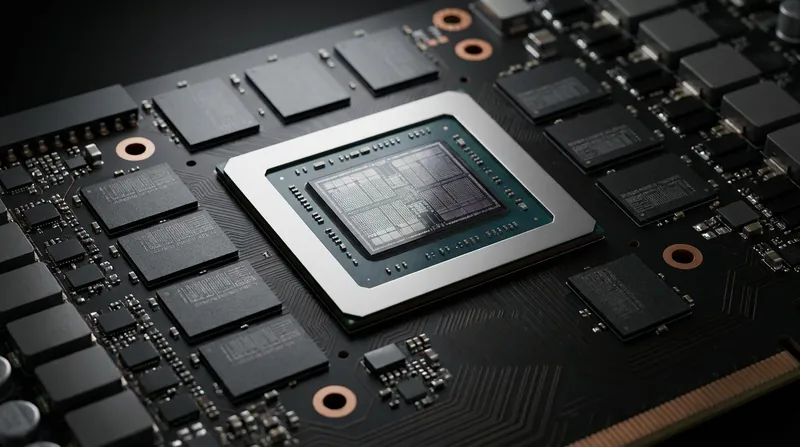
Despite the premium price, the hardware inside the Steam Machine is formidable for its size. The system is powered by a semi-custom AMD platform featuring a 6-core, 12-thread Zen 4 processor and an RDNA 3 graphics architecture with 28 compute units. It also includes 16GB of DDR5 memory and 8GB of dedicated GDDR6 video RAM, all packed into a thermal envelope of just 110 watts.[2][5]
In raw rasterization performance, the Steam Machine's graphical horsepower is roughly equivalent to a desktop Radeon RX 7600—a capable mid-range card. That is more than enough to run modern games at 1080p or 1440p resolutions. However, Valve is targeting the living room, which means the device needs to output a clean, playable image to 4K televisions.[5][6]
Bridging the gap between mid-range hardware and 4K resolution requires software magic. The first layer of that magic is SteamOS and its Proton compatibility layer, which translates Windows-exclusive DirectX commands into Vulkan instructions that Linux can understand. The second, and more crucial, layer is advanced image upscaling.[6]
To ensure the Steam Machine can hit 4K targets without sacrificing frame rates, Valve is working closely with AMD to integrate FidelityFX Super Resolution 4 (FSR 4). Recent updates to the Proton Experimental branch revealed that Valve is actively testing FSR 4.1 for SteamOS, paving the way for its inclusion on the new console.[3][6]
FSR 4 represents a major leap forward in upscaling technology. Unlike previous iterations, which relied on spatial and temporal algorithms, FSR 4 utilizes artificial intelligence and machine learning to reconstruct high-resolution images from lower-resolution inputs. This AI-driven approach significantly reduces the shimmering and visual artifacts that plagued older upscalers, producing an image that often rivals native 4K.[6]
Officially, AMD designed FSR 4 for its upcoming RDNA 4 graphics cards. However, the technology includes a fallback mode that uses INT8 (8-bit integer) calculations, allowing it to run on the RDNA 3 architecture found inside the Steam Machine. While this incurs a slight performance penalty compared to native RDNA 4 hardware, it provides a massive visual upgrade over FSR 3, ensuring the Steam Machine can punch above its weight class on large screens.[3][6]
Because Valve anticipates high demand despite the $1,049 price tag, and because component supplies remain severely constrained, the company is abandoning the traditional pre-order rush. Instead, Valve has instituted a randomized lottery system designed to thwart scalper bots and ensure a fairer distribution.[1]
Prospective buyers have until June 25 to register their interest on the Steam storefront. To qualify, users must have a Steam account in good standing with a purchase history dating back before April 2026. Once the window closes, Valve will randomize the list. Those selected will receive an email on June 29 with a 72-hour window to complete their purchase, while the rest will be placed on a waitlist that is expected to stretch into 2027.[1]
The Steam Machine is a bold, expensive experiment. It proves that Linux-based gaming can scale from the handheld Steam Deck to a high-fidelity living room console, backed by cutting-edge AI upscaling. But it also serves as a stark reminder of the new normal in consumer electronics: in an era where artificial intelligence dictates the supply chain, premium hardware will carry a truly premium price.[5][7]
Key points
- Valve's new Steam Machine starts at $1,049, significantly higher than initial industry estimates.
- A global shortage of DRAM and NAND memory, driven by AI data center demand, is responsible for the high component costs.
- The system utilizes a semi-custom AMD Zen 4 CPU and RDNA 3 GPU to deliver mid-range desktop performance in a compact form factor.
- Valve is integrating AMD's AI-powered FSR 4 upscaling technology to help the machine achieve 4K resolutions on living room televisions.
What we don’t know
- It remains unclear when the global memory shortage will ease enough for Valve to lower the Steam Machine's price.
- We do not yet know exactly how many units Valve has secured for the initial June 29 production run.
- The exact performance penalty of running FSR 4 on the Steam Machine's RDNA 3 architecture, rather than native RDNA 4, has not been independently benchmarked.
How we got here
Late 2025
Valve officially announces the Steam Machine living room PC.
Early 2026
Global DRAM and NAND memory prices surge due to AI data center demand.
April 2026
Sony raises PS5 prices globally, citing the same memory component costs.
June 22, 2026
Valve opens the randomized reservation lottery for the Steam Machine.
June 29, 2026
The first wave of Steam Machines begins shipping to customers.
- PC Gamers & Enthusiasts
- Excited by the hardware's capabilities but frustrated by the steep financial barrier to entry.
- Hardware Manufacturers
- Forced to abandon traditional pricing models to survive skyrocketing component costs.
- AI Infrastructure Sector
- Prioritizing massive memory procurement to build out next-generation data centers.
Perspectives this story doesn't cover
- Independent game developers
- Console competitors (Microsoft/Nintendo)
Sources
Source coverage
7 outlets
3 viewpoints surfaced







- [1]Ars TechnicaPC Gamers & Enthusiasts
Valve's Steam Machine ships June 29 for $1,049, but you probably won't be able to buy one yet
Read on Ars Technica → - [2]EngadgetPC Gamers & Enthusiasts
Valve's Steam Machine starts at $1,049 with 512GB storage and no controller
Read on Engadget → - [3]The VergeHardware Manufacturers
Valve is working with AMD to bring FSR 4 to the Steam Machine
Read on The Verge → - [4]BloombergHardware Manufacturers
Valve Prices Steam Machine Video Game Console Above $1,000, Citing Component Shortage
Read on Bloomberg → - [5]TechSpotPC Gamers & Enthusiasts
The living room gaming PC is finally here. Whether it's worth the price is a harder question.
Read on TechSpot → - [6]PCMagPC Gamers & Enthusiasts
Valve Testing AMD's FSR 4 Upscaling Ahead of Steam Machine Launch
Read on PCMag → - [7]WikipediaAI Infrastructure Sector
2025–present global memory supply shortage
Read on Wikipedia →
More in Technology
See all →Digital Ownership
Sony Sets 2028 End Date for Physical PlayStation Discs as Xbox Tests 'Disc-to-Digital' Conversion
3 sources

Hardware Emulation
Open-Source ZLUDA v6 Breaks NVIDIA Lock, Enabling 3x Performance Boost for PhysX Games on AMD Radeon
2 sources
Game Engines
Epic Games Unveils Unreal Engine 6, Bypassing UE5 for Rocket League's Next Era
2 sources

PC Hardware
NVIDIA Unveils RTX Spark, Its First ARM-Based 'Superchip' to Redefine Windows Gaming and AI PCs
3 sources

Comments
Every angle. Every day.
Get Technology stories with full source coverage and perspective breakdowns, free every day.