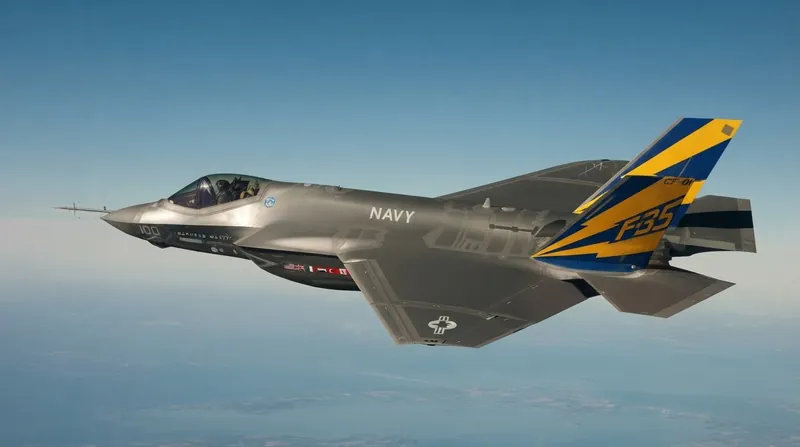
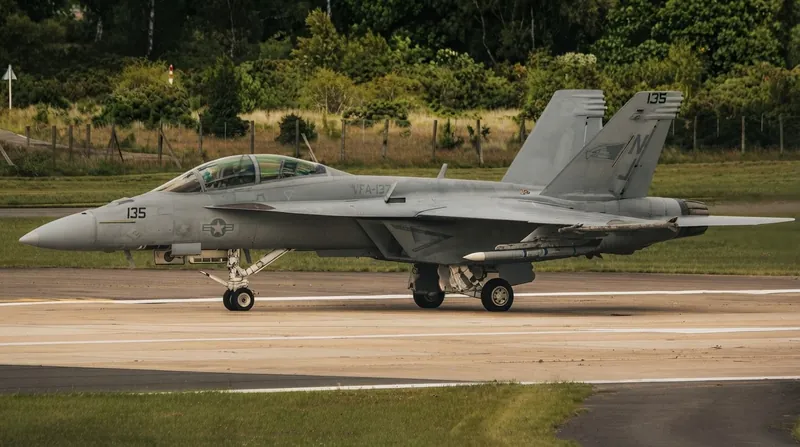
The US Navy plans to integrate uncrewed Collaborative Combat Aircraft into carrier air wings using existing F-35C fighters rather than waiting for the future F/A-XX.
Factlen Newsroom· Updated
Follow US Navy F/A-XX fighter program in the Factlen app and get an alert when there is news. Get the app
US Navy Decouples Collaborative Combat Aircraft Drone Program From Next-Generation F/A-XX Fighter
The US Navy plans to integrate uncrewed Collaborative Combat Aircraft into carrier air wings using existing F-35C fighters rather than waiting for the future F/A-XX. The strategic shift accelerates the deployment of robotic wingmen to the fleet.
The US Navy will decouple its Collaborative Combat Aircraft program from the future F/A-XX fighter.
The F-35C Lightning II will serve as the initial airborne controller for the new uncrewed systems.
The decision allows the Navy to field robotic wingmen years before the F/A-XX enters service in the 2030s.
The Navy issued a request for information for carrier-capable drone prototypes in September 2026.
The US Navy will not wait for its next-generation fighter to introduce robotic wingmen to the carrier fleet. The service plans to decouple its Collaborative Combat Aircraft program from the future F/A-XX, accelerating the deployment of uncrewed systems to the flight deck.[1][2]
William Toti, the official performing the duties of Under Secretary of the Navy, confirmed the strategic shift during a November 19, 2026, confirmation hearing before the Senate Armed Services Committee. He told lawmakers that the two aviation efforts are now structurally independent.[1][3]
"I think we could probably start integrating systems before F/A-XX delivers," Toti testified. The decision allows the Navy to field autonomous drones alongside existing fifth-generation aircraft, rather than tying their operational debut to a fighter that remains years away from its first flight.[1][2]
The F-35C Lightning II is now positioned to serve as the initial airborne controller for the Navy's drone fleet. Toti noted that while the capability to manage uncrewed assets will be built into the F/A-XX from the ground up, the F-35 will also receive the necessary integration.[1][3]
Shifting the Aviation Timeline
The decoupling resolves a major scheduling bottleneck for naval aviation planners. In September 2026, the Navy selected Boeing to build the F/A-XX, which is designed to replace the F/A-18 Super Hornet and EA-18G Growler in the 2030s.[1][3]
Tying the Collaborative Combat Aircraft to that timeline would have delayed the introduction of carrier-based drones by at least a decade. By severing the link, the Navy can begin testing and fielding uncrewed systems as soon as the technology and software mature.[1][2]
AI
William Toti, performing the duties of Under Secretary of the Navy, confirmed the strategic shift during a Senate Armed Services Committee confirmation hearing.
The urgency stems from a shifting strategic environment where mass and range dictate maritime survival. "We need low-cost attritable assets in our air wing, and CCA will provide that," Toti told the committee, emphasizing that drones offer a scalable way to project power.[1][3]
These uncrewed systems are designed to absorb the highest risks in contested airspace. By flying ahead of crewed fighters, Collaborative Combat Aircraft can act as forward sensors, jam enemy radar networks, or draw fire from advanced air defense systems.[1][2]
The Navy took a concrete step toward that goal in September 2026, issuing a prototype-focused request for information to the defense industry. The solicitation detailed specific requirements for carrier integration, signaling that the service is ready to move beyond conceptual designs.[1][2]
Carrier operations impose unique physical constraints on uncrewed aircraft that land-based drones do not face. A naval Collaborative Combat Aircraft must withstand the violent forces of catapult launches and arrested recoveries while navigating the congested, high-tempo airspace around a moving flight deck.[1][2]
Following the Air Force Lead
While the Navy accelerates its timeline, it acknowledges that it is trailing its sister service. The US Air Force has spent several years developing its own Collaborative Combat Aircraft program, aiming to pair drones with its Next-Generation Air Dominance fighter and existing F-22s.[1][2]
"The Air Force has been leading this issue," Toti conceded during the hearing. "We are following closely behind, but the integration of CCA aircraft in the air wing is critically important as we go forward."[1][2]
Decoupling the programs allows the Navy to field uncrewed systems years before the sixth-generation fighter enters service.
The Air Force achieved a major milestone in October 2026 when it tested two Collaborative Combat Aircraft in live air combat maneuvers. The Navy is closely monitoring those software and autonomy developments, hoping to leverage shared architectures where possible.[1][2]
Defense contractors are increasingly treating drone autonomy as a software layer that can be decoupled from the physical airframe. This modular approach allows the military to update the artificial intelligence governing the drones without overhauling the aircraft itself.[1][2]
The F-35C will require substantial software block upgrades to act as a "quarterback" for these autonomous systems. Pilots will need intuitive interfaces to direct multiple drones in combat without becoming overwhelmed by sensor data while flying their own aircraft.[1][3]
Budget Pressures and the F/A-XX
The decision to push CCAs forward independently also provides a hedge against fiscal uncertainty. The incoming Trump administration's 2027 budget request offered only minimal financial support for the F/A-XX program, raising questions about its development pace.[1][2]
Despite the budget friction, Toti strongly defended the necessity of the sixth-generation fighter. He pushed back against any suggestion that the F-35C could serve as the final crewed aircraft developed for carrier operations, calling the idea a non-starter.[1][3]
"Having said that, F/A-XX is a critical capability," Toti testified. "We're going to have these aircraft carriers around for the next 50 years, and the notion that the F-35 is the last airplane that's going to be launched from them is just a non-starter."[1][3]
AI
Illustration: Carrier operations impose unique physical constraints on uncrewed aircraft, requiring robust designs capable of withstanding catapult launches.
The Navy envisions the F/A-XX as a larger, longer-ranged platform than the F-35C, optimized for the vast distances of the Indo-Pacific. It will carry heavier payloads and serve as the central node in a distributed network of crewed and uncrewed systems.[1][2]
The sheer physical size of the F/A-XX is expected to accommodate larger power generation systems, which are necessary for fielding directed energy weapons. Lasers and high-power microwave systems require immense electrical output that current fighters struggle to provide.[1][2]
Until that aircraft arrives, the burden of network-centric warfare will fall heavily on the F-35C and the E-2D Advanced Hawkeye. These existing platforms must bridge the gap, extending the sensor reach of the carrier strike group through manned-unmanned teaming.[1][2]
The Industrial Base Challenge
Accelerating the Collaborative Combat Aircraft program introduces new demands on a defense industrial base that is already struggling with capacity. Building hundreds of attritable drones requires high-rate manufacturing techniques more common in the automotive sector than in traditional aerospace.[1][2]
The Navy's September 2026 request for information specifically targeted prototype development, indicating a desire to move quickly into low-rate initial production. The service wants to avoid the decades-long development cycles that have characterized recent crewed fighter programs.[1][2]
To achieve this, the Navy may look beyond traditional prime contractors. The Air Force has already awarded initial CCA production contracts to a mix of established aerospace giants and newer defense technology firms, establishing a precedent for a diversified supply chain.[1][2]
Future carrier deployments are expected to rely heavily on uncrewed systems to provide combat mass.
The integration of these drones will fundamentally alter the composition of the carrier air wing. Future deployments will likely feature fewer crewed fighters and a larger complement of uncrewed systems, changing how the Navy manages deck space, maintenance, and aviation fuel.[1][3]
For now, the immediate focus remains on proving the concept. The Navy must demonstrate that a drone can safely launch from a carrier, execute a complex tactical mission under the control of an airborne F-35C, and return to the ship.[1][2]
By severing the drone program from the F/A-XX timeline, the Navy has set a ticking clock for its aviation community. The service must now deliver on the promise of manned-unmanned teaming using the fleet it has today, rather than the fleet it hopes to build tomorrow.[1][2]
Sources
[1]The War Zone (TWZ) — Navy CCA Plans Will Not Wait For F/A-XX Next Generation FighterRead on The War Zone (TWZ) →
[2]The Defense Log — Navy nominee Toti says CCA drones need not wait for F/A-XX fighterRead on The Defense Log →
[3]MiGFlug — Navy CCA Drones Won't Wait for F/A-XX, Toti Tells SenatorsRead on MiGFlug →
What to watch
The F/A-XX platform will replace the aging F/A-18 Super Hornet fleet in the 2030s.
In 2025, Boeing won the US Air Force's F-47 contract. The US Navy was also seeking a next-generation carrier-based fighter to project power in contested airspace.
In September, the Navy issued a request for information for carrier-capable drone prototypes.
On October 3, the Navy selected Boeing to develop the F/A-XX sixth-generation strike fighter, awarding a $20 billion contract for the aircraft's full-scale development. The platform is designed to operate alongside unmanned drones.
The victory gave Boeing an effective monopoly on future American crewed fighters and cemented the company's dominance over the future air combat fleet. Production of the new aircraft will be centered at Boeing's newly expanded 1.1 million-square-foot manufacturing facility in St. Louis.