
The Mechanism of the Hall-Effect Thruster: How an Electric Field and a Magnetic Field Accelerate Xenon Ions to 40,000 m/s
By trapping electrons in a magnetic field to prevent electrical short-circuits, Hall-effect thrusters efficiently ionize and accelerate noble gases to extreme velocities. The technology trades immediate thrust for long-term fuel efficiency, making it the default engine for modern satellite constellations.
By Lila Morgan

- Commercial Satellite Operators
- Prioritize propellant cost and availability over absolute thrust efficiency.
- Deep Space Exploration Planners
- Focus on scaling Hall thrusters to the 100-kilowatt range for heavy transport.
- Plasma Physicists
- Investigate the unresolved anomalies in electron transport across the magnetic field.
Perspectives this story doesn't cover
- Chemical Propulsion Manufacturers
- Spacecraft Thermal Engineers
At a glance
- Hall-effect thrusters use a radial magnetic field to trap electrons in a circular drift, preventing them from short-circuiting the engine's electric field.
- These trapped electrons collide with injected noble gases like xenon or argon, stripping away electrons to create positively charged ions.
- An axial electric field then accelerates the heavy ions out of the engine at speeds up to 80,000 meters per second, generating continuous thrust.
- While they produce very low immediate thrust, their extreme specific impulse makes them highly efficient for long-duration satellite station-keeping and deep-space missions.
- Mega-constellation operators are increasingly switching from expensive xenon to cheaper argon, accepting a kinetic efficiency penalty to reduce fueling costs.
For an electric field to accelerate a spacecraft, a fundamental constraint must be overcome: you cannot simply apply a massive voltage across a gas. If you do, the lightweight electrons will instantly rush to the positive anode, short-circuiting the electrical system before the heavy propellant ions even begin to move. The condition that has to hold for electric propulsion to work is that the electrons must be trapped—held in place to maintain the electric field and ionize the gas—while the heavy ions are allowed to escape. In a Hall-effect thruster, this constraint is solved by a radial magnetic field that locks electrons into an endless circular drift. It is a delicate plasma balancing act, and it currently holds true on thousands of satellites in low Earth orbit.[3][4]
Marketing language from aerospace startups often describes Hall thrusters as engines that run on pure electricity, implying a clean, limitless push through the cosmos. The shipped reality is far more constrained. A Hall thruster is an electrostatic accelerator that trades immediate power for extreme fuel efficiency. As noted in a 2026 review by Orbital Radar, "Their limitation is time: manoeuvres that a chemical engine completes in minutes take a Hall thruster weeks of continuous, gentle thrusting." They produce a continuous push of just 20 to 600 millinewtons—roughly the weight of a few coins resting in your hand.[1][3]
But what they lack in brute force, they make up for in specific impulse, the metric of propellant efficiency. While the best chemical rockets achieve a specific impulse of about 450 seconds, a standard Hall thruster reaches 1,500 to 3,000 seconds. This means that for every kilogram of propellant carried into orbit, the thruster can perform several times more work. This efficiency has made them the default engine of the mega-constellation era, actively flying on SpaceX's Starlink network and geostationary communications satellites built by manufacturers like SSL.[1][3]
The mechanism begins inside an annular, ring-shaped channel, typically lined with a ceramic like boron nitride. At the back of this channel sits the anode, a positive electrode that also serves as the distributor for the propellant gas. The propellant is almost always a noble gas—historically xenon, though krypton and argon are increasingly used to cut costs. Outside the channel sits the cathode, a component that emits a steady stream of electrons.[1][4]
When an electric potential of 150 to 800 volts is applied between the anode and the cathode, the electrons are drawn strongly toward the positive anode at the back of the channel. If only the electric field were present, the thruster would immediately short out. To prevent this, electromagnets generate a radial magnetic field of about 100 to 300 Gauss (10 to 30 millitesla) across the open end of the channel.[3]
This magnetic field is the defining feature of the engine. When the electrons attempt to cross the magnetic field lines to reach the anode, the Lorentz force deflects them sideways. The combination of the axial electric field and the radial magnetic field forces the electrons to drift in an azimuthal direction—meaning they fly in a continuous circle around the annular channel. This rotating cloud of trapped electrons is known as the Hall current, named after the American physicist Edwin Hall who discovered the underlying effect in 1879.[3][4]
"The basic idea of Hall thrusters consists in generating a large local electric field in a plasma by using a transverse magnetic field to reduce the electron conductivity," explained a 2017 paper published by the American Institute of Physics. By trapping the electrons, the thruster creates a dense, high-energy barrier that the incoming neutral xenon atoms must pass through.[4]
By trapping the electrons, the thruster creates a dense, high-energy barrier that the incoming neutral xenon atoms must pass through.
As the neutral xenon gas diffuses forward from the anode, it collides with the circulating high-energy electrons, which typically carry 10 to 40 electron-volts of energy. These collisions knock electrons off the xenon atoms, ionizing them into positively charged xenon ions. Because the electrons are trapped, the plasma remains quasi-neutral, allowing the thruster to maintain a strong electric field without being limited by the space-charge effects that constrain other types of ion engines.[3][4]
Once ionized, the xenon ions experience the full force of the 150 to 800-volt electric field. Here, the massive difference in weight between an electron and a xenon ion becomes critical. The radial magnetic field is strong enough to trap the lightweight electrons, but the xenon ions are roughly 240,000 times heavier. Their gyroradius—the radius of their circular path in the magnetic field—is so large that they are practically unaffected by the magnets.[3]
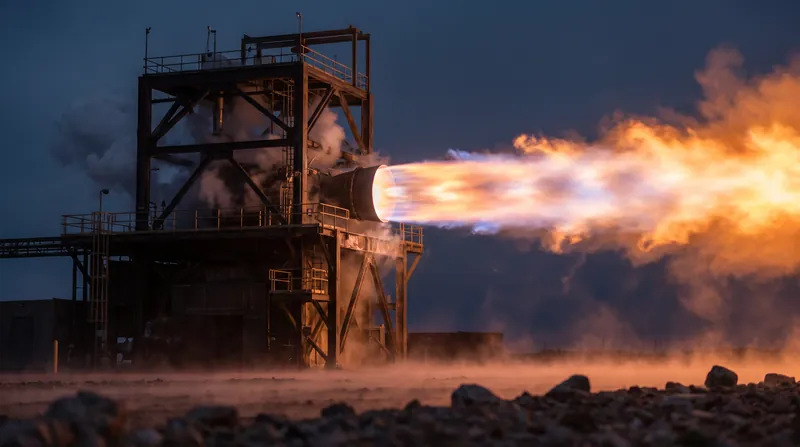
Unimpeded by the magnetic trap, the positive xenon ions are violently accelerated outward by the electric field. They shoot out of the thruster channel at exhaust velocities ranging from 15 to 80 kilometers per second (15,000 to 80,000 meters per second). This high-speed exhaust is what generates the forward thrust, pushing the spacecraft in the opposite direction according to Newton's third law.[3]
However, accelerating the ions out of the engine is only half the job. If the positively charged ions simply left the spacecraft, the vehicle would quickly build up a massive negative static charge. Within milliseconds, that negative charge would grow strong enough to pull the positive exhaust plume right back into the engine, killing the thrust entirely. To prevent this, the external cathode serves a second purpose: it spits a continuous stream of electrons directly into the exiting ion plume, neutralizing the exhaust and allowing it to drift away into space.[3]
While the physics of the Hall current are elegant, the engineering is bound by strict propellant economics. Xenon has long been the gold standard because it is heavy, easy to store, and has a low ionization energy. But xenon is exceedingly rare and expensive. As satellite constellations scale to thousands of units, operators like SpaceX have shifted to krypton and, more recently, argon.[1]
This shift to lighter gases exposes a severe kinetic penalty. In a 2023 study published in Acta Astronautica, researchers tested a 5-kilowatt laboratory Hall thruster on xenon, argon, and molecular nitrogen at a constant mass flow rate of 5.0 to 5.4 milligrams per second. The data reveals the trade-off: while argon achieved a higher specific impulse (up to 2,280 seconds compared to xenon's 1,770 seconds), its anode thrust efficiency dropped from nearly 40% down to 29%.[2]
The efficiency collapse is even more dramatic with molecular propellants. When the thruster was run on nitrogen, the thrust efficiency plummeted to under 17%. The electric field's energy, rather than being used purely to accelerate ions, was wasted on breaking the molecular bonds of the nitrogen gas and exciting its internal energy modes. This is why the industry remains tethered to atomic noble gases, despite their cost.[2]
Scaling these engines presents another hard physical limit. You cannot simply shrink a Hall thruster for a tiny CubeSat or enlarge it indefinitely for a Mars transport. A 2007 Massachusetts Institute of Technology thesis on miniaturized Hall thrusters found that "the inability to maintain geometric similarity was a result of the inherent challenges of maintaining magnetic field shape and strength at small scale." If the channel is too narrow, the ions crash into the boron nitride walls before escaping, eroding the ceramic and destroying the engine.[6]
Conversely, scaling up to the 100-kilowatt power levels required for crewed deep-space missions requires managing massive thermal loads. As a 1999 NASA technical memorandum noted, another potential limit to the maximum discharge current is Joule heating of the anode caused by the back-streaming of electrons, which requires up to 20% of the input power to be actively radiated away.[5]
Despite these constraints, the Hall-effect thruster remains one of the most successful electric propulsion architectures ever flown. From its first flight demonstration on a Soviet satellite in 1971, to propelling NASA's Deep Space 1 probe in 1998, to maintaining the orbits of modern broadband mega-constellations, the technology has proven its durability. It is not a warp drive, and it will never launch a rocket from the surface of the Earth. But in the vacuum of orbit, the continuous acceleration of xenon ions at 40,000 meters per second is exactly what the industry requires.[3]
Terms to know
- Specific Impulse (Isp)
- A measure of how efficiently a rocket uses propellant, expressed in seconds; higher numbers mean more momentum is generated per kilogram of fuel.
- Hall Effect
- The production of a voltage difference across an electrical conductor, transverse to an electric current and to an applied magnetic field perpendicular to the current.
- Gyroradius
- The radius of the circular path a charged particle follows when moving through a uniform magnetic field.
- Quasi-neutral Plasma
- A gas of charged particles where the number of positive ions and negative electrons are roughly equal, resulting in no significant overall electrical charge.
- Anode Thrust Efficiency
- The percentage of the electrical power supplied to the thruster's anode that is successfully converted into the kinetic energy of the directed exhaust beam.
Questions readers ask
Why don't Hall thrusters use normal rocket fuel?
Chemical rockets burn fuel to create expanding gas, which provides high thrust but uses mass very inefficiently. Hall thrusters use electricity to accelerate individual ions to extreme speeds, using far less mass to achieve the same total momentum over time.
Can a Hall thruster launch a spacecraft from Earth?
No. A typical Hall thruster produces less than one Newton of thrust—roughly the weight of a smartphone. They cannot overcome Earth's gravity and only function in the vacuum of space, where even tiny forces gradually build up massive speeds.
What happens if the neutralizer cathode fails?
If the cathode stops injecting electrons into the exhaust plume, the spacecraft will rapidly accumulate a negative static charge. This charge would pull the positively charged exhaust ions back into the engine, completely neutralizing the thrust.
Why is the magnetic field necessary?
Without the magnetic field, the lightweight electrons would immediately fly to the positive anode, short-circuiting the electrical system. The magnetic field traps them in a circular drift, creating a barrier that ionizes the propellant.
Sources
Source coverage
7 outlets
3 viewpoints surfaced







- [1]Orbital RadarCommercial Satellite Operators
Hall-Effect Thruster
Read on Orbital Radar → - [2]Acta Astronautica
Efficiency Model for a Hall Effect Thruster with Several Gaseous Propellants
Read on Acta Astronautica → - [3]Wikipedia
Hall-effect thruster
Read on Wikipedia → - [4]American Institute of PhysicsPlasma Physicists
Physics of Hall thrusters
Read on American Institute of Physics → - [5]NASADeep Space Exploration Planners
High Power Hall Thrusters
Read on NASA → - [6]Massachusetts Institute of TechnologyPlasma Physicists
Miniature Hall Thrusters
Read on Massachusetts Institute of Technology → - [7]Factlen Editorial Team
Synthesis by Factlen editorial team
Read on Factlen Editorial Team →
Comments
More in Technology
See all →Video DRM
Why Downloading a YouTube Video Violates Google's Contract, but Not Necessarily Copyright Law
7 sources

Humanoid Robotics
Why the Humanoid Robotics Industry is Mass-Producing Hardware Before the Software is Ready
7 sources

OLED Technology
The Mechanism of OLED Displays: Why Dark Pixels Save Power but Accelerate Burn-In
7 sources
Software Licensing
The Viral Clause: Why the GPL Requires Derivative Works to Be Open Source, but the MIT License Does Not
8 sources

Every angle. Every day.
Get Technology stories with full source coverage and perspective breakdowns delivered to your inbox.