
Warwick Researchers Synthesize Magnetoelectric Material That Operates Near Room Temperature
A new form of strontium manganite allows magnetic states to be switched with an electric field at nearly room temperature, demonstrating a mechanism that could eventually reduce the power consumption of computer memory.

Share this story
In short
- Researchers have synthesized a strontium manganite crystal that exhibits magnetoelectric coupling near room temperature.
- The material allows magnetic states to be switched using an electric field, which could drastically lower the power consumption of computer memory.
- The breakthrough relies on a coordinated tilt of atom pairs that generates an electrical charge without disrupting magnetic stability.
A newly synthesized crystalline material allows magnetic data states to be flipped using a simple electric field at 280 Kelvin (roughly 7 degrees Celsius), removing the need for the continuous electrical currents that currently drive global computing power consumption.[1]
The discovery, published on August 27, 2026, in the Journal of the American Chemical Society by researchers at the University of Warwick, solves a fundamental bottleneck in materials science. "Systematic strategies to design properties such as ferroelectricity or magnetoelectric coupling are well-established in simple perovskite materials, but they remain scarce in more complex framework structures," wrote lead author Dr. Struan Simpson and his team. Materials that exhibit both magnetism and electrical polarization—known as magnetoelectrics—typically only maintain those coupled properties at cryogenic temperatures near absolute zero.[1]
By engineering a specific structural flaw into a four-layer hexagonal (4H) polytype of strontium manganite, the research team pushed that operating window up to near room temperature. While not yet a commercial memory chip, the bulk crystal demonstrates that energy-efficient magnetic switching is physically possible outside of a deep freeze.[1]
The mechanism relies on a geometric quirk called a rigid-unit mode, or RUM. In standard materials, magnetism and electrical charge are generated by entirely different atomic behaviors, making them difficult to link without the two properties interfering with one another.[1]
The Warwick team bypassed this limitation by focusing on the ternary manganite AMnO3 family, specifically substituting barium, strontium, or calcium into the lattice. Within this specific crystal architecture, pairs of atoms—specifically Mn2O9 bioctahedral dimers—are forced to tilt together in a coordinated, inversion-breaking shift.[1][2]
This tiny, cooperative tilt does two things simultaneously: it generates a spontaneous electrical charge across the material, and it induces a weak, switchable ferromagnetic moment.[1][2]
Because the electrical charge is a direct result of the physical tilt rather than being locked to the magnetic state itself, the two properties remain independently stable as the material warms up. High-resolution diffraction and magnetic susceptibility measurements confirmed that the structural and magnetic orders persist up to 450 Kelvin and 280 Kelvin, respectively.[1][2]
The public framing surrounding the discovery, which first appeared as a preprint on June 5, 2026, positions it as an immediate solution for greener computer memory. This narrative is driven by the fact that artificial intelligence data centers are placing unprecedented demands on global power grids.[2][3]
The reality of semiconductor manufacturing is significantly more constrained. What the Warwick team shipped is a bulk perovskite crystal synthesized in a laboratory, not a thin-film transistor ready for integration into standard silicon foundry processes.[1][3]
Commercial memory architectures require materials that can be deposited in layers only a few nanometers thick, etched with extreme precision, and cycled billions of times without degrading. A bulk crystal proves the physics, but it does not immediately yield a manufacturable device.[3]
Furthermore, while 7 degrees Celsius is a massive leap from the cryogenic temperatures previously required, it still falls short of the ambient operating temperatures inside a commercial server chassis, which require stability well above standard room temperature.[3]
The true value of the discovery lies in its transferable, symmetry-based blueprint. By proving that coordinated atomic tilts can engineer magnetoelectric coupling in complex framework structures, researchers now have a mathematical model to search for other compounds that might push the temperature threshold even higher.[1][2]
Terms to know
- Magnetoelectric coupling
- The rare ability of a material to link its magnetic and electrical properties, allowing one to be controlled by the other.
- Perovskite polytype
- A specific family of crystal structures characterized by a repeating geometric arrangement of atoms, often used in advanced materials research.
- Rigid-unit mode (RUM)
- A type of structural distortion in a crystal where entire geometric units of atoms tilt or rotate together without deforming their internal bonds.
- Spontaneous polarization
- The natural separation of positive and negative electrical charges within a material, creating a built-in electric field.
- Ferromagnetic moment
- The measure of a material's overall magnetic strength and direction, similar to the permanent magnetism found in a standard refrigerator magnet.
Questions readers ask
What is a magnetoelectric material?
It is a rare type of material that exhibits both magnetism and electrical polarization simultaneously, allowing its magnetic state to be altered using an electric field.
Why is this discovery important for computer memory?
Current magnetic memory requires continuous electrical currents to write data, which generates heat and consumes massive amounts of power. Magnetoelectrics could allow data to be written with a simple voltage pulse, drastically reducing energy use.
Is this material ready to be used in computers?
No. The material was synthesized as a bulk crystal in a laboratory and currently only operates up to 7 degrees Celsius, which is too cold for commercial server environments.
What exactly did the researchers change in the material?
They utilized a specific crystal structure where pairs of atoms tilt together in a coordinated way, generating an electrical charge without disrupting the material's magnetic stability.
Different angles
The Materials Science View
A focus on symmetry-guided design and structural instability.
For materials scientists, the breakthrough is not the specific strontium manganite crystal itself, but the mathematical blueprint it provides. By demonstrating that an inversion-breaking rigid-unit mode (RUM) can induce both polar and ferromagnetic orders, researchers now have a proven mechanism to search for other compounds. This shifts the field away from simple perovskite motifs and opens up a vast library of complex framework structures that were previously ignored.
The Hardware Engineering Reality
The practical hurdles of commercializing bulk crystal discoveries.
While the physics community celebrates the 280 Kelvin threshold, hardware engineers view the discovery through the lens of semiconductor manufacturing. Commercial memory requires materials that can be deposited in ultra-thin films, patterned at the nanometer scale, and integrated into existing silicon foundries without introducing contamination. Furthermore, a material that loses its magnetic stability at 7 degrees Celsius cannot survive the ambient heat of a modern data center, meaning years of chemical tuning lie ahead before this mechanism yields a viable product.
- Fundamental Researchers
- Focuses on the symmetry-guided design principles and the expansion of magnetoelectric coupling into new crystal structures.
- Hardware Engineering Realists
- Emphasizes the massive engineering gap between synthesizing a bulk crystal in a lab and manufacturing a scalable, durable memory chip.
Perspectives this story doesn't cover
- Silicon foundry operators
- Data center energy managers
Sources
Source coverage
3 outlets
2 viewpoints surfaced



- [1]Journal of the American Chemical SocietyFundamental Researchers
Near-Room-Temperature Magnetoelectric Coupling Engineered through Inversion-Breaking Tilts in a Bulk Perovskite Polytype
Read on Journal of the American Chemical Society → - [2]arXivFundamental Researchers
Near-room-temperature magnetoelectric coupling engineered through inversion-breaking tilts in a bulk perovskite polytype
Read on arXiv → - [3]Factlen Editorial TeamHardware Engineering Realists
Synthesis by Factlen editorial team
Read on Factlen Editorial Team →

More in Technology
See all →Acoustic Quantum Tech
Stanford Physicists Observe Real-Time Quantum Jumps of Sound, Unlocking Acoustic Error Correction
3 sources
Electric Propulsion
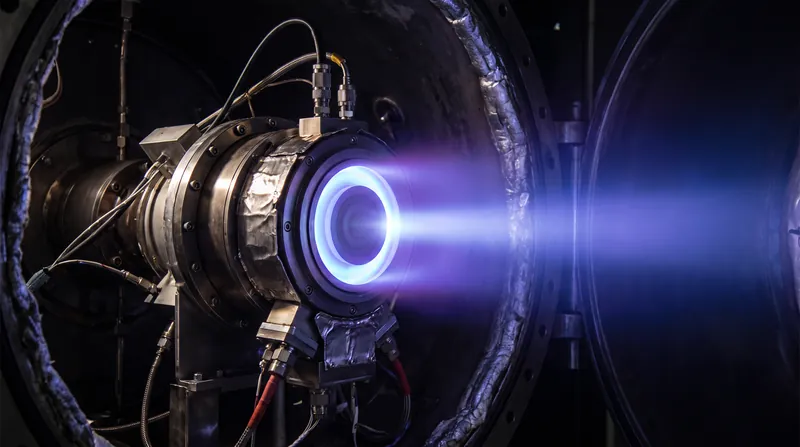
The Mechanism of the Hall-Effect Thruster: How an Electric Field and a Magnetic Field Accelerate Xenon Ions to 40,000 m/s
7 sources
Brain-Computer Interfaces
Why High-Resolution Brain-Computer Interfaces Require Invasive Surgery
8 sources
Battery Tech
Why Solid-State Batteries Short-Circuit, and How Mechanical Stress and Interlayers Stop Lithium Dendrites
6 sources
Comments
Every angle. Every day.
Get Technology stories with full source coverage and perspective breakdowns, free every day.