
The 5 Feet 8 Inches and 7 Feet 9 1/4 Inches: The Official Height and Throwing Distance of a Standard Dartboard
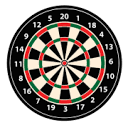
The global standard for steel-tip darts requires the board's bullseye to sit exactly 5 feet 8 inches from the floor, with the throwing line positioned 7 feet 9 1/4 inches away. These precise measurements, governed by the World Darts Federation, ensure competitive consistency from local pubs to the professional stage.

- Professional Sanctioning Bodies
- Organizations like the WDF and PDC that enforce strict standardization to ensure fair competition globally.
- Equipment Manufacturers
- Companies engineering hardware and mounting brackets that make achieving exact measurements foolproof.
- Soft-Tip Regulators
- Leagues utilizing electronic boards that adapt the throwing distance to 8 feet to account for lighter darts.
Perspectives this story doesn't cover
- Amateur Pub Leagues
- Venue Owners
Key terms
- Oche
- The raised throwing line that a player stands behind, which must be at least 1.5 inches high in professional play.
- Bullseye
- The exact center of the dartboard, consisting of an outer ring worth 25 points and an inner circle worth 50 points.
- Sisal
- The stiff natural fiber used to construct high-quality bristle dartboards, allowing the holes created by darts to self-heal.
- Hypotenuse
- The diagonal measurement of 9 feet 7 1/2 inches from the bullseye to the oche, used to verify setup accuracy.
- Spider
- The metal wire web that divides the dartboard into its specific scoring segments.
Key points
- The official height of a standard dartboard is 5 feet 8 inches (1.73 meters) from the floor to the center of the bullseye.
- The throwing distance is exactly 7 feet 9 1/4 inches (2.37 meters), measured from the front face of the board to the oche.
- To verify a setup on uneven floors, officials use a diagonal measurement of 9 feet 7 1/2 inches (2.93 meters).
- Soft-tip electronic darts utilize the same height but extend the throwing distance to an even 8 feet (2.44 meters).
When a Professional Darts Corporation referee measures the stage at a major televised event, they pull a steel tape from the exact center of the bullseye to the floor, looking for a single, non-negotiable number: 5 feet 8 inches. That 1.73-meter vertical drop is the foundational axis of the sport. From that center point, a second measurement extends outward across the floor to the raised throwing line, known as the oche, which must sit precisely 7 feet 9 1/4 inches (2.37 meters) away.[2]
These two dimensions dictate every physical action in steel-tip darts. A player throwing a 23-gram tungsten barrel at the treble 20 bed—a target just 8 millimeters wide—relies entirely on repeatable muscle memory. If the board is hung a half-inch too low, or the oche creeps an inch too close, the parabolic arc of the throw shatters.[1]
The World Darts Federation (WDF) codified these exact specifications to unify a game that once varied wildly from pub to pub across the United Kingdom. Before standardization, local leagues often played to whatever distance fit the room. Today, the WDF rulebook leaves zero room for interpretation, mandating these figures for all sanctioned steel-tip competitions globally.[1]
The vertical measurement of 5 feet 8 inches is taken from the floor directly beneath the board to the absolute center of the bullseye. According to the official World Darts Federation playing rules, "The perpendicular height from the floor to the centre of the Bullseye shall be 1.73 metres." While player heights vary drastically today, this standard forces taller players to throw slightly downward and shorter players to elevate their trajectory.[1]
Securing that height requires specific hardware. Modern bristle dartboards utilize a central screw on the back of the board that slots into a U-shaped wall bracket. This design ensures the screw aligns perfectly with the bullseye, making the 5-foot-8 measurement straightforward to execute during installation.[6]
The horizontal distance—7 feet 9 1/4 inches—is measured from the face of the dartboard, not the wall it hangs on. This is a critical distinction that frequently ruins amateur setups. Because a standard bristle board is roughly 1.5 inches thick, measuring from the wall places the oche an inch and a half too far away.[3]
To ensure absolute accuracy, tournament officials drop a plumb line from the face of the board to the floor. The 7 feet 9 1/4 inches is then measured from that exact point on the floor out to the back edge of the raised oche. A player may lean over the oche, but their front foot cannot touch the floor beyond that 2.37-meter line.[4]
The origin of the 7-foot-9 1/4-inch distance is a product of historical compromise. In the early days of the sport, the throwing line was often marked by three wooden beer crates lined up end-to-end, which roughly equaled 9 feet. As the game formalized, various leagues used distances ranging from 7 feet 6 inches to 8 feet.[7]
In the 1970s, as darts transitioned into a televised sport, the British Darts Organisation sought a universal standard. They settled on 7 feet 9 1/4 inches, a measurement that provided enough distance to require genuine skill while remaining accessible for amateur pub play. This distance was subsequently adopted by the WDF and the PDC, cementing it as the global standard.[8]
In the 1970s, as darts transitioned into a televised sport, the British Darts Organisation sought a universal standard.
For players setting up a board at home, verifying these two measurements can be challenging on uneven floors. To solve this, the sport relies on a third, derived measurement: the diagonal hypotenuse. By applying the Pythagorean theorem to the 5-foot-8 height and the 7-foot-9 1/4 distance, officials calculate a diagonal line from the center of the bullseye to the throwing line.[5]
That diagonal measurement is exactly 9 feet 7 1/2 inches (2.93 meters). If a player pins a measuring tape to the center of the bullseye and pulls it down to the oche, and it reads 9 feet 7 1/2 inches, the setup is mathematically perfect, regardless of baseboard thickness or slight floor variations.[3]
The physical oche itself is also subject to strict regulation in professional play. The PDC requires the raised throwing line to be at least 1.5 inches (38 millimeters) high and 24 inches (610 millimeters) long. This physical barrier prevents players from accidentally inching forward during the high-pressure moments of a match.[2]
In soft-tip darts, which utilizes electronic boards and plastic-tipped projectiles, the dimensions shift slightly. While the height remains 5 feet 8 inches, the throwing distance is universally extended to exactly 8 feet (2.44 meters). This 2.75-inch difference accounts for the lighter weight of soft-tip darts and the larger scoring segments on electronic boards.[8]
The lighting surrounding the board also plays a crucial role in maintaining the integrity of the setup. Professional stages utilize 360-degree LED lighting rings, which eliminate all shadows on the board. If a shadow obscures the wire separating the treble 20 from the single 20, the precise measurements of the board become irrelevant.[6]
The dartboard itself must meet rigid dimensional standards. A regulation WDF bristle board has an overall diameter of 17.75 inches (451 millimeters). The inner bullseye measures exactly 12.7 millimeters across, while the outer bullseye spans 31.8 millimeters.[1]
The treble and double rings, the primary targets for professional scorers, are incredibly narrow. The inside width of these beds is exactly 8 millimeters. Hitting a target that small from nearly eight feet away requires a mechanical, repeatable throwing motion that relies entirely on the board being in the exact same position every single time.[5]
When a professional steps to the oche, they are not aiming at the board; they are aiming at a specific point in space that they have thrown at hundreds of thousands of times. The 5-foot-8 height and 7-foot-9 1/4 distance are the invisible scaffolding that holds the entire sport together.[7]
If a venue fails to meet these standards, the consequences are immediate. In 2024, a regional qualifying event was delayed by two hours because a laser measurement revealed the oches were positioned at 7 feet 8 inches—a mere 1.25 inches too close. The tournament director ordered every board to be re-measured and re-mounted before a single dart was thrown.[4]
This obsession with millimeter-perfect accuracy is what separates professional darts from a casual pub game. The equipment is simple—a sisal board, three tungsten darts, and a raised line on the floor—but the geometry governing them is absolute.[3]
The 5 feet 8 inches and 7 feet 9 1/4 inches represent a strict contract between the sport and the player. As long as those two numbers remain constant, the environment is neutralized. The next time a world championship final comes down to a single dart at double 12, the player knows the target sits exactly where it always has, leaving the outcome entirely dependent on the mechanics of their own arm.[1]
Sources
Source coverage
9 outlets
3 viewpoints surfaced








- [1]Inishowen Mens DartsProfessional Sanctioning Bodies
PLAYING RULES, WORLD DARTS FEDERATION
Read on Inishowen Mens Darts → - [2]PDC EuropeProfessional Sanctioning Bodies
Rules
Read on PDC Europe → - [3]Darts-Oche
Dartboard Setup
Read on Darts-Oche → - [4]Playing Darts
Dartboard Height and Distance Measurements
Read on Playing Darts → - [5]BoxesGenEquipment Manufacturers
Dart Board Dimensions
Read on BoxesGen → - [6]Net World SportsEquipment Manufacturers
Dartboard Information Guide
Read on Net World Sports → - [7]Red Dragon DartsEquipment Manufacturers
Darts Info
Read on Red Dragon Darts → - [8]Darting.comSoft-Tip Regulators
Dart Board Regulations
Read on Darting.com → - [9]Factlen Editorial Team
Synthesis by Factlen editorial team
Read on Factlen Editorial Team →
Comments

More in Sports
See all →Sailing Tactics
The Boat Speed × Cosine Formula: How Sailors Calculate Velocity Made Good
8 sources
Biathlon Mechanics
The 45mm and 115mm Target Diameters and the 150-Meter Penalty Loop in Biathlon
6 sources
FIDE Governance
FIDE Presidential Election Proceeds in Samarkand Amid Delegate Visa Crisis and Cease-and-Desist Dispute
6 sources

Standings
Grant Fisher Surges in Diamond League 5000m Standings With Thrilling Paris Victory as Andreas Almgren Takes Overall Lead
3 sources

Every angle. Every day.
Get Sports stories with full source coverage and perspective breakdowns delivered to your inbox.