
Stanford Researchers Achieve Quantum Entanglement at Room Temperature Using Twisted Light
A new nanoscale optical device bypasses the need for cryogenic cooling, linking the quantum properties of light and electrons at ambient temperatures. The breakthrough removes a major barrier to building scalable, unhackable quantum communication networks.
By Tariq Nasser

Share this story
In short
- Stanford researchers achieved quantum entanglement at room temperature, bypassing the need for cryogenic cooling.
- The device uses a silicon chip and molybdenum diselenide to manipulate 'twisted light'.
- The twisted light transfers orbital angular momentum to electrons, creating stable entanglement before thermal noise disrupts it.
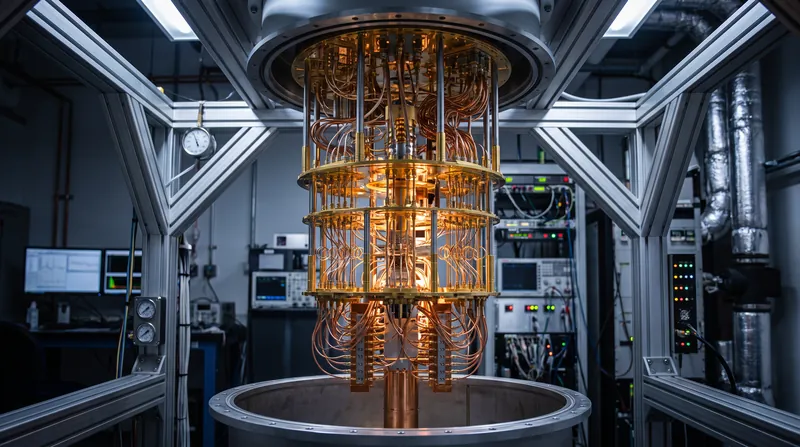
For decades, the greatest enemy of quantum technology has been room temperature. The fragile quantum states required to process information in entirely new ways—known as qubits—are notoriously sensitive to ambient thermal noise. To keep them stable, tech giants and research institutions have been forced to build massive, multi-million-dollar dilution refrigerators that cool quantum processors to 15 millikelvin, a temperature colder than deep space. This cryogenic bottleneck has kept quantum computing confined to a handful of elite, highly funded laboratories, making the dream of a widespread quantum internet seem decades away.[1]
That paradigm may have just shattered. In a landmark paper published in Nature Communications, researchers at Stanford University have demonstrated a nanoscale optical device capable of achieving quantum entanglement at room temperature. By bypassing the need for extreme cooling, the team has successfully linked the quantum properties of light and electrons in an ambient environment. It is a breakthrough that fundamentally alters the trajectory of quantum hardware, shifting the timeline for deployable quantum communication networks from the distant future to the near term.
"The material in question is not really new, but the way we use it is," explained Jennifer Dionne, a professor of materials science and engineering at Stanford and the senior author of the study. The device relies on a phenomenon known as "twisted light" to force an interaction between photons and electrons before thermal energy can destroy the quantum state. While it does not yet constitute a fully functional room-temperature quantum computer, it provides the foundational building block required for unhackable quantum communication.[1]
To understand why this is revolutionary, one must look at how traditional quantum systems fail. In a standard superconducting quantum computer, information is stored in the spin or energy level of a subatomic particle. At room temperature, ambient heat causes atoms to vibrate violently. This thermal noise knocks the qubits out of their delicate superposition—a process known as decoherence—in mere femtoseconds. The information vanishes into randomness before any useful calculation or transmission can occur, which is why extreme cold has always been mandatory.[2]
The Stanford team’s solution was not to fight the thermal noise by freezing the system, but to outrun it. They engineered a way to create and capture the entanglement so quickly and stably that the ambient heat simply does not have time to disrupt the process. "In simple terms, they found a way to dance with the chaos instead of trying to freeze it into stillness," noted one analysis of the breakthrough. This temporal advantage completely rewrites the rules of quantum thermodynamics.[2][3]
The architecture of the device is surprisingly elegant and relies on materials that are already well-understood in the semiconductor industry. The researchers started with a standard silicon chip and engraved it with a precise nanoscale pattern—a structure smaller than the wavelength of visible light itself. On top of this patterned silicon, they laid an ultra-thin crystal of molybdenum diselenide, creating a hybrid structure that bridges the gap between classical photonics and quantum mechanics without requiring exotic new manufacturing techniques.[1]
Molybdenum diselenide belongs to a family of materials known as transition metal dichalcogenides (TMDCs). These materials are highly prized in quantum physics for their unusual electronic and optical properties, particularly their ability to host stable electron spins even outside of a vacuum. However, simply placing the TMDC on a silicon chip is not enough to achieve room-temperature entanglement; the true magic of the device lies in how the underlying patterned silicon manipulates the light passing through it.[2]
When a standard laser beam strikes the nanopatterned silicon, the structure forces the photons into a corkscrew shape. Physicists refer to this phenomenon as "twisted light." This is not merely a visual distortion; the twisted geometry carries a physical property called orbital angular momentum. As this corkscrew of light hits the molybdenum diselenide layer, it transfers its angular momentum directly into the spin of an electron sitting inside the crystal, bridging the gap between light and matter in a highly controlled manner.[1][2]
This direct transfer of properties between the photon and the electron creates a state of quantum entanglement. Entanglement is the deeply strange quantum phenomenon where two particles become inextricably linked, such that the state of one instantly influences the state of the other, regardless of the physical distance between them. By using twisted light, the Stanford team managed to forge this link at room temperature, creating a stable qubit interface without the need for a dilution refrigerator or liquid helium.
The implications for global quantum infrastructure are staggering. Currently, building a quantum communication node requires a dedicated facility with reinforced power grids, specialized cryogenic engineering teams, and massive tanks of rare liquid helium. The Stanford device, by contrast, is a solid-state chip that operates under a controlled beam of light. It can theoretically sit on a standard server rack or be integrated directly into existing fiber-optic network hardware, drastically reducing the physical footprint and operational overhead of quantum technology.[2][3]
"If you don't need extreme cold to create and maintain certain types of quantum entanglement, then suddenly you don't need the $10 million refrigerator," industry analysts point out. This dramatically lowers the barrier to entry. Instead of quantum technology being the exclusive domain of companies like Google, IBM, and state-sponsored labs, room-temperature photonic chips could be manufactured using existing semiconductor fabrication pipelines and deployed by universities, startups, and telecommunications companies around the world, democratizing access to next-generation computing.[2][3]
The most immediate application for this technology is in quantum cryptography and the creation of a secure "quantum internet." Because entangled particles are fundamentally altered if they are observed or intercepted, a communication network built on quantum entanglement is theoretically immune to hacking. Until now, the exorbitant cost and massive size of cryogenic nodes made a global quantum network physically impossible. The Stanford chip provides a realistic blueprint for scalable, deployable secure nodes that could protect sensitive data.[2]
However, researchers and skeptics alike are careful to draw a firm line between a quantum communication node and a universal quantum computer. The Stanford device does not currently run quantum algorithms. It cannot factor large prime numbers to break classical encryption, nor can it simulate complex molecules for pharmaceutical drug discovery. It is a highly specialized component designed specifically to generate and link quantum states, rather than a general-purpose processor capable of replacing classical supercomputers in the near future.[1][3]
Furthermore, significant engineering hurdles remain before this chip can be mass-produced and integrated into commercial networks. While the team has successfully generated the entanglement, reading out those quantum states reliably at scale requires highly sensitive light detectors that are still largely in the experimental phase. The efficiency of the photon-to-electron spin transfer also needs to be optimized to reduce error rates and ensure perfect fidelity in a noisy commercial setting outside the pristine conditions of a laboratory.[3]
Despite these caveats, the psychological and practical barrier of cryogenic cooling has been definitively breached. Historically, breakthroughs of this magnitude—such as the first room-temperature integrated circuit or the first functional laser—started as isolated, fragile lab demonstrations before fundamentally reshaping global technology. The physics problem of room-temperature entanglement has now been solved; what remains is a complex but entirely solvable engineering problem. As fabrication techniques improve, these nanoscale optical devices will inevitably become more robust, reliable, and cheaper to produce at scale.[2][3]
As governments and tech giants race to secure their digital infrastructure against future quantum threats, the ability to deploy quantum-secure nodes without liquid helium changes the geopolitical calculus of technology. Stanford’s twisted light device may not be the final, ultimate form of the quantum computer, but it is undeniably the crucial spark that could bring quantum technology out of the deep freeze and into the real world, paving the way for a new era of secure communication and advanced computation.[3]
Terms to know
- Qubit
- The basic unit of quantum information, capable of existing in multiple states simultaneously, unlike classical binary bits.
- Decoherence
- The process by which a quantum system loses its fragile quantum state due to interaction with its environment, such as thermal heat.
- Twisted Light
- A beam of light shaped into a corkscrew pattern, carrying orbital angular momentum that can interact with the spin of particles.
- Molybdenum Diselenide
- An ultra-thin semiconductor material known as a transition metal dichalcogenide, prized for its ability to host stable electron spins.
- Dilution Refrigerator
- A massive, expensive cryogenic cooling device used to keep traditional quantum processors near absolute zero.
Questions readers ask
What is quantum entanglement?
A phenomenon where two particles become inextricably linked, so the state of one instantly influences the other, regardless of the physical distance between them.
Why do quantum computers usually need extreme cold?
To prevent ambient heat from causing thermal noise, which destroys delicate quantum states in a process called decoherence before calculations can be completed.
Is this a fully working room-temperature quantum computer?
No. It is a foundational device that creates entanglement for quantum communication, but it cannot yet run complex quantum algorithms to replace classical supercomputers.
What is twisted light?
Light that has been forced into a corkscrew shape by a nanoscale pattern, giving it orbital angular momentum that can be transferred directly to electrons.
Different angles
Quantum Hardware Engineers
Focus on the elimination of cryogenic dependencies and the shift to scalable photonics.
For hardware engineers, the Stanford breakthrough represents a fundamental shift in supply chains and infrastructure. By removing the need for liquid helium and dilution refrigerators, the focus moves from thermodynamic management to semiconductor fabrication. Engineers argue that because the Stanford device uses silicon substrates and transition metal dichalcogenides, it can be manufactured using existing CMOS foundries, drastically accelerating the commercialization timeline.
Security & Network Analysts
Emphasize the breakthrough's potential to make unhackable quantum communication networks commercially deployable.
Cybersecurity experts view room-temperature entanglement as the missing link for a global quantum internet. Because entangled particles cannot be intercepted without destroying the transmission, quantum networks offer theoretically unbreakable encryption. Analysts point out that as long as quantum nodes required multi-million-dollar cooling systems, this security was limited to short distances between elite labs. Deployable, room-temperature chips mean telecommunications companies can begin integrating quantum security directly into standard server racks.
Quantum Realists
Caution that while this solves the cooling problem for communication nodes, it is not yet a universal quantum computer.
Skeptics and theoretical physicists are quick to temper expectations, noting the vast difference between generating entanglement and performing complex calculations. They emphasize that the Stanford device is a communication node, not a processor capable of running Shor's algorithm to break classical encryption. Furthermore, they highlight significant unresolved engineering challenges, particularly the need for highly sensitive, room-temperature light detectors capable of reliably reading out these quantum states at scale.
- Quantum Hardware Engineers
- Focus on the elimination of cryogenic dependencies and the shift to scalable, silicon-compatible photonics.
- Security & Network Analysts
- Emphasize the breakthrough's potential to make unhackable quantum communication networks commercially deployable.
- Quantum Realists
- Caution that while this solves the cooling problem for communication nodes, it is not yet a universal quantum computer.
Perspectives this story doesn't cover
- Classical Cryptographers
- Telecommunications Infrastructure Providers
Sources
Source coverage
3 outlets
3 viewpoints surfaced



- [1]Stanford UniversityQuantum Hardware Engineers
Twisted Light Sparks a Quantum Breakthrough at Room Temperature
Read on Stanford University → - [2]Quantum Intelligence NetworkQuantum Realists
The Promise of Stanford's New Room-Temperature Quantum Architecture
Read on Quantum Intelligence Network → - [3]Factlen Editorial TeamSecurity & Network Analysts
Synthesis by Factlen editorial team
Read on Factlen Editorial Team →
More in Technology
See all →Quantum Hardware
Infleqtion Entangles 30 Logical Qubits on Neutral-Atom Quantum Processor
6 sources
Quantum Hardware
IonQ Demonstrates Real-Time Quantum Error Decoder on a Single CPU
6 sources
Quantum Hardware
Trapped Ion vs. Superconducting: The Trade-off in Qubit Connectivity, Coherence, and Gate Fidelity
6 sources
Quantum Hardware
The Overhead of Logical Qubits: Why Thousands of Physical Qubits Are Needed to Create One Error-Free Qubit
6 sources
Comments
Every angle. Every day.
Get Technology stories with full source coverage and perspective breakdowns, free every day.