
Reverberation Time and the NRC Scale: How Textiles and Wall Treatments Actually Absorb Sound in Open-Concept Homes
Modern minimalist interiors often suffer from excessive echo due to hard, reflective surfaces. By understanding the Noise Reduction Coefficient (NRC) and reverberation time (RT60), homeowners can strategically deploy textiles to absorb sound energy and restore acoustic comfort.

Share this story
As major design publications release their fall 2026 trend forecasts this week, a quiet consensus is emerging: the era of the acoustically hostile, ultra-minimalist living room is ending. A standard 400-square-foot open-concept space finished entirely in hardwood, glass, and drywall can sustain a reverberation time of over two seconds—an acoustic profile closer to a medieval cathedral than a comfortable family home.[5][6]
Modern interior design has spent the last decade heavily favoring hard, reflective surfaces. While visually striking, these materials bounce sound waves repeatedly across the room, creating a persistent echo that muddies speech, amplifies background noise, and increases cognitive fatigue for the occupants.[5][6]
As defined by the physics department at Georgia State University, "Reverberation is the collection of reflected sounds from the surfaces in an enclosure," and when excessive, "it makes the sounds run together with loss of articulation." Acousticians quantify this phenomenon using a metric called RT60, which measures the exact time it takes for a sound to decay by 60 decibels after the source stops. For clear conversation and everyday comfort, a residential living space requires an RT60 of roughly 0.5 to 0.8 seconds.[4]
Achieving that target requires understanding the Noise Reduction Coefficient (NRC). Governed by testing standards like ASTM C423, the NRC is a standardized scale from 0.00 to 1.00 that dictates how much mid-range sound energy a material absorbs versus how much it reflects back into the room.[1]
The architectural shell of a modern home offers almost no absorption. Standard painted drywall and hardwood floors carry an NRC of roughly 0.05, meaning they reflect 95 percent of the sound energy that hits them. Large glass windows are even more reflective, testing near an NRC of 0.02.[1]
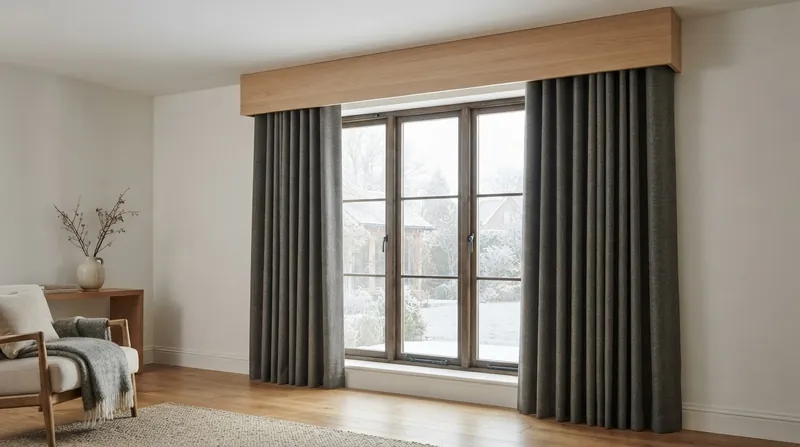
To correct the acoustic imbalance, designers are increasingly turning to absorptive materials. Heavy drapery and thick wool rugs serve as highly functional acoustic treatments that integrate seamlessly into residential decor. A heavy velour curtain, for example, can achieve an NRC of 0.50 to 0.60, absorbing more than half the sound energy it encounters.[5]
The mathematical impact of these textiles is profound. By applying Sabine's equation—which divides a room's volume by its total absorption area in sabins—the exact reduction in echo can be calculated. Introducing just 120 square feet of heavy drapery and a 108-square-foot wool rug to a hard-surfaced 400-square-foot room increases its total absorption by over 140 percent.[4][7]
That single design intervention cuts the room's reverberation time from a harsh 2.2 seconds down to a comfortable 0.89 seconds. The space shifts from an echo chamber to a controlled, conversation-friendly environment without requiring a single structural change to the walls or ceiling.[7]
It is important to note that NRC ratings primarily measure mid-range frequencies between 250 and 2000 Hz, which cover the bulk of human speech. These textiles do not effectively absorb low-frequency bass from home theater subwoofers, which requires thicker, denser architectural interventions.[1]
The acoustic health of a home is dictated entirely by the physical properties of its surfaces. By balancing hard architectural lines with high-NRC textiles, residents ensure their living spaces provide both visual appeal and auditory calm, proving that good design must account for what the ear hears as much as what the eye sees.[7]
Viewpoints in depth
Acoustical Engineers
Focus on quantifiable metrics like RT60 and NRC to achieve objective speech intelligibility.
For acousticians, a room is a mathematical volume where sound energy must be managed. They rely on Sabine's equation to calculate the exact square footage of absorptive material required to hit a target RT60 of 0.5 to 0.8 seconds for residential spaces. From this perspective, the aesthetic of the material is secondary to its tested NRC rating across the 250 Hz to 2000 Hz frequency bands, which govern human speech.
Interior Designers
Prioritize the visual integration of sound-absorbing materials without compromising the architectural aesthetic.
Design professionals approach acoustics as a textural opportunity rather than a purely mathematical problem. Instead of mounting commercial acoustic panels, they deploy heavy drapery, upholstered furniture, and high-pile rugs to introduce necessary absorption. This camp argues that acoustic comfort must be achieved invisibly, using the room's natural decor to soften the harsh reverberation of modern minimalist trends.
Minimalist Homeowners
Value clean lines and hard surfaces, often resisting the addition of heavy textiles.
Advocates for ultra-modern, minimalist spaces often prefer bare hardwood, exposed concrete, and unadorned glass windows. While this achieves a specific architectural purity, it inherently sacrifices acoustic comfort. For this group, the challenge lies in finding invisible acoustic solutions—such as micro-perforated ceiling treatments or hidden absorptive backing—that control reverberation without introducing the visual weight of traditional fabrics.
- Acoustical Engineers
- Focus on quantifiable metrics like RT60 and NRC to achieve objective speech intelligibility.
- Interior Designers
- Prioritize the visual integration of sound-absorbing materials without compromising the architectural aesthetic.
- Editorial Synthesis
- Bridges the mathematical requirements of acoustics with the practical realities of residential design.
Sources
Source coverage
7 outlets
3 viewpoints surfaced





- [1]WikipediaAcoustical Engineers
Noise reduction coefficient
Read on Wikipedia → - [2]WikipediaAcoustical Engineers
Reverberation
Read on Wikipedia → - [3]WikipediaAcoustical Engineers
Architectural acoustics
Read on Wikipedia → - [4]Georgia State UniversityAcoustical Engineers
Reverberation Time
Read on Georgia State University → - [5]Architectural DigestInterior Designers
7 Best Living Room Curtains to Transform Your Space (2026)
Read on Architectural Digest → - [6]Apartment TherapyInterior Designers
5 Home Trends Designers Say Aren’t Worth the Hype
Read on Apartment Therapy → - [7]Factlen Editorial TeamEditorial Synthesis
Synthesis by Factlen editorial team
Read on Factlen Editorial Team →
More in Home
See all →Paint Durability
The ASTM D2486 Cycles-to-Failure: How a Standardized Scrub Test Predicts a Paint's Washability
6 sources

Circadian Lighting
The 460-480 Nanometer Peak: How Blue Light Wavelengths Actually Suppress Melatonin and Govern Circadian Rhythm
9 sources
Product Safety
CPSC Recalls Over 4,000 Amazon Hair Dryer Brushes Due to Electrocution and Fire Risks
7 sources
Furniture Safety
CPSC Recalls 9,000 FJTJBSI Dressers Over Tip-Over Risk, Violating STURDY Act
4 sources
Comments
Every angle. Every day.
Get Home stories with full source coverage and perspective breakdowns, free every day.