
Physicists Create 'Mini-Universe' Where Time Emerges Naturally From Quantum System's Internal Change
A new laboratory experiment using 24,000 ultracold atoms has demonstrated that time can emerge entirely from the internal disorder of a quantum system, without the need for an external clock. The findings provide the first controlled evidence for theories suggesting time is not a fundamental feature of the universe, but an illusion created by quantum entanglement and entropy.
By Mateo Ramos

Share this story
In short
- Researchers created a 'mini-universe' using 24,000 ultracold rubidium atoms to study the fundamental nature of time.
- The experiment proved that time can emerge entirely from the internal entropy and disorder of a closed quantum system.
- The findings validate the Page-Wootters mechanism, which suggests time is an illusion created by quantum entanglement.
For almost a century, modern physics has been haunted by a glaring contradiction at the very heart of reality: the fundamental problem of time. In the macroscopic world governed by Albert Einstein’s theory of general relativity, time is a dynamic, physical dimension that actively bends, stretches, and warps around massive objects like stars and black holes.
Yet in the microscopic realm of quantum mechanics, time is treated as a rigid, external metronome—an absolute background clock that ticks away independently of the subatomic particles it governs. This fundamental mismatch in how the two pillars of physics treat time has prevented scientists from unifying them into a single, cohesive theory of quantum gravity.[4]
Now, a groundbreaking laboratory experiment has provided the first controlled physical evidence for a radical solution to this paradox. By constructing a hermetically sealed 'mini-universe' out of 24,000 ultracold atoms, physicists at the University of Birmingham have successfully demonstrated that time does not actually need an external clock to exist. Instead, the researchers showed that time can emerge naturally from the internal disorder and quantum entanglement of the system itself, offering a profound new perspective on the fabric of reality.[2]
Published in the journal Physical Review Research, the study moves one of the most profound philosophical debates in theoretical physics out of the realm of pure mathematics and into the tangible environment of the laboratory. The findings suggest that time is not a fundamental, built-in feature of the cosmos that exists independently of matter and energy.
Rather, it is an emergent property—a macroscopic illusion created by the shifting, microscopic relationships between different parts of a complex quantum system. By proving that a sequence of events can be ordered without an outside timekeeper, the research challenges our deepest assumptions about the universe.[1]
"In some theories of the universe, especially quantum gravity, time doesn't appear as a built-in feature," explained Professor Giovanni Barontini, the experimental physicist who led the research at the University of Birmingham. "Yet in everyday life, time flows from past to future. Why is this so, when most basic laws of physics work the same way forwards and backwards? This study provides the first controlled experimental evidence that time can be defined by changes within a system rather than as the external ticking clock we think of as time."[2]
The conceptual foundation for this extraordinary experiment dates back to the late 1960s, when physicists John Wheeler and Bryce DeWitt attempted to apply the rules of quantum mechanics to the entire universe. The resulting Wheeler-DeWitt equation successfully described the quantum state of the cosmos, but it contained a startling and highly controversial omission: the mathematical variable for time simply vanished. According to the strict interpretation of their math, the universe at its deepest, most fundamental level is a single, static, and completely unchanging quantum state.[4]
If the universe is fundamentally frozen and timeless, why do human beings experience the relentless, directional forward march of time? In 1983, theoretical physicists Don Page and William Wootters proposed an elegant, albeit highly abstract, answer to this paradox. They argued that the universe only appears static to a hypothetical 'god-like' observer standing completely outside of it.
For observers who are trapped inside the universe, time emerges naturally through the bizarre quantum phenomenon of entanglement. In this framework, time is not a river we float down, but a byproduct of our physical connection to the world around us.[3][4]
In the Page-Wootters mechanism, one part of an entangled quantum system acts as a clock, while the other part evolves relative to it. Because we are inside the universe, inextricably entangled with its matter and energy, we perceive this internal relative evolution as the continuous flow of time.
Until recently, however, testing this mechanism in a complex, many-body system seemed technologically impossible, relegating the idea to the fringes of theoretical philosophy rather than experimental physics. Previous tests were limited to simple pairs of entangled photons, which could not capture the chaotic complexity required to simulate a true universe.[3]
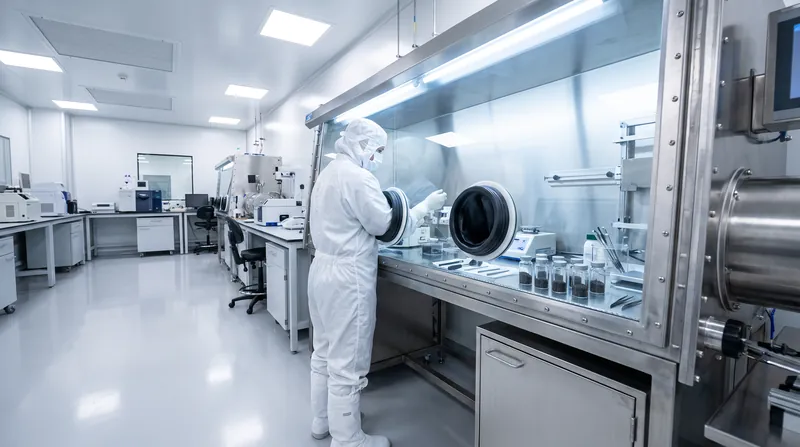
To bring this theory into the physical world, Barontini's team utilized a Bose-Einstein condensate—a bizarre state of matter formed when a cloud of rubidium atoms is cooled to just a few billionths of a degree above absolute zero.
At these extreme, frigid temperatures, the normal thermal motion of the atoms essentially halts, and the entire cloud begins to behave as a single, macroscopic quantum object. This allowed the researchers to manipulate the atoms with an unprecedented level of precision, creating a pristine environment free from the thermal noise of the outside world.[2]
The researchers hermetically sealed this cloud of 24,000 atoms, isolating it completely from the outside environment to prevent any external interference or information leaks. They then used two highly focused laser beams of different frequencies to create a thin optical barrier, effectively dividing their miniature universe into two distinct halves: an observed 'bright' sector and an unobserved 'dark' sector. This boundary served as the critical dividing line between the 'clock' and the rest of the quantum universe, setting the stage for time to emerge from the void.[2]
This division was crucial to the success of the experiment. By choosing to observe only the bright sector and deliberately ignoring the dark sector, the researchers effectively placed themselves in the position of an internal observer entangled within the system.
Atoms were permitted to move freely across the laser barrier, exchanging information and energy between the two halves, but the total system remained entirely self-contained. No external metronome was used to track the progression of the experiment; the researchers had to rely entirely on the internal dynamics of the atoms to understand the sequence of events.[1][4]
As the atoms shifted back and forth between the bright and dark regions, the researchers tracked the entropy—the measure of disorder or missing information—within the observed sector. They discovered that the sequence of events inside their mini-universe could be perfectly ordered and predicted without ever referencing a clock on the laboratory wall. The internal 'entropic time' was driven entirely by the changing disorder of the atoms, proving that time can be measured purely by the internal relationships of a closed system.[1][2]
Fascinatingly, the flow of this emergent time was not constant, behaving very differently from the rigid ticking of a standard clock. When the spread of particles in the bright sector increased rapidly, the internal time of the mini-universe sped up, racing forward as disorder grew.
When the exchange of atoms slowed down, the passage of time dragged. And when the distribution of atoms reached a state of perfect equilibrium, where entropy ceased to change and the system stabilized, time effectively stopped altogether, rendering the mini-universe temporarily static until the atomic balance shifted once again.[2]
The team even manipulated the laser barrier to force the bright sector to repeatedly expand and contract. This dynamic movement mimicked a cosmological cycle of a 'Big Bang' followed by a 'Big Crunch'—a hypothetical scenario where the universe's expansion eventually reverses and collapses back on itself. Even in this extreme, oscillating environment, the entropic clock correctly ordered the sequence of events, proving its robustness as a valid measure of time in a dynamic space. The system successfully reconstructed its own history without any outside help.[2]
The implications of this successful demonstration extend far beyond the behavior of ultracold rubidium atoms in a vacuum chamber. By proving that the standard equations of quantum mechanics remain perfectly valid when using an internally generated entropic time, the Birmingham team has provided a powerful new tool for quantum cosmology. Researchers can now use similar setups to simulate and study the extreme physics of the early universe, the interiors of black holes, and the mechanics of cosmic inflation without leaving the laboratory.[1][2]
Furthermore, the experiment lends heavy physical weight to the relational theory of time, challenging our most basic intuitions about reality. It suggests that our everyday experience of a past, present, and future is not a journey through a pre-existing, invisible temporal dimension that governs the cosmos. Instead, it is the macroscopic consequence of countless microscopic quantum interactions—a byproduct of our entanglement with the universe we inhabit, driven by the relentless increase of entropy. We experience time simply because we are part of a system that is constantly changing.[4]
While a tabletop experiment cannot definitively prove the ultimate nature of reality across the entire cosmos, it bridges a critical gap between abstract mathematical theory and observable physics. By successfully bottling a timeless quantum state and watching time emerge from its internal chaos, physicists have taken a major step toward finally answering one of humanity's oldest questions.
Time, it appears, is not the invisible canvas on which the universe is painted, but a phenomenon generated by the paint itself. As researchers continue to probe these isolated quantum systems, the dream of a unified theory of quantum gravity inches closer to reality.[4]
Definitions
- Bose-Einstein Condensate
- A state of matter formed at temperatures near absolute zero, where a cloud of atoms coalesces to behave as a single quantum object.
- Page-Wootters Mechanism
- A theoretical framework proposing that time is not a fundamental feature of the universe, but an emergent property created by quantum entanglement.
- Wheeler-DeWitt Equation
- A foundational equation in quantum gravity that attempts to describe the entire universe, famously resulting in a completely timeless, static state.
- Entropy
- A measure of disorder, randomness, or missing information within a closed physical system.
- Emergence
- A phenomenon where complex properties or rules appear in a macroscopic system that do not exist at the microscopic, fundamental level.
Questions & answers
Does this mean time is just an illusion?
Not exactly an illusion, but an 'emergent property.' Much like how individual water molecules aren't 'wet' but a collection of them creates the sensation of wetness, time may not exist at the fundamental quantum level but emerges when particles interact.
How did they measure time without a clock?
The researchers tracked the entropy—the changing disorder and movement of atoms—between two halves of an isolated quantum system. The sequence of these internal changes acted as a reliable clock.
Why did time stop in the experiment?
Because the internal clock was driven by the exchange of atoms and changing entropy, time effectively halted when the system reached a state of equilibrium and the distribution of atoms stopped changing.
What does this mean for time travel?
This experiment doesn't directly address time travel, but it reinforces the idea that time is a one-way flow driven by increasing entropy (disorder), making moving backward through time highly improbable.
Analysis by camp
Relational Time Theorists
Argue that time is not a fundamental dimension but a byproduct of quantum entanglement.
Proponents of the Page-Wootters mechanism and the Wheeler-DeWitt equation view this experiment as long-awaited vindication. They argue that the universe at its most fundamental level is a static, timeless quantum state. In this view, time only exists for observers who are entangled with the universe. By successfully demonstrating that an internal clock can be derived entirely from the entropy of a closed system, these theorists believe we are one step closer to removing time as a fundamental variable in the quest for quantum gravity.
Experimental Quantum Physicists
Focus on the practical applications of the mini-universe for testing cosmological models.
For experimentalists, the philosophical debate about the nature of time is secondary to the technological breakthrough of the experiment itself. By proving that the Schrödinger equation functions perfectly using an internal entropic clock, researchers now have a practical laboratory testbed. Experimental physicists plan to use similar isolated Bose-Einstein condensates to simulate extreme gravitational environments, allowing them to study the quantum dynamics of the early universe, black hole event horizons, and cosmic inflation without leaving the laboratory.
Classical Relativists
Maintain that general relativity's dynamic spacetime remains essential for macroscopic physics.
While acknowledging the elegance of the quantum mini-universe, some physicists caution against immediately discarding time as a fundamental dimension. They point out that general relativity relies on time as a physical fabric that bends and interacts with mass and energy to create gravity. Until a fully realized theory of quantum gravity can mathematically bridge the gap between emergent quantum time and the macroscopic curvature of spacetime, relativists argue that time must still be treated as a real, physical dimension at cosmic scales.
- Quantum Gravity Theorists
- View the experiment as proof that time is an emergent property of entanglement.
- Experimental Physicists
- Value the experiment as a new tool for simulating cosmic phenomena in the lab.
- Scientific Synthesis
- Synthesizes the findings to highlight the philosophical and practical implications of emergent time.
Perspectives this story doesn't cover
- Classical Relativists
- Philosophers of Time
Sources
Source coverage
4 outlets
3 viewpoints surfaced




- [1]Physical Review ResearchQuantum Gravity Theorists
Emergence of time from internal entanglement in a Bose-Einstein condensate
- [2]University of BirminghamExperimental Physicists
Scientist creates 'mini-universe' to measure time without a clock
- [3]arXivQuantum Gravity Theorists
Experimental demonstration of the Page-Wootters mechanism in a many-body quantum system
- [4]Factlen Editorial TeamScientific Synthesis
Synthesis by Factlen editorial team
Read on Factlen Editorial Team →

More in Science
See all →Seismic Research
How a Cascadia Megathrust Earthquake Could Trigger the San Andreas Fault
6 sources

Methane Tracking
Advanced Aerial Surveys Reveal Landfill Methane Emissions Are Vastly Underestimated
3 sources

Pancreatic Cancer
Engineered Probiotic Bacteria Infiltrate Pancreatic Tumors, Stimulating Immune Attack in Animal Studies
6 sources

Prebiotic Chemistry
Asteroid Bennu Samples Contain All Essential Building Blocks of Life, Including RNA and Proteins
6 sources
Comments
Every angle. Every day.
Get Science stories with full source coverage and perspective breakdowns, free every day.