
Physicists Observe the 'Evaporation' of a Simulated Black Hole in a Lab
By creating an optical event horizon using laser pulses, researchers have measured the elusive 'backreaction' of Hawking radiation for the first time. The breakthrough confirms the mechanism by which black holes lose energy and slowly evaporate.
By Harper Lane

Share this story
In short
- Physicists created an optical analogue of a black hole using ultrafast laser pulses in a fiber optic cable.
- The experiment successfully measured 'backreaction'—the energy lost by the system when it emits Hawking radiation.
- This confirms the 52-year-old prediction of the mechanism that causes black holes to slowly evaporate.
The defining characteristic of a black hole is its absolute finality. For decades, the scientific consensus held that once matter or light crossed the event horizon, it was permanently removed from the observable universe, trapped in an inescapable gravitational well.
That absolute rule was rewritten in 1974 when theoretical physicist Stephen Hawking introduced quantum mechanics into the equation. Hawking proposed that the vacuum of space is not empty, but teeming with pairs of virtual particles constantly popping into existence and annihilating each other.[1][6]
If this quantum fluctuation occurs exactly at the boundary of an event horizon, Hawking argued, one particle could be pulled into the black hole while its partner escapes. To an outside observer, the black hole appears to be emitting thermal energy—a phenomenon now known as Hawking radiation.[6]
But this emission comes with a strict cosmic accounting requirement. Because energy cannot be created from nothing, the energy carried away by the escaping particle must be subtracted from the black hole itself. Over unimaginable timescales, this energy drain causes the black hole to lose mass, shrink, and eventually evaporate entirely.[3]
The mechanism responsible for this energy transfer is known as "backreaction." It is the recoil, the subtle shove that the black hole experiences as it radiates. While Hawking radiation itself is a robust prediction of modern physics, observing the backreaction that drives the evaporation process has remained one of the field's most elusive goals.[3][4]
The primary obstacle is scale. The Hawking radiation emitted by a typical astrophysical black hole is incredibly weak—its temperature is a tiny fraction of a degree above absolute zero. It is completely drowned out by the cosmic microwave background radiation that permeates the universe, making direct observation with current telescopes impossible.[4]
To bypass this cosmic limitation, physicists have turned to laboratory analogues. If they cannot study the gravitational event horizons of real black holes, they can create artificial horizons using fluids, sound waves, or light. These analogue systems are designed to perfectly mimic the mathematics of general relativity in a controlled environment.[2][6]
In a landmark study published in the journal Nature in July 2026, an international team of physicists led by Lorenzo Procopio at Paderborn University in Germany achieved what was previously thought impossible. They successfully measured the backreaction of analogue Hawking radiation in an optical laboratory.[1]
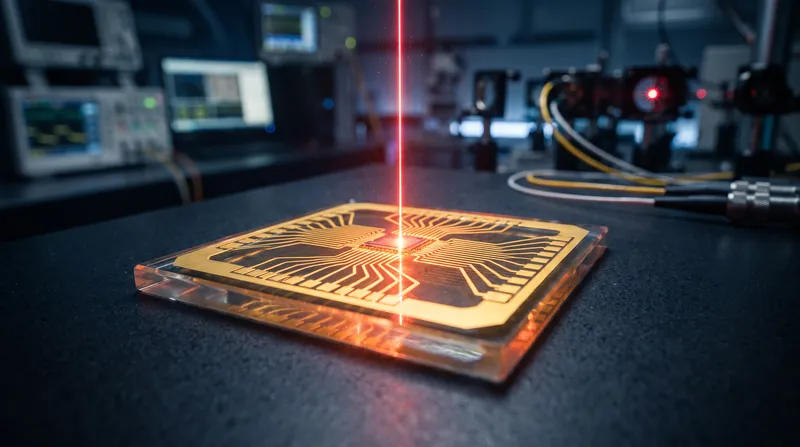
The experiment did not create a literal black hole—there was no risk of the laboratory being swallowed by intense gravity. Instead, the team utilized ultrafast laser pulses traveling through a specially patterned optical fiber to create an analogue of an event horizon made entirely of light.[3]
The setup relied on the nonlinear optical properties of the fiber. When an intense primary laser pulse travels through the medium, it alters the fiber's refractive index. This change creates an optical barrier that appears to bring a second, trailing pulse of light to a standstill.[3]
To the trailing light waves, this barrier acts exactly like an event horizon. They can approach the boundary, but they cannot cross it. At this optical horizon, the researchers observed the analogue of Hawking radiation—photons being emitted with negative frequencies, mirroring the behavior of virtual particles escaping a gravitational pull.[2][5]
Previous experiments had successfully generated this analogue radiation, but the Paderborn team was looking for something far more subtle. They wanted to measure the backreaction—the exact amount of energy the primary laser pulse lost as it generated the radiation.[1][3]
To understand the challenge, consider Newton's third law of motion. If you are standing on roller skates and push a heavy object away, you will roll backward. The researchers were looking for that backward roll—a microscopic shift in the energy of the primary laser pulse caused by the emission of the Hawking photons.[3]
Through incredibly precise measurements, the team detected this tiny energy shift. They confirmed that the radiation does not appear from nowhere; it measurably drains energy from the system that generates it. The energy accounting of Hawking's 52-year-old prediction was finally verified in a physical system.[1]
Beyond confirming the backreaction, the experiment yielded a major surprise regarding how the radiation is produced. For years, theoretical models suggested that analogue Hawking radiation emerged through a complex, messy cascade of nonlinear optical interactions.
Instead, the researchers discovered that the radiation and the backreaction are the result of a single, clean process. The interaction between the radiation field and the driving system follows a direct mathematical coupling known as a "biquadratic interaction."[1][5]
This simplicity is a revelation for theoretical physicists. It replaces convoluted multi-stage models with a straightforward equation, opening up new, highly accurate ways to calculate quantum effects in analogue systems.[3][5]
The researchers suggest that if the analogue holds true, real astrophysical black holes might also radiate through a similarly direct and simple process. This could have profound implications for the most contentious debate in modern physics: the black hole information paradox.[4][6]
The paradox asks a fundamental question: If a black hole evaporates completely, what happens to the quantum information of the stars, planets, and matter that originally formed it? Quantum mechanics dictates that information cannot be destroyed, but general relativity suggests it is lost forever behind the event horizon.[4][6]
By proving that backreaction occurs through a simple, direct interaction, the Paderborn experiment provides theorists with a cleaner mathematical framework. A simpler emission process makes it theoretically easier to model how the quantum information of infalling matter might be encoded into the outgoing Hawking radiation.[5][6]
The researchers are careful to note the limitations of their work. An optical fiber is not curved spacetime, and the experiment replicates the quantum optical physics of a horizon, not its gravitational physics. The leap from a laboratory laser to a supermassive black hole remains a theoretical extrapolation.[6]
Nevertheless, the formal mathematical equivalence between the two systems makes this a historic milestone. Fifty-two years after Stephen Hawking first proposed that black holes are not entirely black, physicists have finally observed the precise mechanism that causes them to fade away.[6]
Terms to know
- Hawking radiation
- Thermal radiation predicted to be spontaneously emitted by black holes due to quantum effects near the event horizon.
- Backreaction
- The energy loss and subsequent shrinking of a black hole as it emits Hawking radiation.
- Event horizon
- The boundary around a black hole beyond which nothing, not even light, can escape.
- Biquadratic interaction
- A direct, simple mathematical coupling between the radiation field and the driving system, replacing older models of complex interaction cascades.
- Information paradox
- A conflict in modern physics regarding whether the quantum information of matter that falls into a black hole is permanently lost when the black hole evaporates.
Questions readers ask
Did scientists create a real black hole on Earth?
No. They created an optical analogue using laser pulses in a fiber optic cable. It mimics the mathematics of an event horizon but has no gravitational pull.
Why can't we just observe real black holes evaporating?
The Hawking radiation emitted by astrophysical black holes is incredibly weak and completely drowned out by the cosmic microwave background radiation of the universe.
What exactly is backreaction?
It is the recoil or energy loss a system experiences when it emits radiation. In this context, it is the mechanism that forces a black hole to lose mass and eventually evaporate.
Does this solve the information paradox?
Not entirely, but it provides a new, simplified mathematical framework for calculating how energy and information might be transferred out of an evaporating black hole.
Different angles
Experimental Physicists
Validating theoretical math through physical analogues.
For experimentalists, the triumph lies in isolating a quantum effect that is otherwise impossible to observe in nature. By proving that backreaction can be measured in a controlled optical system, they validate the mathematical architecture of Hawking's equations. Their focus remains strictly on the data: the precise measurement of the laser pulse's energy shift confirms that the energy accounting of evaporation is a physical reality, not just a theoretical artifact.
Theoretical Cosmologists
Extrapolating laboratory physics to the cosmos.
Theorists are cautious but optimistic. They emphasize that an optical fiber is not curved spacetime, and light in a refractive medium is not gravity. However, because the equations governing both systems are formally equivalent, the discovery of a direct 'biquadratic interaction' offers a new, simpler way to model how real black holes might radiate. They view this as a crucial stepping stone toward a unified theory of quantum gravity.
Quantum Information Theorists
Tracking the fate of quantum states.
This camp is primarily concerned with the black hole information paradox—the question of whether information is destroyed when a black hole evaporates. The discovery that backreaction occurs through a single, direct process rather than a messy cascade gives them a cleaner mathematical model to work with. If the emission process is this direct, it may be easier to trace how the quantum information of infalling matter is encoded into the outgoing Hawking radiation.
- Experimental Physicists
- Focus on creating controllable laboratory analogues to test the mathematical predictions of quantum field theory.
- Theoretical Cosmologists
- Emphasize the implications for actual astrophysical black holes and the quest for a theory of quantum gravity.
- Quantum Information Theorists
- View the breakthrough through the lens of the information paradox, seeking to understand how quantum states are preserved during evaporation.
Perspectives this story doesn't cover
- Astrophysicists focused purely on observational astronomy
Sources
Source coverage
6 outlets
3 viewpoints surfaced






- [1]NatureExperimental Physicists
Backreaction of stimulated Hawking radiation in an optical analogue
Read on Nature → - [2]Weizmann Institute of ScienceTheoretical Cosmologists
Decades-old black hole analog yields new clues on evaporation
Read on Weizmann Institute of Science → - [3]ScienceAlertExperimental Physicists
Physicists Simulated a Black Hole in a Lab. Then It Started to 'Evaporate'
Read on ScienceAlert → - [4]NDTVTheoretical Cosmologists
Scientists Make Major Black Hole Discovery That Could Explain Stephen Hawking's Greatest Mystery
Read on NDTV → - [5]arXivQuantum Information Theorists
Direct biquadratic interaction in analog Hawking radiation
Read on arXiv → - [6]Factlen Editorial TeamQuantum Information Theorists
Synthesis by Factlen editorial team
Read on Factlen Editorial Team →

More in Science
See all →Cancer Vaccines
Scientists Redirect COVID-19 Immune Memory to Create Powerful New Cancer Vaccine
8 sources

Metabolic Science
AI Discovers Naturally Occurring Peptide That Suppresses Appetite Without Ozempic's Side Effects
8 sources

Quantum Tech
First Room-Temperature Quantum Material Created, Unlocking New Era for Computing and Electronics
6 sources
Deep Earth Geophysics
Earth's Inner Core Has Slowed and Begun to Backtrack, USC Study Confirms
6 sources

Comments
Every angle. Every day.
Get Science stories with full source coverage and perspective breakdowns, free every day.