
NYC Housing Construction Plummets 52% in Q2 as Post-421a Tax Break Fails to Spur Development
New York City developers filed plans for just 8,064 new apartments in the second quarter of 2026, a 52% drop from Q1. The decline highlights a growing trend of developers pivoting to smaller buildings to avoid the prevailing wage requirements of the state's new 485-x tax incentive.
By Derya Kaplan

Share this story
In short
- New York City developers filed plans for 8,064 new apartments in Q2 2026, a 52% decline from the previous quarter.
- The drop coincides with the transition from the expired 421-a tax abatement to the new 485-x program.
- To avoid prevailing wage requirements mandated for buildings with 100 or more units, developers are pivoting to smaller projects.
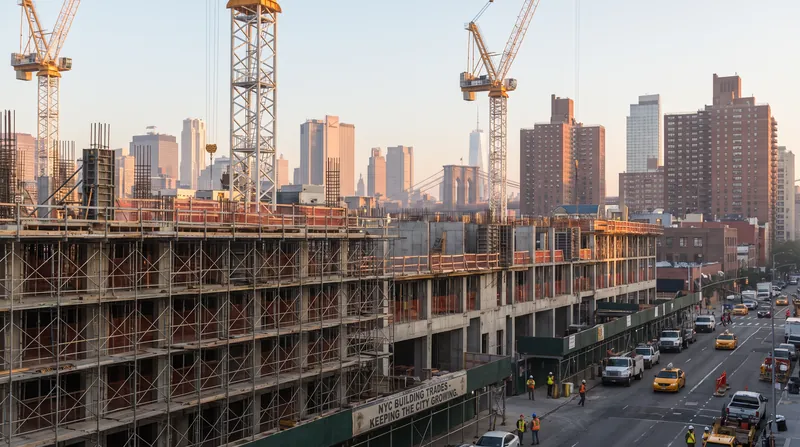
For a New Yorker looking to rent or buy in the coming years, the physical shape of the city's future neighborhoods is being quietly redrawn by a single line of tax code. Instead of sprawling residential towers, the next wave of local housing will overwhelmingly consist of boutique, mid-rise buildings capped at exactly 99 apartments. This shift means fewer mega-complexes, a potential squeeze on overall housing availability, and a new premium on mid-sized developments that blend into existing streetscapes.[6]
The scale of this transformation became starkly visible in the second quarter of 2026. According to the latest New Building Construction Pipeline Report from the Real Estate Board of New York (REBNY), developers filed plans for just 8,064 new multifamily units between April and June. That figure represents a steep 52% plummet from the first quarter of the year.[2][3]
The sharp contraction arrives as the city attempts to navigate the transition between two era-defining tax policies. For decades, the 421-a tax abatement fueled the bulk of New York's ground-up multifamily construction. With that program now expired and its grandfathered sites drying up, developers are being forced to underwrite their new projects using its replacement: the 485-x program, officially known as the Affordable Neighborhoods for New Yorkers initiative.[4][5]
The data reveals a market aggressively optimizing for a specific regulatory threshold. Under 485-x, any residential project containing 100 or more units is subject to strict prevailing wage requirements for construction workers. To avoid these added labor costs, developers are deliberately shrinking their proposals. In the second quarter, 52 of the 172 proposed multiple-dwelling buildings contained between 50 and 99 units.[3][7]
The precision of this pivot is evident in the filings. Nineteen separate buildings were proposed with exactly 99 units, stopping just one apartment short of the wage mandate trigger. By contrast, only nine projects citywide were filed with 100 or more units. This concentration of 99-unit filings is more than double the historical average for mid-sized buildings seen over the past sixteen years.[2][3][6]
The financial calculus driving this trend is straightforward. For large rental projects citywide, 485-x mandates a construction wage floor of roughly $40 per hour, which escalates annually. In designated high-cost zones, such as Manhattan south of 96th Street, the requirement for projects over 150 units jumps to the lesser of $76 per hour or 65% of the prevailing wage.[5]
By capping a building at 99 units, developers bypass the construction wage floor entirely while still qualifying for a 35-year property tax exemption, provided they meet the mandate to set aside 20% of the units for affordable housing at 80% of the Area Median Income. For many builders, sacrificing a few dozen potential apartments is more economically viable than absorbing the higher labor costs across the entire project.[1][5]
While the pivot to smaller buildings keeps some construction moving, it is failing to replace the sheer volume of housing lost from the pipeline. Total proposed construction square footage fell to 9.2 million in the second quarter, a 56% drop from the previous three months.[3]
REBNY officials note that developers are attempting to maximize the value of their 99-unit sites by designing larger, multi-bedroom apartments rather than packing in studios. However, this strategy does not make up for the overall loss in density. The 8,064 units proposed in Q2 fall drastically short of the 17,500 units per quarter that the city estimates are necessary to meet its goal of 700,000 new homes over the next decade.[1][2]
It is crucial to note the limits of this data. As REBNY explicitly cautions, proposed units in building filings should not be interpreted as completed housing production. A filing merely indicates an intent to build; actual groundbreakings depend on securing financing, which remains challenging in the current interest rate environment. The true yield of these Q2 filings will not be known until certificates of occupancy are issued years from now.[3][8]
For the end consumer, this regulatory environment dictates what will be available on the market by 2028 and beyond. The proliferation of 99-unit buildings means renters and buyers will see more mid-rise, boutique options. These buildings often feature larger floor plans—including highly sought-after three-bedroom units—because developers are incentivized to build larger apartments when their total unit count is capped.[1][6]
This shift also alters neighborhood dynamics. Rather than isolated mega-towers, the new supply is more likely to be distributed across smaller infill lots. While this may preserve the architectural scale of certain boroughs, the aggregate shortfall in total units threatens to keep citywide vacancy rates near their current historic lows, maintaining upward pressure on median rents.[1][6]
The Q2 data serves as an early stress test for the 485-x program. Real estate advocates argue that the steep drop in large-scale filings proves the new wage requirements are too onerous for the market to bear without deeper public subsidies. They warn that unless the math improves, the city will systematically under-produce housing.[2][3]
Conversely, housing policy analysts point out that the market is still in a transitional phase. The expiration of 421-a pulled a massive volume of filings forward into late 2025 and early 2026, making the Q2 drop appear exceptionally severe by comparison. It remains to be seen whether developers will eventually adapt to the 100-plus unit economics once the backlog of smaller sites is exhausted.[3][4]
Conversely, housing policy analysts point out that the market is still in a transitional phase.
Ultimately, the evidence from the second quarter confirms that tax policy is the primary architect of the New York skyline. As long as the 99-unit threshold remains the most viable path to profitability, the city's housing growth will be defined not by how high developers can build, but by how skillfully they can navigate the margins of the law.[8]
Definitions
- 485-x Program
- A New York State tax incentive that provides property tax exemptions for new residential construction in exchange for affordable housing set-asides and, for larger projects, prevailing wage requirements.
- 421-a Tax Abatement
- The legacy property tax exemption program that fueled most of New York City's multifamily development for decades before expiring in 2022.
- Prevailing Wage
- A minimum hourly pay rate mandated by the government for construction workers on specific types of projects, often aligned with union scales.
- Area Median Income (AMI)
- The midpoint of a region's income distribution, used by housing agencies to determine eligibility and rent limits for affordable housing units.
Analysis by camp
Real Estate Developers
Industry builders argue that the 485-x wage mandates make large-scale housing economically unfeasible.
Developers and industry groups like REBNY contend that the $40-per-hour wage floor for buildings over 100 units destroys the financial viability of large-scale construction. They point to the Q2 data as proof that without deeper subsidies or lower costs, capital will simply refuse to fund mega-projects. Instead, builders are forced to leave potential density on the table, capping projects at 99 units to make the math work, which ultimately starves the city of the volume needed to ease the housing shortage.
Housing Policy Analysts
Policy experts view the 99-unit trend as a predictable market optimization rather than a permanent freeze.
Analysts note that the surge in 99-unit buildings is a textbook example of regulatory boundary optimization. The 485-x program was designed to guarantee prevailing wages on major projects while still allowing mid-sized infill development to proceed without that burden. From this perspective, the market is functioning exactly as incentivized. Experts caution against interpreting the Q2 drop as a permanent failure, suggesting that the steep decline is partly a hangover from the rush of filings in Q1 and that developers will eventually adapt to the new baseline.
- Real Estate Developers
- Argue that the wage mandates make large-scale housing economically unfeasible without deeper subsidies.
- Housing Policy Analysts
- View the 99-unit trend as a predictable market optimization rather than a permanent freeze.
- Market Strategists
- Focus on the downstream effects on neighborhood character and the shift toward boutique mid-rise developments.
Perspectives this story doesn't cover
- Construction Workers Union
- Low-Income Housing Advocates
Sources
Source coverage
8 outlets
3 viewpoints surfaced







- [1]BisnowReal Estate Developers
Pace Of NYC Housing Construction Plunges As Developers Play Small Ball
Read on Bisnow → - [2]Connect CREReal Estate Developers
REBNY: Construction Filings Drop Sharply in Q2
Read on Connect CRE → - [3]Real Estate Board of New YorkReal Estate Developers
Q2 2026 New Building Construction Pipeline Report
Read on Real Estate Board of New York → - [4]Citrin CoopermanHousing Policy Analysts
Understanding the 485-x Tax Exemption Program
Read on Citrin Cooperman → - [5]NYC Property ValueHousing Policy Analysts
What 485-x Is and What It Replaced
Read on NYC Property Value → - [6]Karen Kostiw Real EstateMarket Strategists
Understanding 99-Unit Buildings in NYC
Read on Karen Kostiw Real Estate → - [7]MRE TaxHousing Policy Analysts
Key Components of the 485x Program
Read on MRE Tax → - [8]Factlen Editorial TeamMarket Strategists
Synthesis by Factlen editorial team
Read on Factlen Editorial Team →

More in Real Estate
See all →NYC Housing
NYC Mayor Mamdani's Pro-Development Housing Plan Wins Over Skeptical Developers, Driving 250% Surge in Proposed Units
6 sources
Worker Classification
The Four Criteria That Determine Whether a Real Estate Agent is an Employee or an Independent Contractor
7 sources

Property Law
The Three Tests That Define a Fixture and Determine Whether an Item Conveys With the Real Estate
6 sources

HOA Law
Why Covenants Running With the Land Legally Bind Homeowners to HOA Rules
7 sources
Comments
Every angle. Every day.
Get Real Estate stories with full source coverage and perspective breakdowns, free every day.