
New Champions League Format: Projected Pots Guarantee Manchester United a High-Stakes Draw
Manchester United's return to the UEFA Champions League places them in Pot 2, ensuring they will face at least two European heavyweights in the revamped league phase.
By Xia Wu

Share this story
The days of easing into the European season against continental minnows are officially over. When the UEFA Champions League anthem rings out at Old Trafford this September, Manchester United fans are guaranteed a baptism of fire. The club's return to Europe's premier competition places them squarely in Pot 2 for the upcoming automated draw, locking them into a schedule that will feature at least two of the continent's undisputed heavyweights.[1]
The stakes for the 2026-27 campaign were crystallized as the final domestic leagues wrapped up, confirming the 29 automatic qualifiers for the 36-team league phase. United secured their ticket in dramatic fashion, sealing a top-five Premier League finish with a crucial 3-2 victory over Liverpool late in the season under manager Michael Carrick. But the reward for that hard-fought domestic success is a brutal, blockbuster European slate.
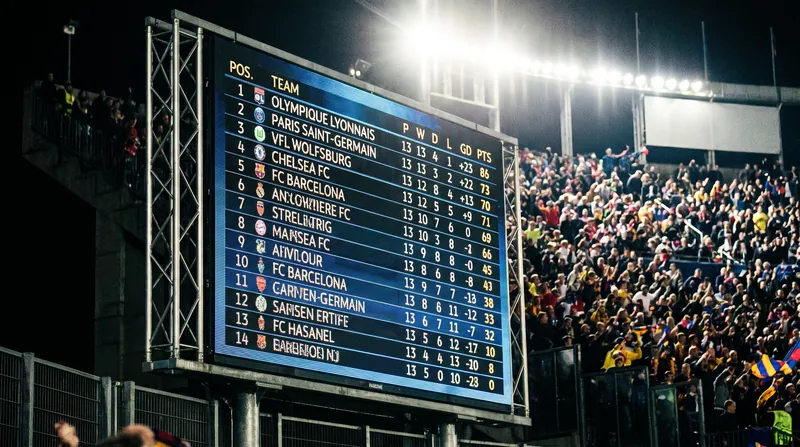
Under the "Swiss model" format—now entering its third season—traditional four-team groups are a thing of the past. Instead, all 36 clubs are ranked in a single massive league table. Every team will play eight matches against eight different opponents: four at home and four away. Crucially, a club's seeding pot no longer protects them from the elite.[1]
Because every team must play two opponents from each of the four pots, Manchester United's placement in Pot 2 offers no shelter. They are mathematically guaranteed to face two juggernauts from Pot 1. Since UEFA rules prohibit clubs from the same country meeting in the league phase, United will avoid English rivals Arsenal, Manchester City, and Liverpool.
That leaves a terrifyingly glamorous list of potential Pot 1 opponents. United will draw two teams from a pool that includes reigning titleholders Paris Saint-Germain, Spanish giants Real Madrid and Barcelona, German powerhouse Bayern Munich, Italian champions Inter Milan, and Atletico Madrid. For the global television audience and match-going supporters, it ensures the kind of heavyweight clashes that used to be reserved for the spring knockout rounds.
The rest of Pot 2 is equally stacked, featuring Europa League winners Aston Villa, Borussia Dortmund, Roma, Sporting CP, Porto, Club Brugge, Real Betis, and PSV Eindhoven. United will also have to navigate two fixtures against teams from this tier, further elevating the difficulty of their eight-game gauntlet.[1]
The sheer density of elite matchups is a feature, not a bug, of UEFA's redesigned tournament. The governing body overhauled the competition precisely to generate more high-stakes fixtures between top clubs early in the season, driving broadcast value and fan engagement. While the bloated schedule has sparked ongoing debates about player welfare—especially following the expanded 2026 FIFA World Cup—the entertainment value of the league phase is undeniable.[1]
To advance directly to the Round of 16, clubs must finish in the top eight of the 36-team table. Teams finishing between ninth and 24th will be forced into a treacherous two-legged playoff just to keep their European dreams alive, while the bottom 12 are eliminated entirely, with no safety net of dropping into the Europa League.
The path forward will be revealed on August 27, when UEFA conducts the league-phase draw. Gone are the days of drawn-out ceremonies with former players pulling plastic balls from glass bowls; the complexity of the Swiss model requires an artificial intelligence-driven automated draw to instantly map out the 144 league-phase fixtures. For Manchester United and their supporters, the computer's calculations will dictate just how steep their mountain back to the summit of European football will be.[1]
Key points
- Manchester United will be in Pot 2 for the 2026-27 UEFA Champions League draw after securing a top-five Premier League finish.
- The Swiss-model format requires every club to play two teams from each of the four seeding pots.
- United is mathematically guaranteed to face two Pot 1 heavyweights, such as Real Madrid, Bayern Munich, or PSG.
- The automated league-phase draw will take place on August 27, mapping out eight fixtures for all 36 clubs.
- The top eight teams in the unified league table advance directly to the Round of 16.
- Tournament Organizers
- Focus on maximizing the entertainment value and commercial revenue of early-season European fixtures.
- Club Management & Squads
- Must navigate the brutal reality of a denser, higher-difficulty schedule while managing player fatigue.
- Global Football Media
- Highlights the dramatic narratives and blockbuster matchups generated by the unshielded draw format.
Perspectives this story doesn't cover
- Domestic League Executives
- Mid-Tier European Clubs
Sources
Source coverage
1 outlets
3 viewpoints surfaced
- [1]FotMobTournament Organizers
2026–27 Champions League Projected Pots: Man Utd Guaranteed Tough Draw
Read on FotMob →
More in Sports
See all →Football Finance
The Four Pillars of Champions League Revenue: How Starting Fees, Performance, Coefficient, and Market Pool Split the €2.5 Billion Prize
6 sources
Draw Algorithm
How UEFA's Automated Software Executes the 36-Team Champions League Draw
4 sources

Stadium Infrastructure
Decoding UEFA Category 4 Stadium Standards: What It Takes to Host a Champions League Match
6 sources
Tournament Format
UEFA Champions League's 36-Team Swiss Model: League Phase and Knockout Playoff Rules
7 sources
Comments
Every angle. Every day.
Get Sports stories with full source coverage and perspective breakdowns, free every day.