
How UEFA's Automated Software Executes the 36-Team Champions League Draw
To accommodate the expanded 36-team Swiss model, UEFA replaced its traditional manual draw with a constrained algorithm that assigns eight opponents in milliseconds. The hybrid system prevents domestic clashes and mathematical dead ends, saving hours of stage time.
By Meera Iyer

Share this story
In short
- UEFA has replaced the fully manual Champions League draw with an automated software system to accommodate the 36-team Swiss model.
- A manual draw for the new format would have required nearly 1,000 balls and taken four hours to complete.
- The software instantly assigns eight opponents while enforcing constraints like country protection and geopolitical blocks.
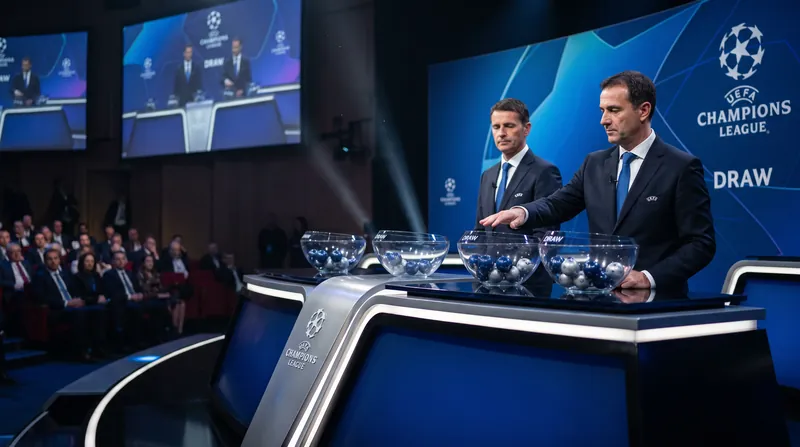
Inside the cavernous Grimaldi Forum in Monaco on the evening of August 27, 2026, the traditional theater of European football fundamentally changed. When a UEFA delegate reached into the glass bowl for Pot 1 and pulled out the ball for Inter Milan, there was no secondary bowl waiting to determine their fate.
Instead, a massive digital screen flashed above the stage. In less time than it takes to blink, an automated software system assigned the Italian champions their eight league-phase opponents—four at home, four away—and locked them into the bracket. The era of endless manual ball-shuffling was over, replaced by a silicon brain.
The stakes of this digital handover are immense, driven entirely by the mathematical weight of the new format. Under the old 32-team group stage, executives spent 45 minutes manually drawing balls to set the autumn calendar. But the expanded 36-team Swiss model, which requires each club to play eight different opponents across four seeding pots, broke the physical limits of a manual draw.
Executing the 2026/27 draw by hand would have required nearly 1,000 balls, 36 separate bowls, and up to four hours of grueling stage time. Faced with an untelevisable logistical nightmare, UEFA had no choice but to hand the keys to a proprietary algorithm.[3]
The resulting hybrid system operates on a strict, split-second sequence. The manual pull from the primary pot maintains the television spectacle and the illusion of physical randomness that fans expect. But the moment a club's name is revealed to the auditorium, the software takes over the actual decision-making.
"The draw will be conducted partly manually and partly automatically using software," UEFA's official guidelines state. "The software will automatically select eight different opponents, two from each pot, while also determining which matches will be played at home and which away." The human hand provides the prompt; the machine provides the answer.
To generate those fixtures without breaking the tournament, the algorithm must navigate a minefield of hard constraints in real time. The primary rule is domestic protection: teams from the same association cannot be drawn against each other, meaning a club like Inter Milan cannot face Juventus or Atalanta in the league phase.
Additionally, the software enforces a strict concentration limit, capping a club at a maximum of two opponents from any other single country. If a Spanish side draws Manchester City and Arsenal, the algorithm immediately blocks them from drawing Liverpool or Aston Villa.
Geopolitics adds another non-negotiable layer of complexity to the code. The software is hard-coded to respect UEFA's prohibited pairings, ensuring that clubs from conflicting nations—such as Armenia and Azerbaijan, or Kosovo and Serbia—cannot be matched under any circumstances. Every single time the software assigns an opponent to a club, it must instantly calculate whether that specific choice leaves a valid, rule-compliant path for the remaining 35 clubs waiting to be drawn. It is a massive logic puzzle solving itself live on stage.[2]
This challenge is known in computer science as the "dead end" problem. If the software simply picked valid opponents at random for the first few teams, it would inevitably reach a state where the final few clubs have no valid opponents left to play—forcing the entire draw to crash and restart.
To prevent this catastrophic failure, the system uses a constrained Fisher-Yates shuffle. Before it locks in a pairing on the screen, the algorithm looks ahead, verifying that at least one complete, valid draw remains mathematically possible for the rest of the board.[1]
Handing the most lucrative club competition in the world over to a black box naturally sparked intense transparency concerns among supporters. A single favorable draw can be worth tens of millions of euros in progression prize money, making the integrity of the algorithm paramount.
To build trust, UEFA had the software audited by Ernst & Young, while independent developers immediately built their own web simulators to verify the math. These public tools run the exact same logic and pot restrictions, proving to skeptical fans that the constraints dictate the outcomes, not a hidden hand.[1][2]
The result of this algorithmic heavy lifting is a compressed, high-stakes calendar that will define the European winter. The 36 clubs will navigate 18 matches per matchday, starting on September 8, 2026.
Because every team sits in a single unified league table rather than isolated groups, the qualification permutations will shift constantly with every goal scored across the continent. It all culminates on January 27, 2027, when the software's ultimate design is realized: an unprecedented final matchday where all 18 games kick off simultaneously, deciding the knockout bracket in real time.[1]
Terms to know
- Swiss Model
- A tournament format where all 36 teams compete in a single unified league table rather than being divided into separate groups.
- Fisher-Yates Shuffle
- A computer science algorithm used to generate a random permutation of a finite sequence, ensuring an unbiased draw.
- Dead End Problem
- A scenario in algorithmic draws where previous selections leave the remaining teams with no valid opponents to play.
- Country Protection
- A UEFA rule ensuring that clubs from the same national association cannot play each other during the league phase.
Questions readers ask
Why did UEFA stop doing a fully manual draw?
The new 36-team format requires each club to draw eight different opponents. Doing this manually would require nearly 1,000 balls and take up to four hours, making it logistically impossible to broadcast.
Can a team play a club from its own country?
No. The software is hard-coded with a country protection rule, meaning a team like Arsenal cannot be drawn against Manchester City or Liverpool in the league phase.
Is the automated software audited?
Yes. UEFA appointed the accounting firm Ernst & Young to audit the software and verify that it executes the draw fairly and randomly within the established constraints.
How many teams advance to the knockouts?
The top eight teams in the 36-team table advance automatically to the Round of 16, while teams finishing 9th through 24th enter a two-legged playoff round.
Different angles
UEFA Administrators
Tournament organizers who view the software as a logistical necessity for the expanded format.
For UEFA, the algorithmic draw is purely a matter of scale and broadcast viability. The governing body argues that executing a 36-team Swiss model draw manually would require 1,000 balls and four hours of stage time, making it unwatchable. By automating the opponent selection, they maintain the television spectacle of the initial ball pull while instantly resolving the complex mathematical constraints of the new league phase.
Traditionalist Supporters
Fans who remain skeptical of a 'black box' determining the fate of their clubs.
A vocal segment of the fanbase views the automated system with inherent suspicion. In a competition where a favorable draw can secure tens of millions of euros in prize money, traditionalists argue that removing the physical balls from the opponent-selection process damages transparency. Despite external audits by firms like Ernst & Young, these supporters feel that a software algorithm lacks the undeniable, visible fairness of a fully manual draw.
Data Analysts and Simulators
Independent developers who have embraced and verified the draw's underlying mathematics.
For the analytics community, the new draw is a fascinating logic puzzle rather than a conspiracy. Independent developers have built public simulators that replicate UEFA's exact constraints—such as country protection and geopolitical blocks—using Fisher-Yates shuffles. By running thousands of simulated draws, these analysts have demonstrated that the software's outcomes are dictated entirely by the strict rules of the format, effectively verifying the integrity of the algorithm from the outside.
- UEFA Administrators
- Tournament organizers who view the software as a logistical necessity for the expanded format.
- Traditionalist Supporters
- Fans who remain skeptical of a 'black box' determining the fate of their clubs.
- Data Analysts
- Independent developers who have embraced and verified the draw's underlying mathematics.
Perspectives this story doesn't cover
- Club Executives
- Broadcast Partners
Sources
Source coverage
4 outlets
3 viewpoints surfaced




- [1]Tips.ggData Analysts
How the Champions League Draw Simulator Works in Three Steps
Read on Tips.gg → - [2]Football-MDData Analysts
Champions League Draw Simulator and Probabilities
Read on Football-MD → - [3]The IndependentTraditionalist Supporters
How will the Champions League draw work?
Read on The Independent → - [4]Factlen Editorial Team
Synthesis by Factlen editorial team
Read on Factlen Editorial Team →
More in Sports
See all →Champions League Records
Erling Haaland Reaches 59 Champions League Goals in 59 Games, Closing in on Lionel Messi's Age Record
6 sources
Coefficient Rules
The 20% Association Floor and the Five-Year Rolling Average: How the UEFA Club Coefficient Actually Works
7 sources
Como 1907
The Relational Engine: How Cesc Fàbregas Engineered Como 1907's Historic Champions League Debut
6 sources

Tournament Rules
Opponent Performance and Disciplinary Points: The 10 Tie-Breakers for the Champions League League Phase
6 sources
Comments
Every angle. Every day.
Get Sports stories with full source coverage and perspective breakdowns, free every day.