
NASA-Backed Study Confirms Arctic Permafrost Is Now a Net Source of Greenhouse Gases
A comprehensive synthesis of satellite and ground data reveals that the Arctic permafrost region has transitioned from a carbon sink to a net emitter of greenhouse gases since 2000, crossing a critical climate threshold.

Share this story
In short
- A NASA-backed synthesis confirms the Arctic permafrost region has been a net greenhouse gas emitter since 2000.
- Microbes breaking down ancient organic matter in thawing soil release both carbon dioxide and potent methane.
- Winter emissions from microbes active beneath the snowpack completely offset the carbon absorbed by summer plant growth.
For millennia, the Arctic has functioned as the planet's freezer, locking away vast quantities of dead plant and animal matter in permanently frozen ground. This dynamic made the northern latitudes a reliable carbon sink, absorbing more greenhouse gases through summer plant growth than they released. However, a comprehensive new study backed by NASA and published in Nature Climate Change confirms that this era has ended. The Arctic permafrost region has officially transitioned into a net source of greenhouse gases.[1]
The research synthesizes over two decades of data, concluding that the tipping point was crossed quietly around the year 2000. Since then, the region has been emitting an estimated net 55 megatons of carbon equivalent annually. While this figure is currently dwarfed by human industrial emissions, the trajectory is steepening as the Arctic warms at nearly four times the global average rate.[2]
To build this evidence pack, researchers relied on two primary streams of data. The first comes from ground-based "eddy covariance" towers scattered across Alaska, Canada, and Scandinavia. These highly sensitive instruments measure the continuous exchange of carbon dioxide and methane between the ground and the atmosphere. By aggregating data from over 100 of these towers, scientists were able to map localized emission spikes with unprecedented accuracy.[3]
The second stream of evidence relies on orbital observation, heavily utilizing data from NASA's Arctic Boreal Vulnerability Experiment (ABoVE). Satellites equipped with advanced spectrometers and radar have tracked both the atmospheric plumes of greenhouse gases and the physical subsidence of the ground. As the ice within the permafrost melts, the land literally sinks, creating a recognizable topographical signature of carbon release.[1][3]
The mechanism driving this shift is fundamentally biological. When permafrost thaws, the organic material that has been frozen for thousands of years begins to decompose. Microbes wake up and consume the ancient carbon, respiring it back into the atmosphere. If the ground is dry, the microbes release carbon dioxide. If the ground is waterlogged—common in the Arctic's newly formed thermokarst lakes—they release methane.
Methane represents a particularly volatile variable in the permafrost equation. Although released in smaller volumes than CO2, methane is roughly 80 times more potent at trapping heat over a 20-year period. The study found that while summer plant growth still absorbs significant amounts of CO2, the continuous bubbling of methane from thawing wetlands tips the overall greenhouse gas budget into the red.[2]
Perhaps the most surprising evidence involves winter emissions. Historically, scientists assumed that microbial activity halted when the Arctic froze over in autumn. However, advanced sensors have revealed that microbes remain active in the unfrozen pockets of soil beneath the insulating snowpack. These winter emissions of CO2 slowly leak through the snow all season long, entirely offsetting the carbon absorbed by the region's brief summer greening.[1]
The evidence pack also highlights the accelerating role of boreal wildfires. As the Arctic dries out during hotter summers, massive fires burn not just the trees, but the organic peat soil itself. These "zombie fires" can smolder underground through the winter and reignite in the spring. By burning away the insulating layer of organic matter, fires expose the underlying permafrost to direct summer heat, triggering rapid, deep thaw.[2]
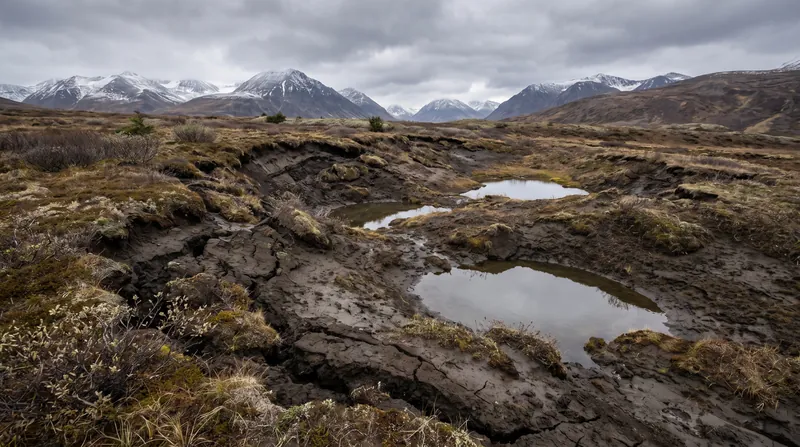
Despite the robust data, researchers acknowledge transparent areas of uncertainty. The most significant unknown is the rate of "abrupt thaw." Most climate models assume permafrost thaws gradually from the top down. However, field observations increasingly show abrupt collapses, where hillsides slump and deep layers of permafrost are exposed all at once. The current study attempts to quantify this, but notes that abrupt thaw could double the projected emissions over the next century.[3]
Another critical gap in the evidence is the lack of real-time data from Siberia, which holds the vast majority of the world's permafrost. Geopolitical tensions have severely restricted international scientific collaboration and data sharing with Russian monitoring stations. Consequently, the researchers had to rely more heavily on satellite extrapolation for the Eurasian Arctic, increasing the margin of error for global totals.[2]
The implications for global climate policy are profound. The Earth's permafrost contains an estimated 1,500 billion tons of carbon—nearly twice the amount currently in the atmosphere. Because this feedback loop is now active, the "carbon budget" available for humanity to burn while staying under the Paris Agreement's 1.5°C or 2.0°C limits is effectively shrinking.
Historically, the Intergovernmental Panel on Climate Change (IPCC) and global climate models have struggled to fully integrate permafrost emissions due to the complexity of the biological and physical processes. This new synthesis provides the hard numbers required to update those models, proving that nature's carbon sinks can no longer be relied upon to subsidize human emissions.[3]
Ultimately, the transition of the Arctic from a sink to a source represents a fundamental shift in the Earth system. It is no longer a theoretical tipping point modeled for the late 21st century; the evidence confirms it is an observed, ongoing reality that will shape global climate dynamics for generations.[1][3]
Jargon, explained
- Permafrost
- Ground, including rock or soil, that remains at or below the freezing point of water for two or more consecutive years.
- Thermokarst
- An uneven, marshy landscape created when ice-rich permafrost melts, causing the ground to collapse and form lakes or pits.
- Eddy Covariance
- A meteorological technique used to measure the exchange of gases (like CO2 and methane) between the earth's surface and the atmosphere.
- Carbon Feedback Loop
- A cycle where warming melts permafrost, releasing greenhouse gases, which in turn causes more global warming and further melting.
Common questions
Is the Arctic emitting more carbon than human activity?
No. Human industrial emissions are still vastly larger. However, permafrost emissions are accelerating and act as an unmanaged addition to the global total.
Does permafrost release carbon dioxide or methane?
It releases both. Dry thawing ground primarily releases carbon dioxide, while waterlogged ground (like newly formed lakes) releases methane, which is a much more potent greenhouse gas.
Can the permafrost refreeze if we stop global warming?
While surface layers can refreeze in winter, deep permafrost thaw is largely irreversible on human timescales. Stopping human emissions will only prevent further deep thawing.
Competing readings
Earth System Scientists
Focus on integrating satellite and ground data to accurately model the physical and biological mechanisms of the thaw.
For researchers studying the Earth as an interconnected system, the primary challenge is quantifying the exact rate of change. They emphasize that permafrost thaw is not a uniform process. While satellite data provides an excellent macro-level view of land subsidence and atmospheric gas plumes, the ground reality is highly variable. These scientists are particularly focused on modeling 'abrupt thaw'—events where ground collapse exposes deep layers of carbon all at once, a dynamic that current global climate models struggle to predict accurately.
Climate Policy Analysts
Emphasize how these natural emissions shrink the remaining human carbon budget and necessitate faster industrial emission cuts.
Policy analysts view the permafrost data through the lens of international climate agreements. Their core argument is that human carbon budgets—the amount of CO2 society can still emit while keeping warming below 1.5°C or 2.0°C—were calculated on the assumption that the Arctic would remain a relatively stable carbon sink. Now that the Earth itself is adding unmanaged emissions to the ledger, these analysts argue that the timeline for human decarbonization must be aggressively accelerated to compensate for the loss of nature's subsidy.
Field Ecologists
Highlight the localized impacts of thaw, such as changing hydrology, microbial winter activity, and the need for more ground sensors.
Ecologists working on the ground are focused on the biological drivers of the emissions. They point to the surprising resilience of soil microbes, which continue to metabolize ancient carbon even when buried under deep winter snow. This camp advocates for a massive expansion of ground-based monitoring, particularly eddy covariance towers, arguing that without localized data on soil moisture, vegetation shifts, and winter microbial activity, satellite data alone cannot provide a complete picture of the ecosystem's transformation.
- Earth System Scientists
- Focus on integrating satellite and ground data to accurately model the physical and biological mechanisms of the thaw.
- Climate Policy Analysts
- Emphasize how these natural emissions shrink the remaining human carbon budget and necessitate faster industrial emission cuts.
- Field Ecologists
- Highlight the localized impacts of thaw, such as changing hydrology, microbial winter activity, and the need for more ground sensors.
Perspectives this story doesn't cover
- Indigenous Arctic Communities
- Russian Climate Researchers
Sources
Source coverage
3 outlets
3 viewpoints surfaced



- [1]NASA Global Climate ChangeEarth System Scientists
NASA-Funded Research Reveals Arctic Permafrost Now Emitting More Carbon Than It Absorbs
Read on NASA Global Climate Change → - [2]The Washington PostClimate Policy Analysts
The Arctic is now emitting more carbon than it absorbs, NASA study finds
Read on The Washington Post → - [3]Factlen Editorial TeamField Ecologists
Synthesis by Factlen editorial team
Read on Factlen Editorial Team →
More in Science
See all →Permafrost Carbon
Major Study Finds Arctic Seabed Captures Most Carbon Released by Thawing Permafrost
5 sources
Climate Metrics
Earth's Energy Imbalance Reaches Record High, Signaling Accelerated Global Warming
5 sources

Climate Models
New Ocean Methane Feedback Loop Discovered, Threatening Accelerated Warming
6 sources

Permafrost Thaw
Global Permafrost Thaw Has Accelerated Since 2000, Confirms 20-Year Global Monitoring Study
6 sources
Comments
Every angle. Every day.
Get Science stories with full source coverage and perspective breakdowns, free every day.