
Memory Maker CXMT Swings to $20 Billion Profit as Global Chip Pricing Surges
The Chinese semiconductor manufacturer expects a massive financial windfall for the first nine months of 2026, reversing a prior-year loss. The surge is driven by a global deficit in standard DRAM as incumbents pivot to AI hardware.
By Wei Zhang

Share this story
The binding constraint for any semiconductor manufacturer's profitability is the global pricing cycle, and right now, that cycle is running at a historic peak. ChangXin Memory Technologies (CXMT) has converted this AI-driven supply shortage into a massive windfall, projecting a net profit of up to 132.5 billion yuan ($19.8 billion) for the first nine months of 2026.[1][2]
The Chinese memory maker's preliminary figures represent a violent swing from a 5.3 billion yuan loss during the exact same period last year. Revenue for the January-to-September window is expected to reach between 265 billion and 270 billion yuan.[1][3]
That top-line figure marks an eightfold increase from the 32.1 billion yuan the company recorded in 2025. This financial explosion is less about a sudden technological leap and more about a severe global deficit in dynamic random-access memory (DRAM).[2]
The standard memory vacuum
As artificial intelligence infrastructure demands massive computing power, the broader memory-chip field has experienced a boom that has sent component prices skyrocketing. CXMT is simply selling into a market that is desperate for supply.[2][4]
The scarcity premium driving these profits stems from a structural shift by the industry's dominant players. Major incumbents like Samsung, SK Hynix, and Micron have aggressively pivoted their fabrication lines toward high-bandwidth memory (HBM) to feed AI accelerators.[4]
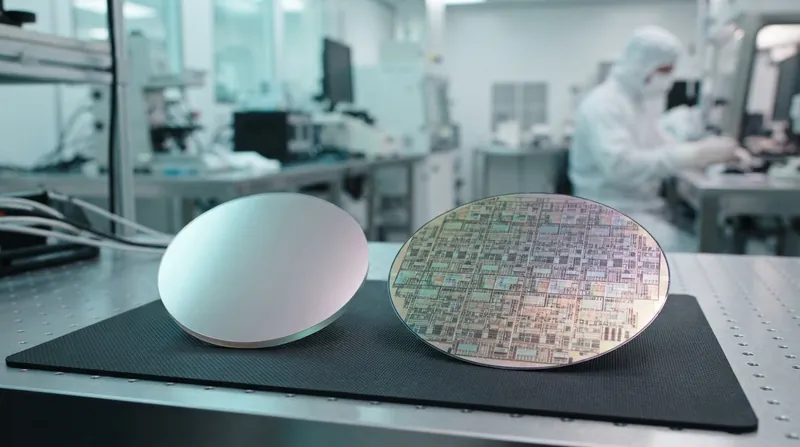
That pivot has left a vacuum in the market for standard server and consumer DRAM. CXMT has capitalized on this gap by aggressively expanding its wafer capacity and improving its factory utilization rates, allowing it to extract more functional chips from each silicon disc.[2][4]
By flooding the market with commodity memory, CXMT is effectively printing money on older-generation architectures. The sheer scale of the profit margin highlights the unusual operating conditions of the current supercycle, with average selling prices rising sharply since the second half of 2025.[1][4]
Technological claims and reality
The critical question is whether CXMT can turn a cyclical cash injection into durable technological parity. The company recently claimed it has achieved a breakthrough in chip technology that rivals pursued for years, announcing plans to roll out a new semiconductor with increased memory density.[2]
However, a distinction must be drawn between what has actually shipped and what is merely marketing language. While CXMT states its fifth-generation DRAM has entered mass production, outside testers have not yet independently verified the performance or yield rates of these denser chips at scale.[1][4]
The company is also pushing into mobile applications, claiming its forthcoming LPDDR6 memory has reached the client evaluation stage. Yet, achieving parity in press releases does not equal parity in the data center.[1][4]
Capitalizing on the windfall
Until these advanced architectures are deployed in volume by neutral third parties, their true competitive threat remains theoretical. To sustain its aggressive expansion, CXMT is deploying its newfound capital heavily, having listed on the Shanghai Stock Exchange in July.[1][4]
Alongside the preliminary earnings forecast, CXMT Chairman Zhu Yiming proposed a share buyback program worth between 1 billion and 2 billion yuan. The repurchased A-shares are earmarked for employee incentive plans, stock ownership schemes, or capital reduction.[1][3]
The dual announcement of a massive profit and an insider buyback is a calculated market signal. "A paired preliminary release of this kind, results alongside an insider buyback proposal, follows a familiar pattern in Chinese listings," noted the Newsquawk market desk.[3]
The geopolitical insulation
The firm added that chairmen historically propose repurchases when they view the equity as undervalued. CXMT's rise is occurring despite sustained efforts by the United States to restrict China's access to advanced semiconductor manufacturing equipment.[3][4]
The company has managed to advance its DDR5 and next-generation DRAM technology even with these export controls in place. By securing a larger share of the global DRAM market, CXMT is fulfilling Beijing's mandate for technological self-reliance.[4]
The company is now a vital domestic alternative for Chinese electronics manufacturers, insulating them from potential supply shocks if geopolitical tensions escalate further. Some Western brands have also begun integrating Chinese DRAM into their consumer memory kits.[1][4]
When the cycle turns
Yet, the company's insulation is only partial. While it can produce vast quantities of standard memory, the equipment bans make it significantly harder to transition to the extreme ultraviolet lithography required for the most advanced nodes.[4]
The staggering top-line numbers reflect a market anomaly rather than a permanent shift in semiconductor dominance. CXMT remains heavily dependent on the current pricing supercycle holding steady; if global supply normalizes or AI infrastructure spending cools, the scarcity premium will inevitably collapse.[4]
When memory prices fall, the industry returns to a brutal war of attrition based on manufacturing efficiency. Yet, the Chinese firm may not need to match its rivals perfectly to succeed.[4]
"CXMT needs only enough competitive capacity to shift the supply-demand balance and collapse the scarcity premium," wrote analysts at Deep Research Global. "Technological parity with established manufacturers is not required."[4]
Key points
- CXMT expects up to 132.5 billion yuan ($19.8 billion) in net profit for the first nine months of 2026, reversing a prior-year loss.
- The financial windfall is driven by a global shortage of standard DRAM as incumbent manufacturers pivot capacity toward AI-focused high-bandwidth memory.
- Chairman Zhu Yiming proposed a share buyback of up to 2 billion yuan, signaling executive confidence following the company's July public listing.
- The chipmaker claims its fifth-generation DRAM has entered mass production, though independent verification of its density and yield rates remains pending.
Unanswered questions
- Whether CXMT's fifth-generation DRAM and LPDDR6 chips can match the power efficiency and yield rates of established competitors in independent testing.
- How much of the 265 billion yuan in revenue came from older-generation commodity chips versus advanced server memory.
- How the company's profit margins will hold up once the current AI-driven memory supercycle ends and global supply normalizes.
- The full scope of the financial data, as current reporting relies on preliminary filings and coverage remains thin.
- Market Cycle Analysts
- Focuses on the macroeconomic forces of the memory supercycle, arguing the profits are driven by temporary scarcity.
- Domestic Industry Trackers
- Views CXMT's financial success as a milestone for China's domestic semiconductor ecosystem and its push for self-reliance.
- Equities & Trading Desks
- Analyzes the corporate signaling, such as insider buybacks, to gauge management confidence and market positioning.
Perspectives this story doesn't cover
- US Export Control Regulators
- End-user Electronics Manufacturers
Sources
Source coverage
4 outlets
3 viewpoints surfaced




- [1]The Next WebDomestic Industry Trackers
China's CXMT swings to a nearly $20B profit as memory prices soar
Read on The Next Web → - [2]The Edge MalaysiaDomestic Industry Trackers
China's CXMT swings to profit after memory chip prices surge
Read on The Edge Malaysia → - [3]NewsquawkEquities & Trading Desks
CXMT (688825 CH) preliminary January- September figures (CNY): Net income 131-132.5bln; Chairman proposed to buy back co. A-Shares worth CNY 1-2bln.
Read on Newsquawk → - [4]Deep Research GlobalMarket Cycle Analysts
Memory Chips: A Share Fight Inside a Supercycle
Read on Deep Research Global →
More in Technology
See all →Process Node
TSMC Reportedly Begins Pilot Production of 1.4nm Chips Ahead of 2028 Target
6 sources
AI Chip Demand
TSMC Reports Record Quarterly Profit Up 69% and Hikes 2026 Guidance on Surging AI Demand
5 sources
Processor Physics
Why the 60-Millivolt Thermal Limit Ended Dennard Scaling and Stalled Processor Voltages
6 sources
EUV Lithography
Matching Tin Plasma Emission to Molybdenum-Silicon Bragg Mirrors: Why Extreme Ultraviolet Lithography Operates at 13.5 Nanometers
5 sources
Comments
Every angle. Every day.
Get Technology stories with full source coverage and perspective breakdowns, free every day.