
Kinetic Energy vs. Battery Chemistry: Why Regenerative Braking Recovers Only 70% of a Vehicle's Momentum
Electric vehicle motors can capture up to 85% of a car's kinetic energy during deceleration, but chemical bottlenecks in the battery pack prevent the system from achieving perpetual motion.
By Dev Anand

Share this story
In short
- Regenerative braking turns the electric motor into a generator, capturing kinetic energy during deceleration.
- While the motor is up to 85% efficient, the battery's chemical limits reduce total recovered energy to roughly 60-70%.
- Gradual deceleration captures more energy than hard braking, which often exceeds the battery's charge acceptance rate.
A traditional friction brake converts a 4,000-pound vehicle's forward momentum entirely into waste heat, wearing down pads and rotors in the process. Regenerative braking flips this equation by turning the electric motor into a generator, but a strict bottleneck in battery chemistry prevents it from capturing every kilowatt of that kinetic energy.[5][9]
For an electric vehicle owner navigating daily commutes in 2026, this distinction dictates both real-world range and long-term maintenance costs. When a driver lifts their foot off the accelerator, the vehicle's kinetic energy drives the motor in reverse, generating electricity that flows back into the high-voltage battery pack.[1][7]
According to engineering data compiled by Stanford University, a standard EV motor operating as a generator can run at roughly 80 to 85 percent efficiency. This means the vast majority of the rotational energy at the wheels is successfully converted into electrical current before it ever reaches the battery.[3]
However, generating the current is only the first half of the equation. The bottleneck occurs when that sudden surge of electricity hits the battery pack. Batteries rely on chemical reactions to store energy, and they can only absorb electrons at a specific rate without overheating or degrading the lithium-ion cells.[4][9]
Calculations published by EVKX.net reveal that during hard deceleration, an electric motor can generate power spikes exceeding 100 kilowatts. Most battery management systems will throttle this incoming charge to protect the pack, especially if the battery is already near full capacity or if ambient temperatures are near freezing.[4]
This charge acceptance limit means that a portion of the generated electricity cannot be stored and must be bled off, or the vehicle must seamlessly blend in the physical friction brakes to shed the remaining speed. Greening Inc notes that this blending process is critical for safety, ensuring the vehicle stops predictably even when the battery cannot accept more regenerative current.[5]
The net result is a round-trip efficiency that falls short of perpetual motion. By the time the kinetic energy is converted to electricity, pushed through the inverter, stored in the battery, and eventually sent back to the motor to accelerate again, the total recovered energy available at the wheels sits closer to 60 or 70 percent.[3][9]
This physical reality explains why an EV cannot fully recharge its battery simply by driving down a steep mountain grade. The 30 to 40 percent loss to heat, aerodynamic drag, and chemical resistance means every cycle of acceleration and braking results in a net loss of total system energy.[1][4]
For the buyer, this translates directly into how they should drive to maximize range. Engadget highlights that anticipating stops and allowing the vehicle to decelerate gradually over a longer distance keeps the generated current below the battery's acceptance threshold, capturing far more energy than a sudden, hard stop.[2]
Data published in 2024 by Mazda USA emphasizes that different manufacturers tune this regenerative curve differently. Some prioritize a natural, coasting feel that mimics a gas-powered automatic transmission, while others default to aggressive one-pedal driving that maximizes energy capture the moment the accelerator is released.[7]
Beyond range extension, the most immediate financial benefit for an EV owner is the dramatic reduction in brake wear. The Alberta Motor Association (AMA) reports that because the electric motor handles the vast majority of routine deceleration, physical brake pads on an EV can often last well over 100,000 miles before requiring replacement.[8]
Yet, this lack of use introduces a new maintenance challenge: rust. Tires Plus warns that in wet or snowy climates, the physical brake rotors can corrode from underuse. Owners are often advised to occasionally perform a hard stop in a safe environment to engage the friction brakes and scrub the rotors clean. Because the available reference materials focus strictly on mathematical models and consumer advice rather than primary interviews, they do not contain direct quotations from the engineers designing these systems.[6]
Viewpoints in depth
Aggressive One-Pedal Driving
Maximizes energy recovery by applying heavy motor resistance the moment the accelerator is released.
For: Captures the maximum possible kinetic energy during stop-and-go city driving, extending urban range by up to 15-20%. It also reduces driver fatigue by largely eliminating the need to pivot between the accelerator and the brake pedal. Against: Can induce motion sickness for passengers if the driver lacks smooth pedal control, and it is less efficient at highway speeds where maintaining momentum is more critical than capturing it. Fits well when: Navigating dense, low-speed urban traffic. Does not fit when: Cruising on open highways or driving with passengers sensitive to sudden deceleration.
Low-Resistance Coasting
Prioritizes maintaining forward momentum, mimicking the feel of a traditional internal combustion vehicle in neutral.
For: Highly efficient for highway driving, as it avoids the conversion losses inherent in sending energy back and forth to the battery. Kinetic energy is used purely to cover distance without mechanical drag. Against: Requires active use of the brake pedal to stop, which may engage the physical friction brakes earlier and reduce total energy recovery in city environments. Fits well when: Driving at sustained highway speeds or on long, flat rural roads. Does not fit when: Navigating steep descents or heavy stop-and-go traffic where braking is unavoidable.
Blended Braking Systems
Uses the brake pedal to seamlessly transition between regenerative motor resistance and physical friction brakes.
For: Provides a familiar, predictable pedal feel for drivers transitioning from gas vehicles. The vehicle's computer automatically maximizes regenerative braking up to the battery's limit before applying the brake pads, requiring no change in driving habits. Against: Complex software and hardware integration can sometimes result in a non-linear or 'spongy' brake pedal feel, particularly when the battery is full and regen is suddenly unavailable. Fits well when: A manufacturer wants to prioritize mass-market accessibility and a traditional driving experience. Does not fit when: Enthusiast drivers demand raw, unfiltered feedback from the mechanical braking system.
- Efficiency Maximizers
- Advocates for aggressive one-pedal driving to capture the maximum possible kinetic energy in urban environments.
- Traditional Driving Advocates
- Prefers a coasting dynamic that mimics internal combustion vehicles, relying on momentum rather than heavy regeneration.
- Automotive Engineers
- Focuses on the thermal and chemical limits of the battery pack, balancing energy recovery with cell longevity and safety.
Perspectives this story doesn't cover
- Battery cell chemists working on high-acceptance rate solid-state batteries
- Independent mechanics dealing with rusted EV brake calipers
Sources
Source coverage
9 outlets
3 viewpoints surfaced









- [1]go-e ChargerEfficiency Maximizers
How to Maximise EV Range with Regenerative Braking
Read on go-e Charger → - [2]EngadgetEfficiency Maximizers
5 Easy Ways To Get More Range Out Of Your EV
Read on Engadget → - [3]StanfordAutomotive Engineers
Regenerative Braking Efficiency
Read on Stanford → - [4]EVKX.netAutomotive Engineers
Regenerative braking calculations: energy, power and real-world recovery
Read on EVKX.net → - [5]Greening IncAutomotive Engineers
Regenerative braking: Technology benefits and limitations
Read on Greening Inc → - [6]Tires Plus
Regenerative Braking: Advantages, Disadvantages, & How It Works
Read on Tires Plus → - [7]Mazda USATraditional Driving Advocates
What Is Regenerative Braking and How Does it Work?
Read on Mazda USA → - [8]AMA
How Regenerative Braking Works in your Electric Vehicle
Read on AMA → - [9]Factlen Editorial Team
Synthesis by Factlen editorial team
Read on Factlen Editorial Team →
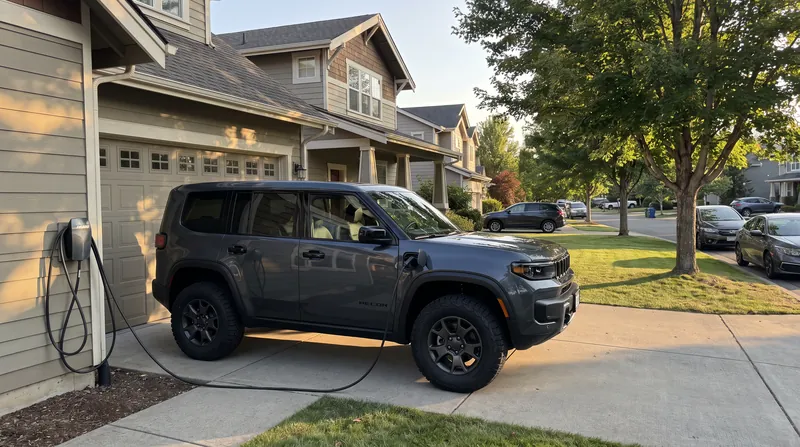
More in Automotive & Transportation
See all →EV Economics
The Economics of the Driveway: Battery-Electric vs. Internal Combustion in Late 2026
4 sources
Powertrain Efficiency
The 60% Well-to-Wheel Energy Loss: Why Hydrogen Fuel Cells Trail Battery-Electric Vehicles in Grid Efficiency
6 sources
Robotaxi Architectures
Vision-Only vs. Sensor Fusion: The Hardware Divide Defining the Robotaxi Market
6 sources
Bidirectional Charging
Comparing V2G, V2H, and Smart Charging: Hardware Costs, Backup Needs, and Grid Trade-Offs
9 sources
Comments
Every angle. Every day.
Get Automotive & Transportation stories with full source coverage and perspective breakdowns, free every day.