
Japanese Torpedo Sinks US Navy Vessel in Friendly Fire Incident During Valiant Shield Exercise
A Japanese submarine accidentally sank a U.S. Navy Littoral Combat Ship during a joint live-fire drill in the Philippine Sea, halting the massive Valiant Shield exercise and triggering a joint investigation.
By Anaya Sharma

Share this story
A major joint military exercise in the Pacific Ocean was abruptly halted on Friday after a Japanese submarine accidentally fired a live torpedo that struck and sank a United States Navy Littoral Combat Ship.
The unprecedented friendly fire incident occurred during Valiant Shield 2026, a massive biennial drill held in the Philippine Sea designed to showcase the integrated combat capabilities of the U.S. and its regional allies. According to initial reports from the U.S. Indo-Pacific Command, the torpedo struck the American vessel amid a complex anti-surface warfare drill, causing catastrophic structural damage that forced an immediate abandon-ship order.[1]
Despite the rapid sinking of the vessel, military officials confirmed that all American sailors aboard were safely evacuated with no reported fatalities. Search and rescue helicopters from nearby carrier strike groups responded within minutes, pulling the crew from the water and life rafts. Several sailors sustained minor injuries during the evacuation and are currently receiving medical treatment aboard a U.S. Navy hospital ship deployed for the exercise. The swift rescue operation averted what could have been the deadliest naval disaster for the U.S. military in decades.
The incident immediately triggered a diplomatic crisis, prompting the Japanese government to issue a formal and profound apology to Washington. Japanese Defense Ministry officials held an emergency press conference in Tokyo, taking full responsibility for the catastrophic error. The Japanese Prime Minister reportedly contacted the White House directly to express deep regret and to pledge total transparency in the forthcoming investigation. Tokyo has ordered an immediate stand-down of its submarine fleet's live-fire operations pending a comprehensive safety review.[2]
Military analysts and naval engineers are now focused on determining the exact mechanism of the failure. Preliminary assessments suggest that the Japanese submarine fired a heavyweight acoustic homing torpedo intended for a decommissioned target hulk positioned several miles away. However, the weapon's guidance system appears to have malfunctioned or been confused by the acoustic signature of the U.S. Littoral Combat Ship, causing it to break its intended track and acquire the friendly vessel instead.
The technological implications of the malfunction are significant, particularly given the heavy emphasis the U.S. and Japan place on interoperability. Valiant Shield is specifically designed to test how seamlessly allied forces can share targeting data, communicate across secure networks, and operate in close proximity during high-intensity combat scenarios. If the torpedo's data-link failed to recognize the allied ship's transponder codes, it exposes a critical vulnerability in the integrated combat systems that form the backbone of the allied deterrence strategy in the Pacific.
The geopolitical timing of the disaster is highly sensitive. Valiant Shield 2026, involving over 12,000 personnel, multiple carrier strike groups, and advanced aircraft, was widely viewed as a direct show of force intended to deter Chinese military assertiveness in the South China Sea and around Taiwan. The sudden suspension of the exercise and the loss of a U.S. warship severely undercut the intended message of allied naval supremacy and flawless tactical coordination.
Adversaries in the region have already begun capitalizing on the incident. Chinese state media outlets quickly amplified the news, framing the friendly fire disaster as evidence of Western military incompetence and a reckless disregard for maritime safety. Editorials in Beijing-aligned publications argued that the U.S. and its allies are a destabilizing force in the Indo-Pacific, using the sunken ship as a metaphor for the fragility of the Washington-Tokyo alliance.
In Washington, the reaction has been a mix of relief over the lack of casualties and intense scrutiny of allied operational protocols. Congressional defense committees have announced plans to hold classified briefings on the incident, demanding answers on how a modern, multi-million-dollar weapon system could fail so catastrophically. Lawmakers are questioning whether the push for rapid integration with allied navies has outpaced the implementation of necessary safety fail-safes.[2]
The U.S. Navy and the Japanese Maritime Self-Defense Force have established a joint review board to conduct a thorough investigation. The board will analyze telemetry data from the submarine, acoustic recordings from the exercise area, and maintenance records for the specific batch of torpedoes used. The findings will be critical in determining whether the failure was an isolated hardware defect, a software glitch in the targeting algorithms, or a human error in the firing sequence.[1]
Looking ahead, the immediate priority for the U.S. Navy is securing the wreck site in the Philippine Sea. Salvage operations are being planned to recover sensitive cryptographic equipment, weapon systems, and classified communication gear from the sunken Littoral Combat Ship before foreign intelligence assets can attempt to access them. The long-term impact on the U.S.-Japan alliance remains to be seen, but military leaders on both sides have emphasized that the partnership must endure and adapt in the face of this unprecedented tragedy.
Key points
- A Japanese submarine accidentally sank a U.S. Navy Littoral Combat Ship during the Valiant Shield exercise.
- All American crew members were safely evacuated by nearby search and rescue teams, with only minor injuries reported.
- The Japanese government issued a formal apology and grounded its submarine fleet's live-fire operations.
- A joint review board is investigating whether the torpedo suffered a hardware defect or a targeting software glitch.
Unanswered questions
- Whether the torpedo's failure was caused by a hardware defect, a software glitch, or human error.
- How much classified technology on the sunken Littoral Combat Ship can be successfully salvaged.
- The long-term impact this incident will have on the rules of engagement for future joint U.S.-Japan naval exercises.
How we got here
Friday Morning
U.S. and Japanese forces commence a complex anti-surface warfare live-fire drill in the Philippine Sea.
Shortly After Launch
A Japanese submarine fires a torpedo that breaks its intended track and strikes a U.S. Littoral Combat Ship.
Within Minutes
The U.S. vessel issues an abandon-ship order, and nearby helicopters successfully evacuate the entire crew.
Friday Afternoon
The Valiant Shield exercise is officially halted, and Japan issues a formal diplomatic apology to the United States.
- US Military Leadership
- Focuses on the successful evacuation of the crew and the need to investigate technical failures without permanently damaging the alliance.
- Japanese Defense Officials
- Takes full responsibility for the incident, emphasizing a commitment to transparency and a comprehensive review of their submarine fleet's targeting systems.
- Geopolitical Analysts
- Views the incident as a major strategic setback that undermines the intended show of force against regional adversaries.
- Chinese State Media
- Frames the disaster as proof of Western military incompetence and a sign that the U.S.-Japan alliance is a destabilizing force in the region.
Perspectives this story doesn't cover
- Families of the evacuated crew members
- Local Philippine maritime authorities
Sources
Source coverage
2 outlets
4 viewpoints surfaced


- [1]ReutersJapanese Defense Officials
US Navy ship sinks after accidental torpedo strike by Japanese submarine
Read on Reuters → - [2]Fox NewsGeopolitical Analysts
New York Harbor whale strike sinks fire rescue boat after July 4 celebrations
Read on Fox News →
More in News & Politics
See all →PLA Armor
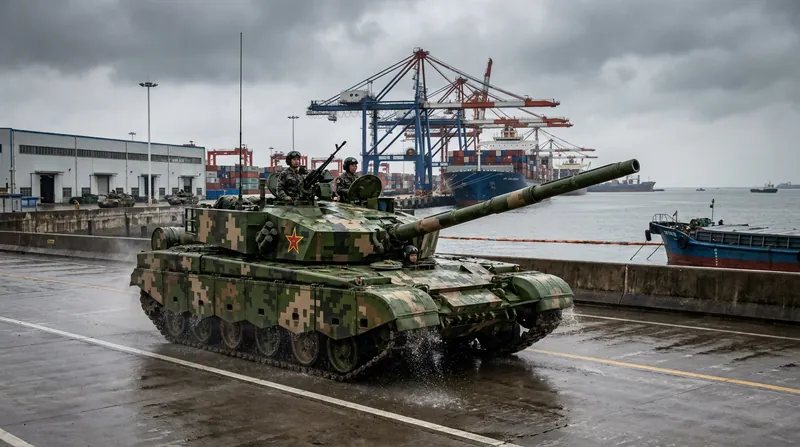
China Deploys Premier Type 99 Heavy Tanks to Coastal Units Facing Taiwan and Japan
4 sources
Military Space
US Army Establishes Dedicated Space Operations Branch in Major Strategic Shift
3 sources
Ukraine Air War
Ukraine Signs $2.5 Billion Contract With Sweden for Gripen E Fighters, Securing Major Air Force Upgrade
4 sources
NATO Posture
Pentagon Discloses Massive Cuts to Strategic Military Assets Available to NATO
3 sources
Comments
Every angle. Every day.
Get News & Politics stories with full source coverage and perspective breakdowns, free every day.