
How Twistlocks and Lashing Rods Prevent Container Stacks From Collapsing During Parametric Rolling
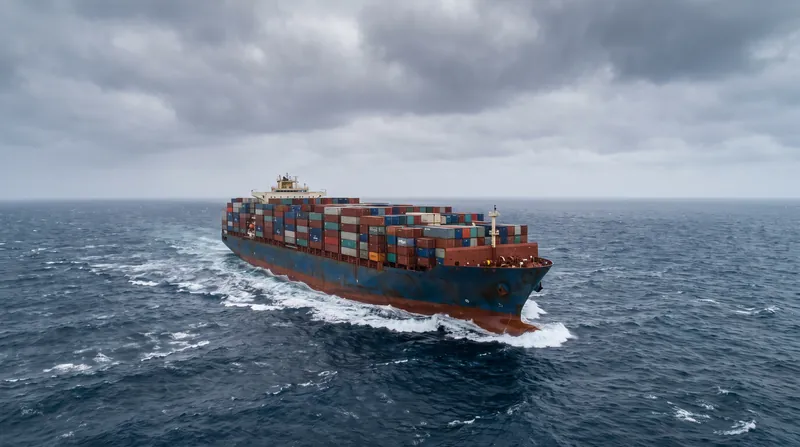
Modern ultra-large container vessels depend on a precise geometry of steel rods and locking cones to secure cargo against extreme ocean forces. When wave patterns trigger violent side-to-side parametric rolling, this securing system becomes the only barrier preventing thousands of tons of cargo from tearing loose.

Share this story
In short
- Semi-automatic twistlocks and lashing rods form a rigid matrix that prevents container stacks from separating or distorting under extreme ocean forces.
- Parametric rolling occurs when wave patterns perfectly match half a ship's natural roll period, violently amplifying the vessel's side-to-side motion.
- During severe rolls, the structural frames of the lowest containers often crush under racking forces before the steel lashing rods actually break.
Before a vessel leaves port, the ship's master and cargo planners decide exactly how thousands of steel boxes will be stacked and secured on deck. They rely on a calculated matrix of semi-automatic twistlocks and lashing rods to lock the tiers together. Once the ship enters open water, the crew can no longer adjust these external lashings, leaving the vessel's structural integrity entirely dependent on those initial port-side calculations.[6]
The foundation of this system is the semi-automatic twistlock, a forged steel device inserted into the corner castings of containers. Stevedores place these twistlocks into the bottom corners of a container before a crane lowers it onto the tier below. The weight of the descending box triggers a spring-loaded mechanism, automatically locking the containers together with a safe working load of roughly 250 kilonewtons in tension.[6]
While twistlocks prevent vertical separation, lashing rods provide the lateral cross-bracing required to keep the stack rigid. These heavy steel bars connect the bottom corners of the second or third tier of containers to the deck or a raised lashing bridge. Crew members tighten turnbuckles on the rods to remove slack, creating a diagonal tension that resists the side-to-side forces generated by the ocean.[6]
This securing geometry is meticulously designed to withstand standard maritime conditions, but the physics change dramatically when a vessel encounters a specific wave resonance. The most severe threat to these steel connections is a hydrodynamic phenomenon known as parametric rolling.[6]
The Mechanics of Parametric Roll
Parametric rolling occurs when a ship travels through head or following seas and the wave encounter period matches approximately half the vessel's natural roll period. As the wave crests pass the midships section, the hull's waterplane area decreases, reducing the ship's transverse stability.[3]
When the wave trough reaches the midships, the wider sections of the bow and stern are submerged, suddenly increasing stability and violently pushing the ship back upright. This alternating loss and gain of stability acts like a child pumping their legs on a swing, amplifying the roll angle with each successive wave.[3]
Within a matter of minutes, a massive container ship can develop roll angles exceeding 30 degrees, even in relatively moderate wave heights. The Maritime Research Institute Netherlands launched the TopTier project in 2021 to study this exact mechanism, utilizing scaled model tests to quantify how modern hull forms interact with these specific wave frequencies.[3]
The MARIN TopTier simulations demonstrated that ultra-large container vessels, with their pronounced bow flares and wide flat sterns, are particularly susceptible to these rapid stability variations. The resulting transverse accelerations at the top of a container stack, which can sit 40 meters above the waterline, are immense.[3]
Transverse Acceleration and Racking
As the ship whips from side to side, the containers in the upper tiers act as a massive pendulum. The primary force exerted on the lower containers is racking, which is the tendency of the rectangular steel frame to distort into a parallelogram under lateral load.[1][2]
The lashing rods bear the brunt of this racking force, transferring the load from the container frames down into the ship's reinforced deck structures. If the transverse acceleration exceeds the design limits, the tension on the turnbuckles and rods can surpass their breaking strength of approximately 500 kilonewtons.[2]
Simultaneously, the semi-automatic twistlocks face extreme shear and tension forces as the stack tries to tip outward. The corner castings of the containers themselves, rather than the solid steel twistlocks, often become the weak link in this structural chain.[1][2]
When the racking forces exceed the structural limits of the lowest container in a stack, its steel frame buckles. This transfers the entire dynamic load of the upper tiers onto the adjacent stacks, creating a cascading failure that the lashing system was never designed to arrest.[1]
When the Securing System Fails
The consequences of these forces exceeding the hardware's limits are documented in multiple marine casualty investigations. In January 2018, the UK Marine Accident Investigation Branch investigated the loss of 137 containers from the CMA CGM G. Washington in the North Pacific.[1]
The MAIB report concluded that the vessel experienced heavy rolling, reaching an estimated 20 degrees, which triggered the collapse. The investigation found that the structural limits of the containers were exceeded before the securing gear failed, demonstrating that even perfectly tensioned lashing rods cannot save a stack if the boxes themselves crush.[1]
Similarly, the Australian Transport Safety Bureau investigated the June 2018 loss of 81 containers from the YM Efficiency off the coast of New South Wales. The ATSB determined that the ship experienced a rapid succession of heavy rolls, generating transverse accelerations that overwhelmed the lashing system and the container frames.[2]
In both cases, the initial failure of a single stack led to a domino effect, with collapsing containers striking and dislodging adjacent rows. The sheer mass of a collapsing 10-tier stack easily shears the semi-automatic twistlocks of neighboring containers, sending thousands of tons of cargo into the ocean.[1][5]
Routing Around the Resonance
Because the crew cannot reinforce the lashing rods once a storm begins, the only defense against parametric rolling is for the ship's master to alter the vessel's hydrodynamic interaction with the waves. The master must break the resonance by changing the wave encounter period.
The master achieves this by altering the ship's course or reducing its speed. Turning the vessel just 10 to 15 degrees away from a pure head sea or following sea can disrupt the timing of the wave crests passing the hull, instantly dampening the parametric roll amplification.
However, recognizing the onset of parametric rolling in the chaotic environment of a North Pacific winter storm is notoriously difficult. By the time the bridge crew registers the abnormal roll period, the transverse accelerations may have already exceeded the safe working loads of the lashing rods on the aft deck.
The World Shipping Council tracks the outcome of these incidents globally. In its 2024 update, the organization noted that while the total number of containers lost at sea remains a tiny fraction of the 250 million transported annually, severe weather events continue to drive the major losses.[4]
"The liner shipping industry works continuously to enhance safety," the World Shipping Council stated in the 2024 report, highlighting ongoing efforts to improve weather routing and securing standards. These efforts include the deployment of stiffer lashing bridges that allow rods to reach higher tiers, reducing the racking loads on the lowest containers.[4]
The integrity of global supply chains relies entirely on the precise tension of steel turnbuckles and the forged cones of semi-automatic twistlocks. Until active stabilization systems can counter these massive forces, avoiding resonant wave frequencies remains the only guaranteed method to keep the stacks intact.[6]
How we did this
- Method
- Synthesizing accident investigation data with hydrodynamic model tests to quantify the specific failure thresholds of container securing systems under parametric roll conditions.
- What we found
- The securing gear (twistlocks and lashing rods) rarely fails first; instead, the extreme transverse accelerations of parametric rolling typically cause the structural racking limits of the lowest containers to be exceeded before the steel lashings snap, transferring catastrophic loads to the twistlocks.
- What we worked from
- CMA CGM G. Washington roll angles and container loss count: 20 degrees, 137 containers — Marine Accident Investigation Branch
- YM Efficiency container loss count: 81 containers — Australian Transport Safety Bureau
- Parametric roll amplification mechanisms: TopTier model tests — MARIN
- Limits of this analysis
- Analysis relies on post-incident modeling and scaled tank tests, which cannot perfectly replicate the chaotic multi-directional wave states of an actual ocean storm.
Key terms
- Parametric rolling
- A violent side-to-side motion triggered when a ship's natural roll period aligns with the frequency of passing waves, rapidly amplifying the roll angle.
- Semi-automatic twistlock
- A forged steel locking device placed between vertically stacked containers that automatically engages when a box is lowered onto it.
- Lashing rod
- A heavy steel bar equipped with a turnbuckle used to diagonally cross-brace container stacks to the ship's deck.
- Racking force
- The lateral pressure that attempts to distort a rectangular container frame into a parallelogram shape.
- Waterplane area
- The two-dimensional cross-section of a ship's hull where it intersects the surface of the water.
Frequently asked
Can the crew tighten the lashings during a storm?
No. Once a vessel enters heavy seas, it is too dangerous for stevedores or crew members to access the exposed weather decks to adjust turnbuckles or twistlocks.
Why do modern ships suffer from parametric rolling more often?
Ultra-large container vessels feature wide bow flares and flat sterns to maximize cargo space, which causes more extreme variations in stability as waves pass along the hull.
What happens when a container stack collapses?
The collapsing stack acts as a massive pendulum, striking adjacent rows with enough force to shear their twistlocks and trigger a cascading loss of cargo overboard.
Viewpoints in depth
Naval Architects
Focus on hull form optimization and lashing bridge design.
Naval architects emphasize that the root cause of parametric rolling lies in the hull geometry of ultra-large container vessels. The pronounced bow flares and wide, flat sterns required to maximize cargo capacity inherently create massive variations in waterplane area as waves pass along the hull. To counter this, designers are increasingly incorporating higher lashing bridges, which allow securing rods to reach the third or fourth tiers of containers, significantly reducing the racking loads on the vulnerable bottom boxes.
Ship Masters and Crew
Focus on weather routing and real-time vessel handling.
For the officers on the bridge, parametric rolling is a dynamic operational hazard that must be managed through active vessel handling. Because the crew cannot adjust external lashings once a storm begins, their primary defense is altering the ship's course or speed to break the resonant wave encounter period. Masters rely on advanced weather routing software and real-time motion sensors to detect the early onset of parametric roll, allowing them to turn the vessel 10 to 15 degrees and dampen the amplification before transverse accelerations exceed the securing gear's limits.
Marine Investigators
Focus on structural limits and cascading failure modes.
Accident investigators from agencies like the MAIB and ATSB consistently find that the steel securing gear is rarely the first component to fail during a severe roll event. Their analyses demonstrate that the extreme transverse accelerations typically cause the corner castings or steel frames of the lowest containers to crush under racking forces. Once a single container buckles, the entire stack loses its structural integrity, transferring catastrophic dynamic loads to adjacent rows and triggering a domino effect that shears twistlocks across the deck.
- Naval Architects
- Focus on hull form optimization and lashing bridge design.
- Marine Investigators
- Focus on structural limits and cascading failure modes.
- Industry Operators
- Focus on weather routing and global safety trends.
Perspectives this story doesn't cover
- Port Stevedores
- Container Manufacturers
Sources
Source coverage
6 outlets
3 viewpoints surfaced




- [1]Marine Accident Investigation BranchMarine Investigators
Loss of cargo containers overboard from container ship CMA CGM G. Washington
Read on Marine Accident Investigation Branch → - [2]Australian Transport Safety BureauMarine Investigators
Loss of containers overboard involving YM Efficiency, 16 NM east-south-east of Newcastle, New South Wales, on 1 June 2018
Read on Australian Transport Safety Bureau → - [3]MARINNaval Architects
TopTier model tests and simulations on parametric roll behaviour of two large container vessels
Read on MARIN → - [4]World Shipping CouncilIndustry Operators
World Shipping Council Releases Containers Lost at Sea Report – 2024 Update
Read on World Shipping Council → - [5]Marine Accident Investigation BranchMarine Investigators
Loss of cargo containers overboard from container ship Ever Smart
Read on Marine Accident Investigation Branch → - [6]Factlen Editorial Team
Synthesis by Factlen editorial team
Read on Factlen Editorial Team →
More in Transportation
See all →Naval Blockade
US Fighter Jet Disables Panama-Flagged Cargo Ship in Gulf of Oman Amid Blockade
5 sources

Hydrodynamics
Under-Keel Water Acceleration Drops Hydrodynamic Pressure: Why Moving Ships Squat Toward the Seabed in Shallow Channels
6 sources
Maritime Safety
Water Density Differentials and a 1/48th Draft Margin: How the 1966 Load Line Convention Calculates Plimsoll Freeboard Marks
9 sources
Maritime Law
York-Antwerp Rules: Sharing the Cost of Sacrificed Cargo in Maritime Emergencies
7 sources
Comments
Every angle. Every day.
Get Transportation stories with full source coverage and perspective breakdowns, free every day.