
Direct Versus Indirect Potable Reuse: Regulatory, Energy, and Cost Trade-Offs
As municipalities face growing water scarcity, the engineering choice between direct and indirect potable reuse dictates the financial, energetic, and regulatory footprint of their water infrastructure.
By Hao Li

Share this story
In short
- Indirect potable reuse (IPR) uses natural buffers like lakes or aquifers to store and filter treated wastewater before drinking.
- Direct potable reuse (DPR) bypasses natural buffers, piping highly purified water directly into the municipal supply.
- DPR systems require significantly higher upfront capital to build advanced membrane and oxidation facilities.
The defining moment in modern wastewater reclamation occurs at the discharge valve: whether highly purified water is routed into a natural reservoir, or piped directly into a municipal drinking supply. That single routing decision—the presence or absence of an environmental buffer—separates indirect potable reuse (IPR) from direct potable reuse (DPR). It dictates the regulatory framework, the required treatment technology, and the ultimate energy footprint of the water system. As municipalities face stressed aquifers and population growth, choosing between these two pathways has become the central infrastructure question for water managers.[4]
Indirect potable reuse relies on nature to provide a final layer of filtration and time. In this model, wastewater is treated and then discharged into a groundwater aquifer, lake, or river. The U.S. Environmental Protection Agency notes that this environmental buffer provides retention time and natural attenuation before the water is withdrawn and treated again at a conventional drinking water plant. Because it mimics the natural water cycle, IPR has historically enjoyed greater public acceptance and regulatory approval.[4]
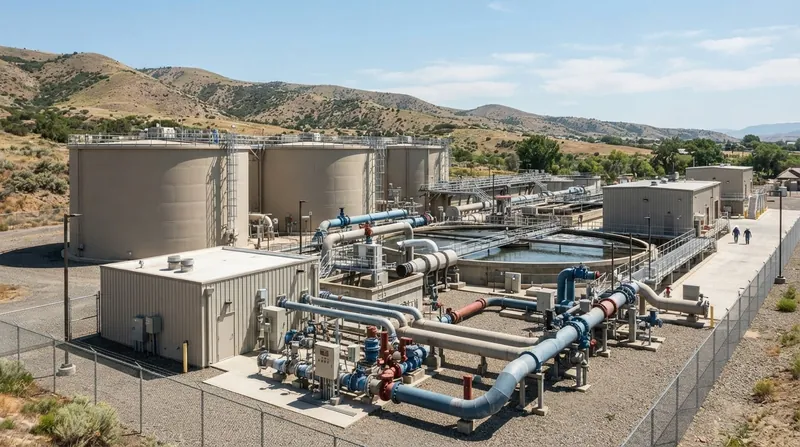
Direct potable reuse removes the natural buffer entirely. Instead, effluent is treated to drinking-water quality through an engineered multi-barrier process and introduced directly into the potable water distribution system. Without the safety net of a reservoir or aquifer, DPR systems depend on real-time monitoring, redundancy, and advanced treatment trains. These typically include microfiltration, reverse osmosis, and ultraviolet advanced oxidation processes to ensure pathogens and contaminants are neutralized instantaneously.[1][4]
The financial trade-offs between the two approaches are stark, driven largely by infrastructure requirements. A system dynamics model evaluating water supply alternatives in southern Nevada found that the net present worth of a DPR system ranged from $1.0 billion to $4.0 billion, representing a significant economic hurdle compared to the $0.6 billion required for the status quo IPR approach. The disparity stems from the intense capital costs of constructing advanced membrane filtration and oxidation facilities onsite.[1]
However, operational costs tell a different story once the infrastructure is built. According to a 2014 white paper published by the WateReuse Association, "The cost of potable reuse depends on many site-specific factors, but is expected to be on the order of $820 to $2,000 per acre-ft." That translates to roughly $2.52 to $6.14 per 1,000 gallons. For membrane-based potable reuse facilities, the American Chemical Society reports that operations and maintenance costs generally range from $1.80 to $2.00 per 1,000 gallons.[2][5]
The energy equation is equally complex, balancing treatment intensity against conveyance. While the advanced treatment required for DPR is highly energy-intensive, it eliminates the need to pump water over long distances or extract it from deep underground aquifers.
The Nevada case study confirmed that implementing DPR could achieve a net reduction in energy costs of up to $250 million over the system's lifespan, while still ensuring an adequate water supply. By avoiding the massive uphill pumping energy costs associated with imported water or environmental buffers, DPR can sometimes offer a leaner operational footprint.[1]
Environmental considerations also weigh heavily on the choice, particularly regarding salinity and waste streams. Reverse osmosis, a cornerstone of DPR, achieves up to 90 percent water recovery and 99 percent total dissolved solids (TDS) rejection. However, this process generates a concentrated brine stream that must be managed. In inland areas like Las Vegas, DPR systems face hurdles such as estimated TDS concentrations reaching 1,300 mg/L, complicating brine disposal.[1]
IPR systems, by contrast, can sometimes dilute these byproducts within larger environmental buffers, though this risks long-term salt loading in local aquifers. The environmental buffer in IPR acts as a shock absorber for both chemical concentrations and public anxiety, but it requires suitable geology. Regions lacking large surface reservoirs or porous aquifers simply do not have the physical geography to support IPR, making the direct route their only viable option for reclamation.[1][5]
The regulatory landscape is shifting to accommodate these geographic realities. The 2017 EPA Potable Reuse Compendium highlighted that while federal potable reuse regulations do not exist in the United States, state-level frameworks are increasingly backing engineered multi-barrier treatment processes. This shift acknowledges that relying on an environmental buffer is not inherently safer than relying on continuous, automated sensor networks that can shut down a plant in seconds if water quality deviates.[4]
The regulatory landscape is shifting to accommodate these geographic realities.
The decision between these two frameworks hinges on site-specific geography and public perception. The National Research Council once considered potable reuse an option of last resort, but it has since emerged as a viable alternative for addressing water scarcity. While IPR currently holds greater cognitive legitimacy among the public, the rising costs of imported water—projected to reach $2,000 per acre-foot in some regions—are pushing more municipalities to evaluate the direct, buffer-free efficiency of DPR.[1]
Jargon, explained
- Environmental Buffer
- A natural water body, such as a lake, river, or groundwater aquifer, used to store and naturally filter treated wastewater before it is withdrawn for drinking.
- Reverse Osmosis
- A water purification process that uses a partially permeable membrane to remove ions, unwanted molecules, and larger particles from drinking water.
- Advanced Oxidation Process
- A set of chemical treatment procedures designed to remove organic materials in water by oxidation through reactions with hydroxyl radicals, often using ultraviolet light.
- Net Present Worth
- A financial metric that calculates the current total value of a future stream of payments and costs, used to compare the long-term economics of infrastructure projects.
- Total Dissolved Solids (TDS)
- A measure of the combined content of all inorganic and organic substances contained in a liquid in molecular, ionized, or micro-granular suspended form.
Common questions
What is the main difference between DPR and IPR?
Indirect potable reuse (IPR) discharges treated wastewater into an environmental buffer like a lake or aquifer before it is treated again for drinking. Direct potable reuse (DPR) pipes the purified water directly into the drinking water system without a natural buffer.
Is direct potable reuse safe to drink?
Yes. DPR systems use engineered multi-barrier treatments, including microfiltration, reverse osmosis, and advanced oxidation, to purify the water to standards that meet or exceed federal drinking water regulations.
Why is direct potable reuse more expensive to build?
DPR requires intense upfront capital investment to construct the advanced membrane filtration and oxidation facilities onsite, as well as the automated sensor networks needed to monitor water quality in real time.
Does direct potable reuse save energy?
It can. While the treatment process itself is highly energy-intensive, DPR eliminates the need to pump water over long distances to environmental buffers or extract it from deep underground aquifers, which can result in net energy savings.
Competing readings
Municipal Water Managers
Prioritize supply reliability and long-term cost efficiency.
For municipal water districts, the appeal of direct potable reuse lies in its absolute control and efficiency. By eliminating the environmental buffer, managers avoid the water losses associated with evaporation in surface reservoirs or the pumping costs of retrieving water from deep aquifers. They argue that advanced sensor networks and multi-barrier treatments provide a higher, more consistent standard of safety than relying on the variable conditions of a natural lake or river.
Environmental Conservationists
Focus on the ecological impacts of brine disposal and aquifer health.
Conservation groups often highlight the downstream consequences of advanced water treatment. While they support water recycling to reduce reliance on imported water, they raise concerns about the highly concentrated brine generated by reverse osmosis. In inland areas, disposing of this brine without harming local ecosystems is a significant challenge. Furthermore, some argue that indirect potable reuse provides a dual benefit by actively replenishing depleted groundwater basins and supporting riparian habitats.
Public Health Advocates
Emphasize the necessity of fail-safes and the 'cognitive legitimacy' of natural buffers.
Public health perspectives frequently center on the margin of error. An environmental buffer provides days, weeks, or even months of retention time, allowing natural attenuation to occur and giving operators ample time to detect and isolate contamination before it reaches the drinking supply. While acknowledging the sophistication of modern membrane filtration, these advocates argue that the psychological and practical safety net of an aquifer or reservoir remains a crucial component of public trust.
- Infrastructure & Efficiency Advocates
- Prioritize supply reliability, absolute control, and long-term cost efficiency through advanced technology.
- Ecological & Regulatory Stewards
- Focus on the ecological impacts of brine disposal, aquifer health, and regulatory frameworks.
- System Dynamics Analysts
- Emphasize the holistic trade-offs between capital costs, energy demands, and public acceptance.
Perspectives this story doesn't cover
- Agricultural water users
- Industrial wastewater producers
Sources
Source coverage
6 outlets
3 viewpoints surfaced





- [1]PMCSystem Dynamics Analysts
Evaluating the sustainability of indirect potable reuse and direct potable reuse: a southern Nevada case study
Read on PMC → - [2]ACS ES&T EngineeringInfrastructure & Efficiency Advocates
Cost and energy intensity of U.S. potable water reuse systems
Read on ACS ES&T Engineering → - [3]UNM Digital RepositoryEcological & Regulatory Stewards
The Cost of Direct and
Read on UNM Digital Repository → - [4]U.S. Environmental Protection AgencyEcological & Regulatory Stewards
Basic Information about Water Reuse
Read on U.S. Environmental Protection Agency → - [5]Water & Wastes DigestInfrastructure & Efficiency Advocates
The Opportunities and Economics of Direct Potable Reuse
Read on Water & Wastes Digest → - [6]Factlen Editorial TeamSystem Dynamics Analysts
Synthesis by Factlen editorial team
Read on Factlen Editorial Team →
More in Environment
See all →Water Infrastructure
Explainer: Comparing the Energy, Cost, and Brine Disposal of Reverse Osmosis and Thermal Desalination
7 sources
Water Infrastructure
EPA Announces $1 Billion in Funding to Address PFAS in Drinking Water
7 sources
Water Infrastructure
Texas Water Demand to Outpace Supply Within Four Years, Driven by Data Center Boom and Population Growth
6 sources
Water Infrastructure
Thermal Stratification and Biofilm Resistance Force Water Utilities to Switch From Free Chlorine to Monochloramine
3 sources
Comments
Every angle. Every day.
Get Environment stories with full source coverage and perspective breakdowns, free every day.