
How Fast Neutron Reactors and Pyroprocessing Could Cut Nuclear Waste Lifespans by 99 Percent
By transmuting long-lived actinides and breeding new fuel, the closed nuclear fuel cycle promises to extract 100 times more energy from uranium while reducing waste isolation times from a million years to a millennium.
By Hunter Cole

Share this story
The debate over the future of nuclear energy rests on a fundamental disagreement about what to do with its most controversial byproduct. One faction argues that burying spent nuclear fuel is a profligate waste of resources, advocating for a closed fuel cycle that uses fast neutron reactors to extract up to 100 times more energy from mined uranium while reducing the radioactive lifespan of the waste from a million years to a single millennium.
The opposing camp maintains that the chemical reprocessing required to close that cycle separates weapons-usable plutonium, creating an unacceptable global proliferation risk that far outweighs the benefits of waste reduction, especially when mining fresh uranium remains vastly cheaper.[3][4]
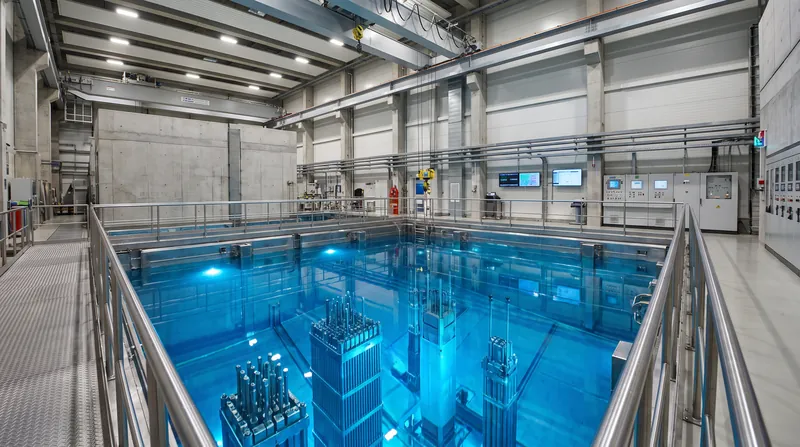
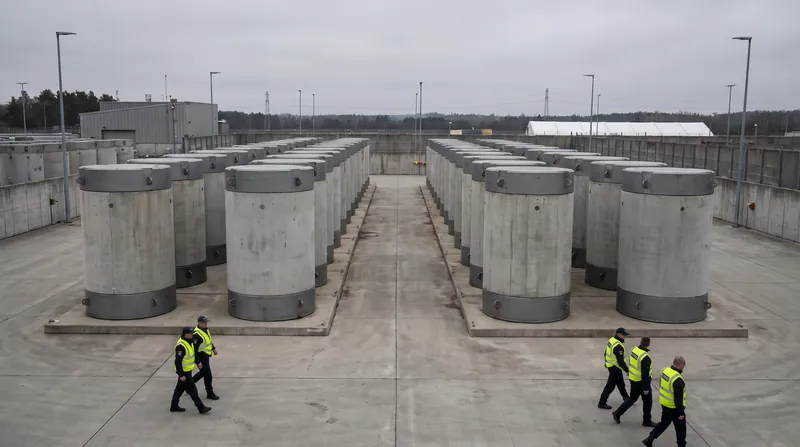
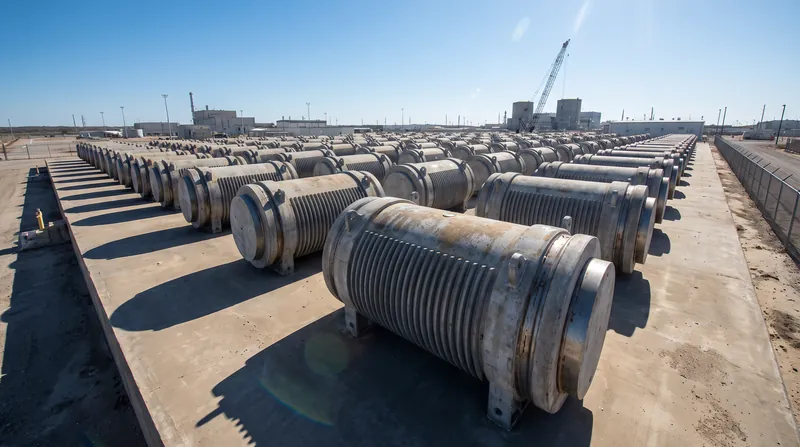
The vast majority of the world's commercial nuclear fleet operates on an open, or once-through, fuel cycle. In this model, uranium is mined, enriched, fabricated into fuel assemblies, and irradiated in a thermal light-water reactor for roughly 18 to 24 months. Once the fuel can no longer efficiently sustain a chain reaction, it is removed and stored indefinitely in cooling pools or dry casks.[2]
This open cycle is highly inefficient from a resource perspective. Standard light-water reactors rely on thermal, or slow, neutrons to split uranium-235, an isotope that makes up less than one percent of natural uranium. The remaining mass is primarily uranium-238, which thermal neutrons cannot easily fission.
As a result, a typical light-water reactor fissions only about 1 percent of the uranium it consumes. Over a 60-year lifespan, a single conventional reactor requires approximately 11,000,000 kilograms of mined uranium to produce the 46,000 kilograms of enriched material that actually enters the core.[2]
When that fuel is discharged, it retains roughly 90 percent of its potential energy. The spent fuel consists of about 95 percent unreacted uranium-238, 1 percent unburned uranium-235, 1 percent plutonium created during operation, and a mix of highly radioactive fission products and minor actinides like neptunium, americium, and curium. It is these minor actinides and plutonium isotopes that dictate the extreme longevity of the waste, requiring deep geological isolation for up to 1,000,000 years.[3][4]
The alternative is the closed fuel cycle, a system designed to recycle the unburned uranium and plutonium into fresh fuel. The linchpin of this theoretical cycle is the fast neutron reactor. Unlike thermal reactors, fast reactors do not use water to slow down neutrons. By maintaining neutrons at higher energy levels, these reactors can fission a much broader range of isotopes, including the abundant uranium-238 and the problematic minor actinides.[1][3]
Operating without a moderator requires a different cooling medium, typically liquid sodium or lead, and a much higher initial fuel enrichment. While standard light-water reactor fuel is enriched to around 5 percent uranium-235, early fast reactors required enrichments exceeding 20 percent to compensate for the lower probability of fast neutrons colliding with fissile nuclei.[2]
The defining advantage of the fast neutron environment is its ability to breed its own fuel. When a fast neutron strikes a uranium-238 nucleus, it can transmute that nucleus into plutonium-239, which is highly fissile. By carefully designing the core, engineers can achieve a breeding ratio greater than 1.0, meaning the reactor produces more fissile material than it consumes. This mechanism allows a closed fuel cycle to extract 50 to 100 times more energy from a given quantity of natural uranium than a once-through system.[3][5]
Beyond resource efficiency, fast reactors offer a profound waste management benefit through a process called transmutation. When minor actinides are placed in a fast neutron flux, they are split into lighter, shorter-lived fission products. By continuously recycling the fuel and burning off the actinides, the closed cycle eliminates the longest-lived radioactive components of the waste stream.[1][3]
The impact on the required storage timeline is dramatic. Without transmutation, the radiotoxicity of spent nuclear fuel takes up to 1,000,000 years to decay back to the level of natural uranium ore. By extracting and burning the plutonium and minor actinides in a fast reactor, that isolation period drops to roughly 1,000 years—a timeframe that is vastly easier to engineer for in geological repositories.[4][5]
The barrier to realizing this closed cycle is not the reactor physics, which have been proven over 400 reactor-years of global operating experience, but the chemical reprocessing required to separate the usable fuel from the fission products. The standard industrial method for this separation is PUREX, an acronym for Plutonium Uranium Redox Extraction.[4]
Developed during the mid-20th century, PUREX is an aqueous hydrometallurgical process that dissolves spent fuel in nitric acid and uses organic solvents to separate pure plutonium and uranium from the highly radioactive fission products. Because the PUREX process yields a stream of separated, weapons-grade plutonium, it presents a severe proliferation vulnerability. As researchers at the Carnegie Endowment for International Peace note, "the history of reprocessing is rooted in nuclear weapons development, a linkage that persists today."[4]
This proliferation risk fundamentally altered the trajectory of global nuclear policy. In 1977, the Carter administration banned the commercial reprocessing of spent nuclear fuel in the United States, citing the danger that separated plutonium could be diverted by state or non-state actors. While the ban was later lifted, the economic and regulatory chill effectively ended American development of the closed fuel cycle, leaving the country with a growing stockpile of spent fuel.[4][5]
To circumvent the proliferation risks of PUREX, researchers have developed alternative reprocessing technologies, most notably pyroprocessing. Unlike the aqueous PUREX method, pyroprocessing is an electrometallurgical technique that operates at high temperatures, typically exceeding 800 degrees Celsius, using molten salts and electrical currents to separate the elements.[6]
The critical nonproliferation advantage of pyroprocessing is that it cannot isolate pure plutonium. Instead, the process yields a depleted uranium ingot and a mixed product containing depleted uranium and transuranic elements—plutonium, neptunium, americium, and curium—in a roughly 1:1 ratio. Because the plutonium remains mixed with highly radioactive actinides, it is self-protecting and vastly more difficult to divert for weapons use, while remaining perfectly suitable for fuel in a fast neutron reactor.[5][6]
Despite these technical solutions, the closed fuel cycle faces formidable economic headwinds. Reprocessing spent fuel, whether through PUREX or pyroprocessing, requires heavily shielded, remote-operated facilities that cost billions of dollars to construct. Historically, the cost of recycling spent fuel has far exceeded the cost of simply mining, enriching, and fabricating fresh uranium, rendering the closed cycle economically uncompetitive in deregulated electricity markets.[4]
Furthermore, fast reactors present significant materials engineering challenges. The high-energy fast neutron flux causes severe radiation damage to reactor components, embrittling steel and degrading cladding materials much faster than the moderated thermal neutrons in a conventional reactor. Designing materials that can withstand this environment for decades remains a primary focus of Generation IV reactor research.[1][2]
Today, the closed fuel cycle exists only in fragments. France continues to reprocess spent fuel at its La Hague facility using PUREX, recycling the plutonium into mixed-oxide fuel for conventional reactors, though it has postponed the deployment of fast reactors. Russia operates the world's only large-scale commercial fast neutron reactors, the BN-600 and BN-800, and is actively working to close its fuel cycle. Meanwhile, China is constructing new reprocessing plants and fast breeder reactors to secure its long-term energy independence.[4]
The global nuclear industry remains caught between two imperfect paradigms. The open cycle is economically viable and proliferation-resistant, but it leaves behind a legacy of million-year waste and squanders 99 percent of the energy potential in mined uranium. The closed cycle promises near-total resource utilization and manageable waste timelines, but demands massive capital investment and rigorous international safeguards to ensure that the technology used to power the grid is never repurposed to threaten it.[1][4]
Viewpoints in depth
Closed-Cycle Advocates
Proponents argue that fast reactors are essential for the long-term sustainability of nuclear energy.
Organizations like the World Nuclear Association emphasize that the current once-through fuel cycle is fundamentally unsustainable, leaving 99 percent of uranium's energy potential untapped. By deploying fast neutron reactors, the industry can stretch existing uranium reserves for thousands of years while simultaneously solving the political and engineering nightmare of million-year geological waste repositories. For this camp, the failure to close the fuel cycle is a failure of political will, not a technical impossibility.
Nonproliferation Analysts
Security experts warn that the widespread adoption of reprocessing creates unacceptable risks of nuclear weapons proliferation.
Analysts focused on global security, including researchers at the Carnegie Endowment, argue that the theoretical benefits of waste reduction do not justify the creation of industrial-scale plutonium separation facilities. Because the traditional PUREX process yields weapons-usable material, exporting closed-cycle technology to non-nuclear-weapon states inherently lowers the barrier to weapons development. This camp often argues that mining fresh uranium and utilizing dry cask storage remains the safest, most economically rational approach to nuclear power.
Advanced Fuel Cycle Researchers
Engineers are focused on developing proliferation-resistant reprocessing methods like pyroprocessing.
Materials scientists and nuclear engineers acknowledge the proliferation flaws of legacy aqueous reprocessing but argue that technology has evolved. By shifting to high-temperature electrometallurgical techniques like pyroprocessing, researchers aim to create a closed cycle where pure plutonium is never isolated. This camp focuses on overcoming the severe materials engineering challenges of fast neutron fluxes and the high capital costs of remote-handling facilities to make advanced recycling commercially viable.
- Closed-Cycle Advocates
- Proponents argue that fast reactors are essential for the long-term sustainability of nuclear energy.
- Nonproliferation Analysts
- Security experts warn that the widespread adoption of reprocessing creates unacceptable risks of nuclear weapons proliferation.
- Advanced Fuel Cycle Researchers
- Engineers are focused on developing proliferation-resistant reprocessing methods like pyroprocessing.
- Factlen Editorial Synthesis
- The editorial framing comparing the trade-offs of both systems.
Sources
Source coverage
7 outlets
4 viewpoints surfaced





- [1]IAEAClosed-Cycle Advocates
Fast Reactors and Related Fuel Cycles
Read on IAEA → - [2]ASMEAdvanced Fuel Cycle Researchers
Reprocessing, Weapons Proliferation, and Waste
Read on ASME → - [3]World Nuclear AssociationClosed-Cycle Advocates
Fast Neutron Reactors
Read on World Nuclear Association → - [4]Carnegie Endowment for International PeaceNonproliferation Analysts
The Proliferation Risks of Reprocessing
Read on Carnegie Endowment for International Peace → - [5]National Center for Public Policy ResearchNonproliferation Analysts
Nuclear Fuel Reprocessing
Read on National Center for Public Policy Research → - [6]Texas A&M UniversityAdvanced Fuel Cycle Researchers
Proliferation Resistance of Pyroprocessing
Read on Texas A&M University → - [7]Factlen Editorial TeamFactlen Editorial Synthesis
Synthesis by Factlen editorial team
Read on Factlen Editorial Team →
More in Energy
See all →Nuclear Fuel Cycle
New Processes Unlock Trillions in Reusable Fuel and High-Value Isotopes from US Nuclear Waste Stockpile
5 sources
Nuclear Fuel Cycle
Why Extracting the 95 Percent Unused Uranium in Spent Fuel Costs Far More Than Mining Fresh Ore
6 sources
Nuclear Safety
The 0-to-7 Scale That Classifies the Severity of Nuclear Accidents and Incidents
6 sources
Waste Classification
The Low-Level, Intermediate-Level, and High-Level Categories That Define Nuclear Waste Disposal and Isolation
5 sources
Comments
Every angle. Every day.
Get Energy stories with full source coverage and perspective breakdowns, free every day.