
Turning Uranium Ore Into Nuclear Fuel Through Milling, Conversion, and Enrichment
Transforming raw uranium into reactor-ready fuel requires a complex, multi-stage industrial process known as the nuclear fuel cycle. At the heart of this cycle is enrichment, a delicate balancing act that dictates whether the material will power a commercial grid, fuel an advanced microreactor, or pose a proliferation risk.
By Aarav Khanna

Share this story
In short
- The nuclear fuel cycle encompasses the mining, conversion, enrichment, fabrication, use, and disposal of uranium.
- Natural uranium contains only 0.7% of the fissile U-235 isotope and must be enriched for use in most commercial reactors.
- Gas centrifuge technology is the modern standard for enrichment, using centrifugal force to separate heavier U-238 from lighter U-235.
As global energy grids strain under the dual pressures of decarbonization and rising electricity demand, nuclear power is experiencing a renaissance. But the electricity that powers homes, hospitals, and hyperscale data centers does not flow directly from mined rock. It relies on a highly specialized, multi-stage supply chain known as the nuclear fuel cycle. Understanding how raw uranium is transformed into reactor-ready fuel is essential for grasping the economic and geopolitical stakes of the next generation of nuclear energy.[1][4][5]
The journey begins at the "front end" of the fuel cycle with exploration and mining. Uranium is a relatively abundant metal, found in rocks, soil, and even seawater, but it must be extracted from concentrated deposits using open-pit, underground, or in-situ recovery methods. Once mined, the ore is crushed and chemically treated at a mill to separate the uranium from the surrounding rock. This milling process yields a concentrated uranium oxide powder commonly known as "yellowcake" (U3O8).[1][5]
Yellowcake, however, cannot be loaded directly into a commercial reactor. Natural uranium consists almost entirely of the isotope uranium-238 (U-238), which decays slowly and does not readily sustain a fission chain reaction. Only about 0.7 percent of natural uranium is uranium-235 (U-235), the fissile isotope necessary to release large amounts of energy. To make the material usable in most modern power plants, the concentration of U-235 must be artificially increased through a process called enrichment.[2][3][5]
Before enrichment can occur, the solid yellowcake must be converted into a gas. In a conversion facility, the uranium oxide is chemically combined with fluorine to create uranium hexafluoride (UF6). This compound is unique because it transitions into a gas at relatively low temperatures, making it ideal for the physical separation techniques used in enrichment plants.[3]
The actual enrichment process relies on the slight mass difference between the two isotopes; U-238 is about one percent heavier than U-235. Historically, the United States relied on gaseous diffusion, a method where UF6 gas was pumped through hundreds of porous membranes. The lighter U-235 molecules passed through the barriers slightly faster than the heavier U-238 molecules. While effective, gaseous diffusion required massive amounts of electricity and has largely been replaced worldwide by more efficient second-generation technologies.[2]
Today, the commercial standard is gas centrifuge enrichment. In this method, UF6 gas is fed into rapidly spinning cylindrical centrifuges. The intense centrifugal force pushes the heavier U-238 isotopes toward the outer wall of the cylinder, while the lighter U-235 isotopes concentrate near the center. The slightly enriched gas is drawn from the center and fed into the next centrifuge in a long sequence known as a cascade, progressively increasing the U-235 concentration until it reaches the desired level.[2][3]
The target enrichment level is dictated by the reactor's design and purpose. Most of the world's commercial light-water reactors operate on Low-Enriched Uranium (LEU), which contains between 3 and 5 percent U-235. This level provides enough fissile material to sustain a controlled chain reaction for several years before the fuel must be replaced.[2][5]
However, the next generation of advanced reactors and small modular reactors (SMRs) often requires High-Assay Low-Enriched Uranium (HALEU). HALEU is enriched to between 5 and 20 percent U-235. This higher concentration allows reactors to be smaller, run for longer periods without refueling, and produce less total waste. Developing a domestic supply chain for HALEU has become a major policy priority for the U.S. government, as it seeks to deploy advanced nuclear technologies while reducing reliance on foreign enrichment services.[3][5]
Beyond 20 percent enrichment, the material is classified as Highly Enriched Uranium (HEU). While HEU is used in specialized research reactors and naval propulsion systems, uranium enriched to 90 percent or higher is considered weapons-grade. Because the same centrifuge technology used to produce commercial LEU can be reconfigured to produce weapons-grade HEU, enrichment facilities are subject to strict international safeguards and monitoring by the International Atomic Energy Agency (IAEA).[3][5]
Once the uranium is enriched to the appropriate level, it moves to a fabrication plant. Here, the enriched UF6 gas is converted back into a solid uranium dioxide (UO2) powder. This powder is compressed into small ceramic pellets, which are then stacked and sealed inside long metal tubes made of zirconium alloy. These tubes, known as fuel rods, are bundled together into fuel assemblies, ready to be loaded into the reactor core.[1][5]
Inside the reactor, the fuel assemblies undergo fission, generating the intense heat needed to produce steam and drive electricity-generating turbines. After about three to six years, the buildup of fission byproducts reduces the fuel's efficiency, and the assemblies are removed. This marks the transition to the "back end" of the fuel cycle.[1][5]
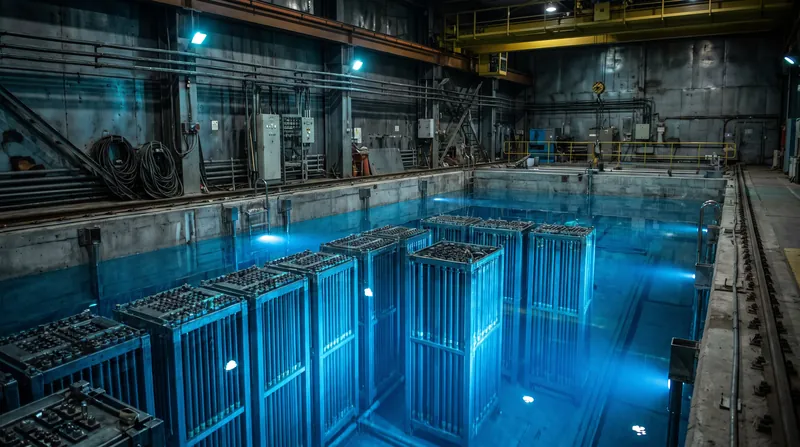
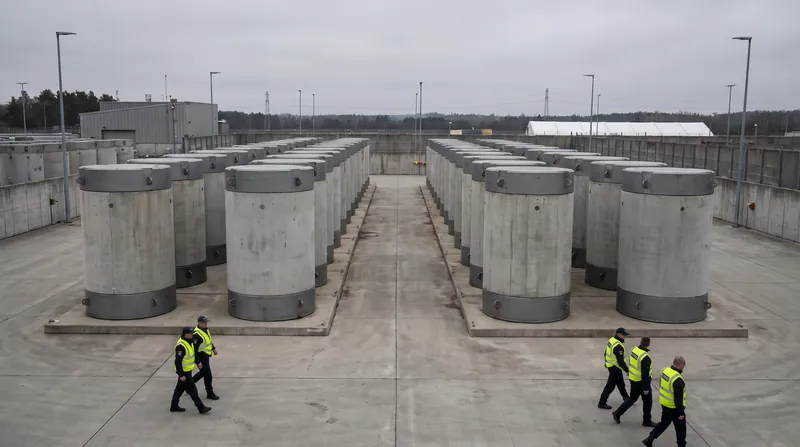
The spent nuclear fuel is highly radioactive and continues to generate decay heat. It is initially stored in deep pools of water at the reactor site, which cool the fuel and shield workers from radiation. After several years, the cooled fuel can be transferred to massive concrete and steel dry casks for long-term interim storage.[1][5]
The spent nuclear fuel is highly radioactive and continues to generate decay heat.
While the United States currently employs an "open" or "once-through" fuel cycle—meaning spent fuel is destined for permanent geological disposal—other nations utilize a "closed" cycle. In a closed cycle, spent fuel is reprocessed to recover the remaining usable uranium and plutonium, which can be fabricated into new mixed-oxide (MOX) fuel. Reprocessing significantly reduces the volume of high-level waste but introduces additional proliferation concerns, highlighting the complex trade-offs inherent in managing the nuclear fuel cycle.[1][4][5]
Jargon, explained
- Yellowcake
- A concentrated uranium oxide powder (U3O8) produced after milling raw uranium ore, serving as the baseline material for the fuel cycle.
- Uranium Hexafluoride (UF6)
- A chemical compound of uranium and fluorine that becomes a gas at low temperatures, allowing isotopes to be separated during enrichment.
- Gas Centrifuge
- A rapidly spinning cylinder that uses centrifugal force to separate the slightly lighter U-235 isotopes from the heavier U-238 isotopes.
- Fissile Isotope
- An atom, such as uranium-235, that is capable of sustaining a nuclear fission chain reaction when struck by a neutron.
- High-Assay Low-Enriched Uranium (HALEU)
- Uranium enriched to contain between 5% and 20% U-235, required by many advanced and small modular reactor designs.
- Reprocessing
- A chemical operation that separates usable uranium and plutonium from spent nuclear fuel so it can be recycled into new fuel assemblies.
Common questions
Why can't natural uranium be used directly in most power plants?
Natural uranium contains only about 0.7% of the fissile uranium-235 isotope. Most commercial light-water reactors require a concentration of 3% to 5% to sustain a controlled nuclear chain reaction.
What is the difference between reactor-grade and weapons-grade uranium?
Reactor-grade uranium is typically enriched to between 3% and 5% U-235, which is sufficient for power generation but cannot create a nuclear explosion. Weapons-grade uranium must be highly enriched, typically to 90% or more U-235.
What happens to nuclear fuel after it is removed from the reactor?
Spent fuel is initially stored in deep water pools to cool and block radiation. Later, it is moved to dry concrete and steel casks for long-term storage, pending either permanent geological disposal or reprocessing.
Why is uranium turned into a gas before enrichment?
Converting solid uranium into uranium hexafluoride (UF6) gas allows enrichment facilities to use physical properties, like the slight difference in mass between isotopes, to separate them in centrifuges.
Competing readings
Non-Proliferation Advocates
Emphasize the security risks associated with expanding uranium enrichment capabilities.
This camp argues that the widespread deployment of enrichment technologies, particularly those capable of producing High-Assay Low-Enriched Uranium (HALEU), inherently increases the risk of nuclear weapons proliferation. Because the same gas centrifuge infrastructure used for civilian fuel can theoretically be reconfigured to produce weapons-grade material, they advocate for strict multilateral control over the fuel cycle. They often support "once-through" fuel cycles over reprocessing, arguing that separating plutonium creates an unacceptable security vulnerability that outweighs the waste-reduction benefits.
Advanced Nuclear Developers
Focus on the necessity of higher enrichment levels to unlock next-generation reactor designs.
Proponents of advanced nuclear technologies argue that transitioning to HALEU (enriched between 5% and 20%) is essential for the future of clean energy. They point out that higher enrichment allows for smaller reactor cores, longer operating cycles between refueling, and enhanced passive safety features. This group views the current lack of domestic HALEU enrichment capacity as a critical bottleneck and advocates for rapid government and private investment to build out a secure, localized supply chain independent of foreign state-owned enterprises.
Closed-Cycle Proponents
Advocate for reprocessing spent nuclear fuel to maximize resource efficiency and minimize long-term waste.
This perspective, often championed by nations like France and various scientific institutions, views spent nuclear fuel not as waste, but as an untapped energy resource. They highlight that commercial reactors only extract a fraction of the energy potential from uranium before the fuel is removed. By chemically reprocessing spent fuel to recover usable uranium and plutonium, they argue the industry can drastically reduce the volume and radiotoxicity of high-level waste destined for geological repositories, creating a more sustainable, closed-loop energy system.
- Advanced Nuclear Developers
- Focus on the necessity of higher enrichment levels (HALEU) to unlock next-generation reactor designs.
- Non-Proliferation Advocates
- Emphasize the security risks and monitoring challenges associated with expanding uranium enrichment capabilities.
- Closed-Cycle Proponents
- Advocate for reprocessing spent nuclear fuel to maximize resource efficiency and minimize long-term waste.
Perspectives this story doesn't cover
- Local Communities Near Mining Sites
- Anti-Nuclear Environmental Groups
Sources
Source coverage
5 outlets
3 viewpoints surfaced




- [1]U.S. Energy Information AdministrationClosed-Cycle Proponents
The nuclear fuel cycle
Read on U.S. Energy Information Administration → - [2]Department of EnergyAdvanced Nuclear Developers
Uranium Enrichment, Explained
Read on Department of Energy → - [3]World Nuclear AssociationClosed-Cycle Proponents
Uranium Enrichment
Read on World Nuclear Association → - [4]WikipediaClosed-Cycle Proponents
Nuclear fuel cycle
Read on Wikipedia → - [5]Factlen Editorial TeamNon-Proliferation Advocates
Synthesis by Factlen editorial team
Read on Factlen Editorial Team →
More in Energy
See all →Nuclear Fuel Cycle
How Fast Neutron Reactors and Pyroprocessing Could Cut Nuclear Waste Lifespans by 99 Percent
7 sources
Nuclear Fuel Cycle
New Processes Unlock Trillions in Reusable Fuel and High-Value Isotopes from US Nuclear Waste Stockpile
5 sources
Nuclear Fuel Cycle
Why Extracting the 95 Percent Unused Uranium in Spent Fuel Costs Far More Than Mining Fresh Ore
6 sources
Nuclear Safety
The 0-to-7 Scale That Classifies the Severity of Nuclear Accidents and Incidents
6 sources
Comments
Every angle. Every day.
Get Energy stories with full source coverage and perspective breakdowns, free every day.