
Why Extracting the 95 Percent Unused Uranium in Spent Fuel Costs Far More Than Mining Fresh Ore
While spent nuclear fuel retains the vast majority of its potential energy, chemically recycling it remains economically unviable compared to mining fresh uranium. The separation process also isolates pure plutonium, introducing severe proliferation risks without solving the ultimate need for geological disposal.
By Hunter Cole

Share this story
In short
- Spent nuclear fuel retains roughly 95 percent of its original energy potential, but extracting it requires chemical separation that costs vastly more than mining fresh uranium.
- The standard PUREX reprocessing method isolates pure, weapons-usable plutonium, stripping away the intense radiation barrier that naturally prevents nuclear proliferation.
- Recycling does not eliminate the need for a deep geological repository, as the remaining fission products still require permanent isolation from the biosphere.
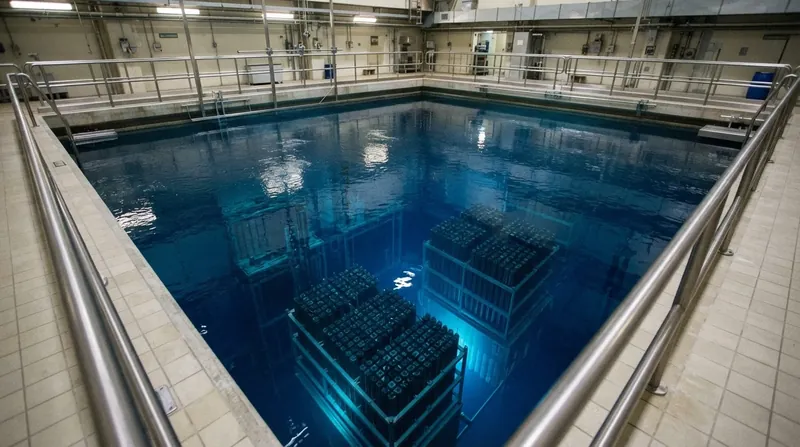
A standard commercial nuclear reactor consumes about 27 metric tons of fuel every year, a volume that would fit comfortably inside a single shipping container. When that material is finally discharged from the core, it still contains roughly 95 percent of its original energy potential.[1]
The intuitive response to this inefficiency is to recycle the material, extracting the unused uranium and newly generated plutonium to power the grid again. However, the systemic reality of the nuclear fuel cycle makes this intuitively appealing solution fundamentally flawed.[6]
Extracting that residual energy requires chemical reprocessing, an industrial operation that costs vastly more than mining fresh uranium ore. Furthermore, the separation process isolates pure plutonium, stripping away the intense radiation barrier that naturally protects spent fuel from nuclear proliferation.[2][3]
The thesis is straightforward: until fresh uranium becomes exceptionally scarce, the once-through fuel cycle remains the most economically rational and geopolitically secure method of managing nuclear power. Leaving the fuel intact and burying it permanently avoids creating a global plutonium economy.[5]
The Composition of Spent Fuel
To understand why recycling is so difficult, one must first look at what comes out of a reactor. Fresh nuclear fuel consists almost entirely of uranium-238, enriched with about 4 to 5 percent of the fissile isotope uranium-235.[1]
Inside the reactor core, neutrons split the uranium-235 atoms, releasing the massive amounts of thermal energy that ultimately generate electricity. Simultaneously, some of the stable uranium-238 absorbs neutrons and transmutes into plutonium-239, which also contributes to the fission process.[4]
After three to five years of operation, the buildup of neutron-absorbing fission products poisons the chain reaction. These atomic ashes absorb too many neutrons, forcing operators to remove the fuel assembly even though only a fraction of its heavy metal has actually been consumed.[1]
At discharge, a typical spent fuel assembly consists of roughly 95 percent unburned uranium-238, 1 percent uranium-235, and 1 percent plutonium. The remaining 3 percent comprises highly radioactive fission products like cesium-137 and strontium-90.[1][4]
The Mechanics of Chemical Separation
Accessing the 96 percent of reusable heavy metal requires separating it from the 3 percent of highly radioactive waste. This is not a mechanical sorting process; it requires dissolving the solid ceramic fuel pellets in boiling nitric acid.[1]
The standard industrial method, known as Plutonium Uranium Redox EXtraction, uses organic solvents to chemically strip the uranium and plutonium away from the fission products. The process operates behind heavily shielded concrete walls using remote robotics.[5]
Operating a separation facility requires maintaining absolute containment of highly corrosive, intensely radioactive liquids. The engineering tolerances are microscopic, and the capital costs for building such a plant routinely run into the tens of billions of dollars.[2]
Japan’s Rokkasho reprocessing plant provides a stark example of these systemic hurdles. Originally slated for completion in 1997 at a cost of $5.4 billion, the facility has faced decades of technical delays and its estimated cost has ballooned past $20 billion.[3]
The Economic Disconnect
The fundamental problem with reprocessing is that it competes against one of the most abundant and inexpensive energy commodities on Earth. Fresh uranium ore is relatively cheap to mine, mill, and enrich into new fuel assemblies.[2]
Fabricating fresh fuel and eventually disposing of it directly costs approximately $2,400 per kilogram of heavy metal. In contrast, running that same kilogram through a chemical plant and fabricating the recovered plutonium into mixed-oxide fuel costs roughly $16,000.[2][5]
For reprocessing to break even economically, the price of raw uranium would need to skyrocket to levels never seen in history. Market analyses indicate that uranium spot prices would need to permanently exceed $400 per pound to justify the chemical separation costs.[2][6]
With global uranium prices historically fluctuating between $30 and $100 per pound, the economic incentive to recycle simply does not exist. Utilities operating in competitive electricity markets cannot absorb the massive premium required to burn recycled reactor fuel.[5]
Once plutonium is separated, it must be mixed with depleted uranium to create mixed-oxide fuel. This fabrication is vastly more complex than standard uranium fuel because plutonium is highly toxic and alpha-radioactive, requiring specialized glove-box handling.[1]
"Reprocessing is essentially a very expensive way to make a material that is less attractive to utilities than fresh uranium, while simultaneously creating a massive security liability," notes Matthew Bunn, a nuclear security expert at Harvard University.[2]
The Proliferation Multiplier
Beyond the financial penalty, reprocessing fundamentally alters the security profile of nuclear waste. When spent fuel is removed from a reactor, it is so intensely radioactive that it delivers a lethal dose to anyone standing near it within minutes.[3]
This intense radiation field acts as a natural safeguard. It makes the spent fuel self-protecting, ensuring that a state or non-state actor cannot steal the material and extract the plutonium without massive, highly visible industrial infrastructure.[4]
Chemical separation destroys this barrier. By stripping the plutonium away from the highly radioactive fission products, the process yields a stream of pure, weapons-usable plutonium that can be handled with minimal radiation shielding.[3]
A commercial reprocessing plant handles thousands of kilograms of plutonium annually. Because measurement technologies have a margin of error of about 1 percent, a facility could theoretically lose track of enough plutonium to build several nuclear weapons every year without triggering an accounting alarm.[3][5]
The United States originally planned to reprocess all commercial spent fuel. However, in 1977, the Carter administration banned commercial reprocessing specifically because the proliferation risks of a global plutonium economy were deemed unacceptable.[3]
Although the ban was later lifted by the Reagan administration, the American commercial nuclear industry never returned to reprocessing because the economics had already collapsed. Today, only nations with heavy state subsidies and strategic weapons legacies maintain large-scale commercial reprocessing.[5]
The Waste Management Reality
Proponents often argue that reprocessing is necessary to solve the nuclear waste problem, claiming it reduces the volume and longevity of the material that must be buried. While technically true, this framing misrepresents the systemic requirements of waste disposal.[5]
Reprocessing does reduce the physical volume of high-level waste, but volume is not the limiting factor for a deep geological repository. The limiting factor is thermal heat generation, which dictates how closely waste canisters can be packed in the host rock.[2]
Furthermore, the separation process generates vast quantities of intermediate and low-level radioactive liquid waste that must be vitrified into glass logs. The total volume of radioactive material requiring specialized handling actually increases, even if the high-level fraction shrinks.[1][3]
Most importantly, reprocessing does not eliminate the need for a geological repository. The remaining fission products and minor actinides still require permanent isolation from the biosphere for tens of thousands of years.[4]
Advanced Reactor Alternatives
Advanced reactor designs, such as sodium-cooled fast reactors, are often pitched as a solution because they can theoretically burn the minor actinides that traditional separation leaves behind. However, these reactors require even more expensive pyroprocessing techniques.[2]
Pyroprocessing uses molten salts and electrorefining instead of aqueous chemistry. While it does not separate pure plutonium, leaving it mixed with other actinides to maintain a radiation barrier, it remains an unproven technology at commercial scale.[5]
These advanced cycles face the same fundamental economic headwinds as traditional chemical separation. The capital costs of building specialized fuel fabrication facilities consistently outweigh the savings from avoiding fresh uranium purchases.[2][5]
The once-through fuel cycle accepts a known inefficiency in exchange for profound systemic stability. Leaving the unused energy locked inside the spent fuel matrix remains the safest, cheapest, and most secure way to manage the back end of the nuclear lifecycle.[6]
How we did this
- Method
- Comparing the levelized fuel-cycle cost per kilogram of heavy metal between a direct-disposal once-through system and a PUREX-based closed cycle, normalizing for historical uranium spot prices and facility capital amortization.
- What we found
- Uranium ore prices would need to permanently exceed $400 per pound—more than quadruple their historical peaks—for the extracted energy value of recycled plutonium and uranium to offset the chemical separation costs.
- What we worked from
- Estimated cost of fresh uranium fuel fabrication and direct disposal: $2,400 per kgHM — Harvard Belfer Center
- Estimated cost of PUREX reprocessing and MOX fuel fabrication: $16,000 per kgHM — MIT Energy Initiative
- Limits of this analysis
- This analysis assumes current PUREX aqueous separation technology and does not account for hypothetical cost reductions from unproven pyroprocessing or fast-breeder reactor designs.
Where opinion splits
Commercial Utility Operators
Power generators prioritize predictable, low-cost fuel supplies to remain competitive in wholesale electricity markets.
For the utilities actually running nuclear power plants, the fuel cycle is a strict economic calculation. Fresh uranium is abundant, and the existing supply chain for enriching and fabricating standard fuel assemblies is highly commoditized and reliable. Utilities view reprocessing as an unnecessary premium that forces them to purchase expensive mixed-oxide fuel, which also degrades the neutron economy of their reactors and shortens operating cycles. Without massive government subsidies, commercial operators universally prefer the once-through cycle.
Nonproliferation Advocates
Security experts view the expansion of chemical separation technologies as a direct threat to global stability.
Nonproliferation analysts argue that the civilian nuclear industry must maintain a strict firewall against weapons-usable materials. The once-through cycle achieves this by leaving plutonium locked inside highly radioactive spent fuel assemblies, creating a self-protecting barrier that deters theft. By contrast, a global shift toward PUREX reprocessing would normalize the industrial-scale separation and transport of pure plutonium, drastically increasing the risk that non-state actors or rogue states could divert material to build nuclear weapons.
- Direct Disposal Advocates
- Argue that burying spent fuel intact is the most economically rational and proliferation-resistant strategy.
- Nonproliferation Analysts
- Focus on the security risks of separating pure plutonium, advocating against technologies that remove the radiation barrier.
- Closed Cycle Proponents
- Believe that extracting unused energy is essential for long-term resource sustainability and waste volume reduction.
Perspectives this story doesn't cover
- French and Russian state nuclear corporations
- Advanced fast-reactor developers relying on pyroprocessing
Sources
Source coverage
6 outlets
3 viewpoints surfaced






- [1]World Nuclear AssociationClosed Cycle Proponents
Processing of Used Nuclear Fuel
Read on World Nuclear Association → - [2]Harvard Belfer CenterDirect Disposal Advocates
The Economics of Reprocessing vs. Direct Disposal of Spent Nuclear Fuel
Read on Harvard Belfer Center → - [3]Union of Concerned ScientistsDirect Disposal Advocates
Nuclear Reprocessing: Dangerous, Dirty, and Expensive
Read on Union of Concerned Scientists → - [4]International Atomic Energy AgencyNonproliferation Analysts
Spent Fuel Management Options
Read on International Atomic Energy Agency → - [5]MIT Energy InitiativeNonproliferation Analysts
The Future of the Nuclear Fuel Cycle
Read on MIT Energy Initiative → - [6]Factlen Editorial Team
Synthesis by Factlen editorial team
Read on Factlen Editorial Team →
More in Energy
See all →Nuclear Fuel Cycle
How Fast Neutron Reactors and Pyroprocessing Could Cut Nuclear Waste Lifespans by 99 Percent
7 sources
Nuclear Fuel Cycle
Turning Uranium Ore Into Nuclear Fuel Through Milling, Conversion, and Enrichment
5 sources
Nuclear Fuel Cycle
New Processes Unlock Trillions in Reusable Fuel and High-Value Isotopes from US Nuclear Waste Stockpile
5 sources
Materials Science
Fast Neutrons Sputter Cladding and Displace Lattice Atoms, Capping Reactor Fuel Lifespans
6 sources
Comments
Every angle. Every day.
Get Energy stories with full source coverage and perspective breakdowns, free every day.