
Hennessey Unveils 2,031-Horsepower Venom F5-M, Claiming Title of World's Most Powerful Manual Hypercar
Texas-based Hennessey Special Vehicles has revealed the Venom F5-M Roadster, pairing a 2,031-horsepower twin-turbo V8 with a six-speed gated manual transmission. Limited to just 12 units, the $2.65 million hypercar prioritizes visceral driver engagement over automated lap times.

Share this story
In an era where the automotive industry is hurtling toward silent electrification and algorithmic perfection, the manual transmission has become an endangered species. Hypercars, the apex predators of the automotive world, abandoned the clutch pedal years ago in favor of lightning-fast, paddle-shifted dual-clutch automatics that can manage immense power without human error.
Yet, Texas-based Hennessey Special Vehicles has chosen to swim aggressively against this current. With the unveiling of the Venom F5-M Roadster, the boutique manufacturer has created a mechanical anomaly: a hypercar that pairs a traditional stick shift with an astonishing 2,031 horsepower.
The Venom F5-M is not merely a nostalgic design exercise; it is a calculated engineering statement. Billed as the world's most powerful manual production car, the F5-M strips away the digital safety nets that typically separate a driver from a 2,000-horsepower powertrain. By forcing the driver to manually actuate the clutch and slot the gears through a physical metal gate, Hennessey is prioritizing visceral engagement and sensory overload over the sterile pursuit of ultimate lap times.[1]
At the heart of this mechanical theater sits Hennessey's proprietary 6.6-liter twin-turbocharged V8, appropriately dubbed the 'Fury.' While the standard Venom F5 already produced a staggering 1,817 horsepower, the F5-M benefits from a suite of upgrades known as the 'Venom F5 Evolution.' These enhancements push the engine's output to 2,031 brake horsepower at 8,000 rpm, alongside a massive 1,445 pound-feet of torque at 5,200 rpm.
Mating this level of explosive power to a manual gearbox presents a monumental engineering challenge. Traditional manual transmissions are rarely designed to handle the sheer twisting force generated by a twin-turbocharged hypercar engine, often resulting in shattered gears or vaporized clutches. To make the F5-M viable, Hennessey engineers had to completely rethink the powertrain's power delivery and structural reinforcement.
The solution lies in sophisticated engine management and traction control systems. Rather than dumping all 2,031 horsepower to the rear wheels at once—which would instantly overwhelm the tires and the driver—the F5-M's software is calibrated to deliver a precise, linear application of power. This progressive mapping ensures that the driver can confidently manage the output in every gear, preventing the car from becoming an undrivable hazard while still requiring immense skill to master.
The physical interface of this power is a bespoke six-speed gated manual shifter. Machined from billet aluminum, the shifter sits elevated in the center console, positioning it perfectly for the driver's hand. The open metal gate provides a satisfying, mechanical 'clink' with every gear change, a tactile feedback loop that modern paddle shifters simply cannot replicate. This physical connection is the defining characteristic of the F5-M, transforming the act of driving into a demanding, full-body exercise.[1]
Because the F5-M is exclusively offered as an open-top Roadster, the sensory experience is further amplified. Without a roof to insulate the cabin, occupants are subjected to the unrestricted soundtrack of the Fury V8 screaming just inches behind their heads. The induction noise, the whistle of the massive precision turbochargers, and the mechanical symphony of the gearbox are all delivered directly to the driver's ears, completely free from electronic synthesis.
Managing 2,031 horsepower requires more than just a robust gearbox; it demands a comprehensive aerodynamic overhaul. The F5-M introduces a striking 55-inch dorsal fin that stretches from the integrated roof scoop all the way to the rear deck lid. This massive carbon fiber stabilizer is not merely a cosmetic flourish; it is a critical aerodynamic component designed to keep the car tracking straight when speeds climb well beyond 200 mph.
The dorsal fin bridges a newly designed, single-piece glass engine cover that allows onlookers to view the Fury V8 in all its glory. Previously, the Roadster's engine was hidden beneath solid panels, but the F5-M exposes the meticulously machined heat shielding, valve covers, and cosmetic gloss carbon fiber that make up the engine bay. The vents surrounding the engine were also completely redesigned to accommodate the new aerodynamic profile and manage the immense heat generated by the twin turbos.
Beneath the bespoke bodywork lies a new carbon fiber monocoque chassis, part of the F5 Evolution package. This ultra-rigid tub provides the structural integrity necessary to handle the torsional stress of a 2,000-horsepower manual car without a fixed roof. The F5-M also introduces active suspension to the Venom lineup for the first time, allowing the shock absorbers to dynamically adjust to different driving modes and road conditions, further aiding in power delivery and stability.[1]
The exclusivity of the Venom F5-M is as extreme as its performance. Hennessey has capped production at just 12 units worldwide, ensuring that the manual hypercar remains one of the rarest vehicles on the planet. Unsurprisingly, all 12 build slots were spoken for long before the car was officially revealed, despite a starting price of $2.65 million before taxes and bespoke customization.
The first production model, known as Chassis 1, perfectly illustrates the extreme personalization available to buyers. Commissioned by a British collector through Hennessey's 'Maverick' bespoke division, the car is finished entirely in exposed purple-tinted carbon fiber. The owner, whose family name 'Sheikh' is emblazoned on the rear and embroidered into the cabin, opted for anodized gold accents throughout the vehicle, including a 24-karat gold nose badge and gold-finished wheels.[1][2]
Inside Chassis 1, the bespoke touches continue. The cabin features pure white leather upholstery on the seats, door cards, and steering yoke, providing a stark contrast to the purple carbon fiber tub. The billet aluminum shifter, center console, and air conditioning vents are all finished in gold, matching the charge pipes in the engine bay. Hand-painted British Union and American Stars and Stripes flags adorn either side of the dorsal fin, symbolizing the transatlantic collaboration between the Texas builder and the UK owner.[1]
The Venom F5-M is scheduled to make its dynamic global debut at the 2026 Goodwood Festival of Speed in the United Kingdom. Rather than sitting as a static display, Chassis 1 will be piloted by professional racing driver Alex Brundle, who will muscle the manual hypercar up the famous Goodwood Hill climb twice a day throughout the festival, providing a public demonstration of the car's raw, unassisted power.[2]
While the F5-M itself is limited to a dozen examples, its development signals a broader shift for Hennessey. The company has confirmed that the updated carbon fiber chassis architecture and the six-speed manual transmission option will eventually be made available across other Venom F5 variants. This means future buyers of the closed-roof Coupe and the track-focused Revolution models will also have the opportunity to spec their cars with a third pedal.[1]
Ultimately, the Hennessey Venom F5-M serves as a mechanical counter-movement in the hypercar space. While competitors push the boundaries of electrification and automated efficiency, Hennessey has proven that there is still a rabid, well-funded market for analog terror. By marrying cutting-edge aerodynamics and a 2,000-horsepower V8 with a traditional stick shift, the F5-M guarantees its place as one of the most demanding and visceral driving experiences ever engineered.
Key points
- Hennessey has unveiled the Venom F5-M, a 2,031-horsepower hypercar with a six-speed gated manual transmission.
- The open-top Roadster is billed as the world's most powerful manual production car.
- Production is strictly limited to 12 units, all of which have been sold at a base price of $2.65 million.
- The car features significant aerodynamic upgrades, including a 55-inch dorsal fin for high-speed stability.
What we don’t know
- The official top speed of the Venom F5-M, as Hennessey has not yet conducted a verified top-speed run for this specific variant.
- How the manual transmission will affect the car's 0-60 mph acceleration times compared to its paddle-shifted siblings.
- When the manual transmission option will officially become available for the standard Venom F5 Coupe and Revolution models.
How we got here
2024
Hennessey first announces the concept of the F5-M, promising a manual transmission paired with 1,817 horsepower.
2025
Hennessey unveils the 'Venom F5 Evolution' upgrades, pushing the engine output past 2,000 horsepower.
July 6, 2026
Hennessey officially reveals the production-ready Venom F5-M Roadster ahead of its public debut.
July 9, 2026
The Venom F5-M is scheduled to make its dynamic global debut, running the hill climb at the Goodwood Festival of Speed.
- Hypercar Purists
- Enthusiasts and collectors who value the tactile, analog experience of driving over digital perfection.
- Performance Maximalists
- Engineers and drivers focused on absolute speed, efficiency, and technological advancement.
- Boutique Manufacturers
- Low-volume automakers who cater to ultra-wealthy collectors by prioritizing bespoke, emotional engineering.
Perspectives this story doesn't cover
- Safety regulators evaluating manual hypercars
- Tire manufacturers managing 2,000+ hp loads
Sources
Source coverage
2 outlets
3 viewpoints surfaced


- [1]AutoblogBoutique Manufacturers
First Hennessey Venom F5-M Debuts in Gold and Purple Glory
Read on Autoblog → - [2]AutoevolutionPerformance Maximalists
Hennessey Venom F5-M Chassis 1 Will Make Its Public Debut at FoS and Will Run up the Goodwood Hill
Read on Autoevolution →
More in Automotive & Transportation
See all →Hypercar Engineering
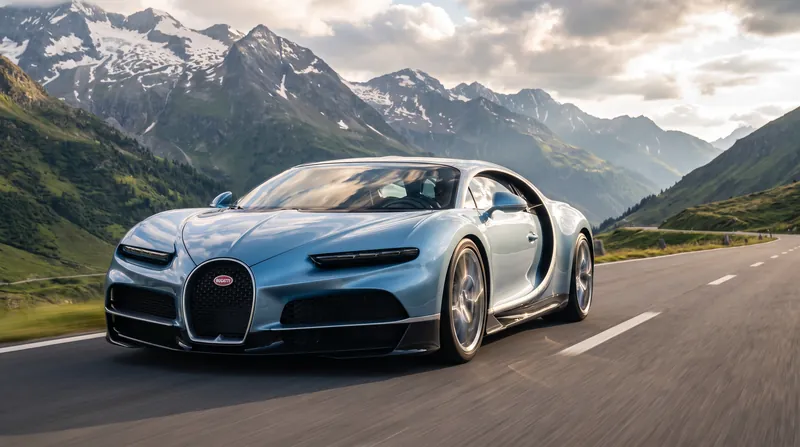
How Bugatti's 1,775-Horsepower V16 Hybrid Powertrain Actually Works
7 sources
E-Fuel Strategy
Ferrari CEO Confirms Biofuel Strategy to Save V12s After First EV Sells Out 2026 Allocation
5 sources
Luxury Market
Global Supercar Sales Plunge 21% as Capital Shifts to Stock Market, Hitting Ferrari and Porsche Hard
7 sources
Supercar Economics
Lamborghini Posts Record H1 Revenue as US Tariffs and Market Shifts Squeeze Operating Profit
7 sources
Comments
Every angle. Every day.
Get Automotive & Transportation stories with full source coverage and perspective breakdowns, free every day.