
BYD's Denza Z Electric Hypercar Debuts at Goodwood With 1,500 HP and 9-Minute Fast Charging
The Chinese automaker's luxury sub-brand unveiled a 1,582-horsepower electric hypercar capable of recharging from 10% to 97% in just nine minutes, directly challenging Europe's legacy sports car elite.
By Tao Yang

Share this story
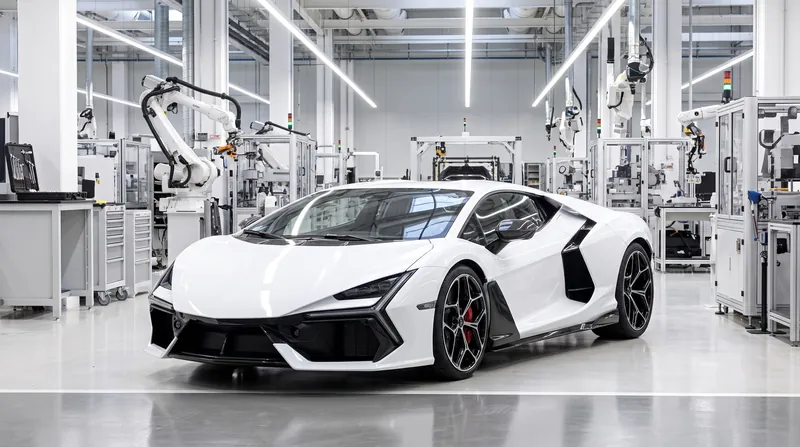
The Goodwood Festival of Speed is traditionally a celebration of roaring V8s and screaming V12s, a place where European legacy automakers flex their mechanical muscle. But at the 2026 event, the most talked-about vehicle on the hill climb was entirely silent. BYD, the Chinese electric vehicle juggernaut, used the British automotive festival to host the global debut of the Denza Z, a hypercar that blends staggering performance with breakthrough battery technology.[1]
Unveiled by BYD Executive Vice President Stella Li and former Formula One World Champion Jenson Button, the Denza Z is the flagship of BYD's premium Denza sub-brand. It arrives not as a concept, but as a production-ready vehicle aimed squarely at the European market, signaling a watershed moment for the global auto industry.
The headline figures are immense. The Denza Z generates a combined 1,582 horsepower (1,180 kW) and 1,240 Nm of torque. This immense power is delivered through BYD's new e3 (pronounced "e-cube") Sports Car Platform, which utilizes a tri-motor configuration—one electric motor on the front axle and two independently controlled motors at the rear.[1][2][3]
This tri-motor setup enables active torque vectoring, allowing the vehicle's onboard computers to distribute power precisely to individual wheels in milliseconds. The result is a 0 to 62 mph (100 km/h) sprint of just 2.25 seconds for the standard Coupe. When equipped with optional semi-slick tires, the track-focused Racing variant cuts that time to a blistering 1.96 seconds, placing it in the upper echelon of global hypercar performance.[1][3]
However, the Denza Z's most significant engineering breakthrough is not its acceleration, but how it replenishes its energy. For years, the Achilles' heel of electric sports cars has been track-day usability; driving an EV at the limit drains the battery rapidly, leading to hours of downtime at a charger. BYD claims to have solved this with its new "Flash Charging" system.[4]
The Denza Z is equipped with a 76-kWh second-generation Blade Battery, utilizing lithium iron phosphate (LFP) chemistry. When connected to a compatible Flash DC charger, the vehicle can accept a staggering 1,500 kW of charging power.[1][4][5]
This multi-megawatt capability translates to refueling times that rival internal combustion engines. The Denza Z can charge from 10% to 70% in just five minutes, and from 10% to 97% in under ten minutes. Even in extreme cold weather of minus 30 degrees Celsius, the battery can reach a 97% charge in 12 minutes.[2][5]
Achieving these charging speeds requires immense thermal management. Pushing 1.5 megawatts of electricity into a 76-kWh pack generates massive heat. BYD manages this through a multi-channel cooling system and a Cell-to-Body (CTB) architecture, where the battery pack is integrated directly into the carbon fiber composite chassis. This not only aids in thermal dissipation but also significantly increases the vehicle's torsional rigidity.[1][3][4]
Despite the extreme performance, the Denza Z is designed with varying degrees of everyday usability across its three launch variants: the Coupe, the open-top Spider, and the hardcore Racing model.[5]
The standard Coupe maintains a 2+2 seating layout, offering enough practicality for grand touring. The interior is a stark departure from stripped-out track cars, featuring power-adjustable heated and ventilated seats, a built-in refrigerator in the center console, and a 12-speaker Devialet sound system. The digital cockpit includes a 12.8-inch infotainment screen with native Google integration.[2][4]
The Racing variant, by contrast, sacrifices some luxury for pure aerodynamic grip. It features an extended carbon-fiber front splitter, underfloor vortex generators, and a massive adjustable swan-neck rear wing. Together, these aerodynamic elements generate over 1,060 kilograms (2,337 pounds) of downforce at its 217 mph (350 km/h) top speed.[2][3][4]
Handling is further refined by a fully in-house-developed steer-by-wire system, which eliminates the mechanical connection between the steering wheel and the tires, allowing for variable steering ratios based on speed and track conditions. The suspension utilizes BYD's DiSus-M magnetorheological intelligent dampers, which can adjust stiffness in milliseconds to absorb bumps or keep the chassis perfectly flat through high-G corners.[1][5]
The arrival of the Denza Z presents a formidable challenge to Europe's established supercar elite, including Porsche, Ferrari, and Lamborghini. Historically, Chinese automakers were viewed as budget-friendly alternatives, but the Denza Z competes directly on technology, performance, and design.[2][4][5]
The disruption is most evident in the pricing strategy. The Denza Z Coupe is available to order in the UK starting at £142,900 (approximately $184,800). This price point significantly undercuts European electric rivals like the Porsche Taycan Turbo GT and the Rimac Nevera, while offering comparable or superior performance metrics.[1][5]
The primary uncertainty surrounding the Denza Z's real-world appeal is infrastructure. While the vehicle is capable of 1,500 kW charging, chargers capable of delivering that output are virtually nonexistent on public networks. To address this, BYD has announced plans to roll out roughly 3,000 proprietary Flash charging stations across Europe by the end of 2026.
For buyers who find the standard models insufficiently extreme, BYD is already developing a fourth variant. Dubbed the "Special Edition," this model is expected to push total output close to 2,000 horsepower and achieve a sub-1.7-second 0-62 mph time.[4]
This Special Edition is currently undergoing testing with a specific goal in mind: shattering lap records at the Nürburgring Nordschleife later this year. If successful, it will cement BYD's transition from a mass-market battery manufacturer to a dominant force in the global hypercar arena.[5]
Key points
- BYD's Denza Z electric hypercar debuted at the Goodwood Festival of Speed with 1,582 horsepower.
- The vehicle features a 1,500 kW Flash Charging system capable of a 10% to 97% charge in nine minutes.
- The track-focused Racing variant can accelerate from 0 to 62 mph in 1.96 seconds.
- Starting at £142,900, the Denza Z significantly undercuts European legacy supercars on price.
Unanswered questions
- How quickly BYD can actually deploy its promised 3,000 Flash Charging stations across Europe to support the 9-minute charge times.
- Whether the steer-by-wire system and heavy curb weight will deliver the tactile steering feedback demanded by traditional supercar buyers.
- The final performance specifications of the Nürburgring-targeted 'Special Edition.'
How we got here
April 2026
BYD unveils the Denza Z Spider concept at the Beijing Auto Show, introducing the 'Pure Emotion' design language.
July 2026
The production-ready Denza Z Coupe, Spider, and Racing variants make their global dynamic debut at the Goodwood Festival of Speed.
Summer 2026
Order books open for the Denza Z in the UK and select European markets.
Late 2026
Expected start of customer deliveries and the planned Nürburgring lap record attempt by the Special Edition.
- Chinese Automakers
- Focusing on rapid technological iteration and aggressive pricing to capture the high-end market.
- EV Performance Enthusiasts
- Prioritizing charging speeds and track usability over traditional brand loyalty.
- European Legacy Marques
- Relying on brand heritage and driving dynamics to defend their home turf against new EV entrants.
Perspectives this story doesn't cover
- Public charging network operators
- Traditional combustion-engine purists
Sources
Source coverage
5 outlets
3 viewpoints surfaced





- [1]CarNewsChinaChinese Automakers
BYD's Denza Z debuts at Goodwood with 1,582 hp, pre-sale from 184,800 USD
Read on CarNewsChina → - [2]AutoEvolutionChinese Automakers
Denza Z Hypercar Brings 1,500 HP and 9-Minute Charging to Goodwood
Read on AutoEvolution → - [3]Motor1EV Performance Enthusiasts
China's 1,582-HP Denza Z Electric Supercar Is Headed To Europe
Read on Motor1 → - [4]NotebookCheckEuropean Legacy Marques
BYD Denza Z challenges Porsche with 1,604 hp and 9-minute fast charging
Read on NotebookCheck → - [5]MotoringResearchEuropean Legacy Marques
Denza Z: 217mph Chinese EV supercar launched at Goodwood
Read on MotoringResearch →
More in Automotive & Transportation
See all →Hypercar Strategy
Porsche Abandons All-Electric Mission X, Pivots to Hybrid V8 Hypercar Based on 963 Racer
5 sources
E-Fuel Strategy
Ferrari CEO Confirms Biofuel Strategy to Save V12s After First EV Sells Out 2026 Allocation
5 sources
Luxury Market
Global Supercar Sales Plunge 21% as Capital Shifts to Stock Market, Hitting Ferrari and Porsche Hard
7 sources
Supercar Economics
Lamborghini Posts Record H1 Revenue as US Tariffs and Market Shifts Squeeze Operating Profit
7 sources
Comments
Every angle. Every day.
Get Automotive & Transportation stories with full source coverage and perspective breakdowns, free every day.