
Bugatti Tourbillon Revealed: 1,800 HP V16 Hybrid Hypercar Starts at $4.6 Million
Bugatti has unveiled the Tourbillon, a $4.6 million hybrid hypercar that pairs an all-new naturally aspirated V16 engine with three electric motors to produce 1,800 horsepower.
By Derya Kaplan

Share this story
For two decades, Bugatti’s identity has been inextricably linked to a single, monstrous piece of engineering: the quad-turbocharged W16 engine. But as the automotive industry hurtles toward full electrification, the French marque faced an existential question of how to evolve without losing its soul. The answer has arrived in the form of the Bugatti Tourbillon, a $4.6 million hybrid hypercar that redefines the pinnacle of automotive performance.
Unveiled as the official successor to the Chiron, the Tourbillon represents the first clean-sheet design under the leadership of Bugatti Rimac CEO Mate Rimac. Rather than bowing to the trend of silent, all-electric hypercars, Bugatti has engineered a masterpiece that uses electrification to amplify the visceral thrill of internal combustion.[1][2][3][5]
The departure from the W16 engine marks the end of an era that began with the Veyron in 2004. That powerplant defined modern Bugatti, setting top-speed records and establishing a new benchmark for excess. However, the W16 was heavy, complex, and reliant on four turbochargers to breathe. For the Tourbillon, engineers sought a different kind of emotional resonance, opting for a naturally aspirated setup that prioritizes high-revving acoustics and immediate throttle response over forced induction.[1][2][3][4][6]
At the core of the Tourbillon sits an all-new 8.3-liter V16 engine, developed in collaboration with legendary British engine builder Cosworth. Stretching nearly 10 inches longer than the outgoing W16, this naturally aspirated mill is a mechanical marvel. It produces 1,000 horsepower entirely on its own, revving to a shrieking 9,000 rpm redline. Remarkably, despite its massive displacement and cylinder count, the engine weighs just 556 pounds—a testament to modern lightweight materials and dry-sump lubrication.[2][3][4][6]
But the V16 is only half of the Tourbillon’s propulsion story. To push the car into the upper echelons of hypercar performance, Bugatti integrated a highly advanced plug-in hybrid system that fundamentally changes how the vehicle delivers power. The setup features three electric motors: two mounted on the front e-axle and a third positioned at the rear alongside the transmission.
These motors, capable of spinning at an astonishing 24,000 rpm, contribute an additional 800 horsepower to the powertrain. Mate Rimac, CEO of Bugatti Rimac, emphasized that the electric powertrain was designed not to mute the combustion engine, but to act as an enabler that unlocks the V16's full emotional potential.[1][4][5][6]
When the V16 and the electric motors work in unison, the Tourbillon generates a staggering 1,800 total horsepower. This combined output eclipses even the most potent iterations of the Chiron. The performance metrics are predictably mind-bending: Bugatti claims the Tourbillon will sprint from zero to 62 mph in a flat 2.0 seconds. Keep the throttle pinned, and the car will reach 186 mph in under 10 seconds, eventually topping out at an electronically limited 276 mph with the use of a special Speed Key.[1][2][3][4][6]
Feeding the electric motors is a 25-kilowatt-hour, oil-cooled battery pack that represents a breakthrough in packaging and thermal management. Rather than simply bolting the battery into an existing frame, Bugatti integrated it directly into the car’s T800 carbon-composite monocoque, utilizing the pack as a structural element to increase overall chassis rigidity.
This 800-volt architecture not only provides the rapid energy discharge required for blistering acceleration but also allows the Tourbillon to operate as a silent, zero-emission vehicle when desired. The battery system is seamlessly integrated, ensuring that the vehicle's center of gravity remains incredibly low.[3][4][5]
In a stark departure from the roaring arrivals typical of Bugatti owners, the Tourbillon can travel an estimated 37 miles on electric power alone. This dual personality allows the hypercar to navigate urban emission zones or slip out of a neighborhood quietly before the V16 is summoned on open roads. The electric motors also serve as torque-fillers, instantly bridging any microscopic gaps in power delivery while the combustion engine climbs toward its 9,000-rpm peak.[1][4][5][6]
Perhaps the most impressive engineering feat of the Tourbillon is its overall weight. Hybrid systems—with their heavy copper motors, inverters, and dense battery packs—typically add hundreds of pounds to a vehicle's mass. Yet, Bugatti claims that the Tourbillon is actually lighter than the pure-combustion Chiron it replaces.
This counterintuitive achievement was realized through obsessive weight-saving measures across the entire vehicle, including 3D-printed structural braces and a completely redesigned multi-link suspension system featuring airfoil-shaped arms. The V16 engine itself, despite its massive size, weighs only 556 pounds, further contributing to the hypercar's lean profile.[2][3][6]
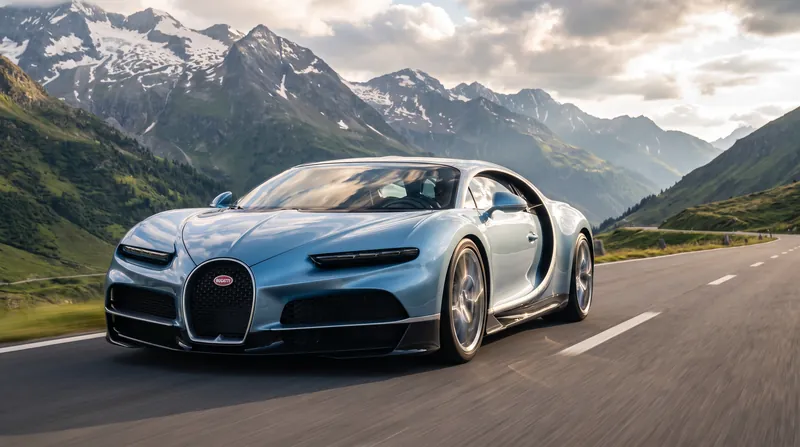
Visually, the Tourbillon is an evolution of Bugatti’s established design language, but every panel has been optimized for aerodynamic efficiency at speeds exceeding 250 mph. The car sits lower and features a more pointed, arrow-like nose compared to the Chiron. Bugatti Design Director Frank Heyl noted that reducing the frontal area was critical for achieving the car's top speed. The classic horseshoe grille has been widened, and the iconic C-line sweeping across the profile has been subtly reshaped for a leaner, more aggressive stance.[1][2][4]
While the exterior pushes the boundaries of aerodynamic science, the interior is a deliberate and striking rejection of modern automotive trends. In an era where even ultra-luxury cars are dominated by massive touchscreens and digital interfaces, the Tourbillon embraces mechanical permanence and tactile engagement.
The car's name itself is a nod to a 200-year-old watchmaking invention designed to counteract gravity and improve accuracy, setting the thematic tone for the entire cabin. Bugatti's designers recognized that digital screens age rapidly, whereas mechanical craftsmanship remains timeless, ensuring the car will look just as striking on a concours lawn a century from now.[1][4][6]
The centerpiece of the interior is a breathtaking, fully analog instrument cluster designed and built with the expertise of Swiss watchmakers. Comprising over 600 intricate pieces, including titanium, sapphire crystal, and rubies, the cluster is a skeletal masterpiece of gears and dials. In a stroke of ergonomic genius, the gauges are fixed to the steering column, while the steering wheel rim rotates around them, ensuring the driver's view of the dials is never obstructed.[2][3][4]
Bugatti did not entirely banish digital convenience, but the company deliberately hid it away to preserve the cabin's timeless aesthetic. A small, high-definition screen is concealed within the center console, deploying mechanically only when the driver explicitly requests Apple CarPlay or shifts into reverse to activate the mandatory backup camera.
Otherwise, the cabin remains a tactile sanctuary of premium leather, machined aluminum, and crystal glass. The interior features fixed lightweight seats to keep the center of gravity as low as possible, utilizing an adjustable pedal box and steering column to accommodate different drivers comfortably.[3][4]
To support the production of this new flagship, Bugatti has invested heavily in its historic home in Molsheim, France, ensuring the manufacturing process matches the car's engineering pedigree. In July 2026, the company inaugurated 'La Manufacture,' a purpose-built, 3,245-square-meter facility dedicated exclusively to assembling the Tourbillon.
This new hall handles everything from exterior and interior pre-assembly to the specialized polishing and painting required for a multi-million-dollar hypercar. The opening of this facility signals Bugatti's long-term commitment to the Rimac era, providing a dedicated space capable of producing up to 200 cars a year.[7]
Exclusivity remains a cornerstone of the Bugatti business model, and the Tourbillon will be even rarer than its predecessor. The company plans to build just 250 examples of the hypercar, a significant reduction from the 500 Chirons produced during that model's lifecycle.
With a starting price of roughly €3.8 million (approximately $4.6 million), the Tourbillon is aimed squarely at the absolute zenith of the global hypercar market. Customer deliveries are scheduled to begin in 2026, and given the brand's history, the entire production run is expected to be spoken for quickly by elite collectors.[1][3][4][6]
Ultimately, the Tourbillon is more than just a collection of staggering numbers and exotic materials. It represents a definitive philosophical statement about the future of the hypercar in an increasingly electrified world. By using cutting-edge electric motors and battery technology not to replace the internal combustion engine, but to elevate it to unprecedented heights, Bugatti has created a machine that honors its mechanical heritage. The Tourbillon proves that the pursuit of ultimate performance can still be an emotional, visceral experience, securing Bugatti's relevance and dominance in a hybridized automotive future.[5][6]
Key points
- The Bugatti Tourbillon replaces the Chiron, introducing an 1,800-horsepower hybrid powertrain.
- The hypercar pairs an 8.3-liter naturally aspirated V16 engine with three electric motors.
- Despite the addition of a 25 kWh battery and hybrid system, the Tourbillon is lighter than its predecessor.
- The interior rejects modern digital screens in favor of a fully analog, Swiss watch-inspired instrument cluster.
Unanswered questions
- The exact curb weight of the Tourbillon has not been officially published, though Bugatti confirms it is lighter than the Chiron.
- It remains unclear exactly how many of the 250 units will be allocated to the United States market.
- Bugatti has not yet confirmed if the Tourbillon will attempt to set a new official production car top-speed record.
How we got here
2004
Bugatti launches the Veyron, introducing the quad-turbo W16 engine and redefining the modern hypercar.
2016
The Chiron debuts, pushing the W16 engine to 1,500 horsepower and setting new top-speed benchmarks.
2021
Bugatti merges with Croatian electric hypercar manufacturer Rimac, signaling a shift toward electrification.
June 2024
Bugatti officially reveals the Tourbillon, confirming the end of the W16 era and the introduction of a V16 hybrid.
July 2026
Bugatti inaugurates 'La Manufacture' in Molsheim, a dedicated facility for Tourbillon production.
- Hypercar Traditionalists
- Collectors and purists who value mechanical engagement over digital interfaces.
- Electrification Advocates
- Engineers and analysts focused on the transition to zero-emission performance.
- Automotive Engineers
- Industry experts analyzing the packaging and weight-saving achievements.
Perspectives this story doesn't cover
- Environmental Regulators
- Mass-Market EV Manufacturers
Sources
Source coverage
7 outlets
3 viewpoints surfaced







- [1]Car and DriverHypercar Traditionalists
2026 Bugatti Tourbillon Revealed!
Read on Car and Driver → - [2]The DriveHypercar Traditionalists
New Bugatti Tourbillon: 1,800-HP V16 Hybrid, Coolest Gauge Cluster Ever
Read on The Drive → - [3]AutoweekHypercar Traditionalists
Bugatti Tourbillon Is the 1,800-HP V16 Hybrid
- [4]HotCarsElectrification Advocates
New Bugatti Hypercar Unveiled: 1,800 HP, 0-60 In 2 Seconds, And Top Speed Of 276 MPH
- [5]BugattiAutomotive Engineers
The Powertrain of the Tourbillon: A New Era of Performance
Read on Bugatti → - [6]CarBuzzElectrification Advocates
Bugatti Tourbillon Hybrid Engine and Performance
Read on CarBuzz → - [7]AutoNextAutomotive Engineers
Bugatti opens a new Molsheim factory for the Tourbillon era
More in Automotive & Transportation
See all →Hypercar Engineering
Hennessey Unveils 2,031-Horsepower Venom F5-M, Claiming Title of World's Most Powerful Manual Hypercar
2 sources
Hypercar Engineering
How Bugatti Engineered the 1,800-HP Tourbillon: Inside the V16 Hybrid Powertrain
3 sources
Analogue Supercars
McLaren Unveils McL 6GT Concept, Signaling Return to Manual Transmission for First Time Since the F1
5 sources
Hypercar Strategy
Porsche Abandons All-Electric Mission X, Pivots to Hybrid V8 Hypercar Based on 963 Racer
5 sources
Comments
Every angle. Every day.
Get Automotive & Transportation stories with full source coverage and perspective breakdowns, free every day.