
Hand-Drawn 2D vs. 3D CGI: The Economics and Aesthetics Reshaping Modern Anime
As the global anime industry scales to meet unprecedented demand, studios are weighing the nostalgic warmth of traditional 2D animation against the scalable efficiency of 3D CGI.

In short
- Traditional 2D animation costs $1,500–$6,000 per minute but is bottlenecked by the intense labor required for frame-by-frame drawing.
- 3D CGI requires a higher upfront investment of $6,000–$12,000 per minute for modeling and rigging, but scales efficiently through asset reuse.
- 3D animation allows for dynamic, sweeping camera movements and complex mechanical designs that are nearly impossible to achieve in pure 2D.
The anime industry is currently locked in a tug-of-war between the heart and the spreadsheet. Stated plainly: traditional 2D animation offers the bespoke, expressive warmth that fans grew up on, but it is fundamentally bottlenecked by human endurance. On the other side, 3D CGI requires a massive upfront investment in digital modeling and rigging, but once those assets are built, they scale with ruthless efficiency.
That is the trade-off defining modern production. As global demand for anime skyrockets, studios can no longer rely solely on armies of animators drawing every frame by hand. They are being forced to choose their pipelines carefully, weighing the artistic soul of a scene against the brutal realities of production schedules and budgets.[1][2][3][5]
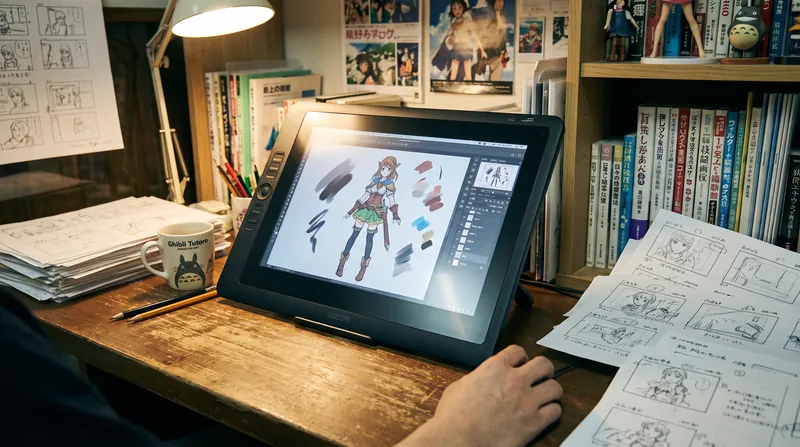
Walk into a modern animation studio in Tokyo, and you will immediately spot the divide. On one side of the floor, traditional animators are hunched over digital drawing tablets, meticulously sketching keyframes by hand. They are focused on the art of the draft—manipulating perspective, squash, and stretch to convey weight and emotion.
On the other side, technical directors are staring at complex skeletal rigs in 3D software. They are not drawing; they are puppeteering, moving digital bones through a virtual three-dimensional space. The former is an inherently artistic process, while the latter is deeply mechanical and technical.[1][2][5]
The traditional 2D pipeline is a marvel of craftsmanship, but it is grueling. Because characters and objects are created flat, they only exist from the exact angle they are drawn. If a director wants the camera to sweep around a character, the animator must completely redraw that character for every single frame of the rotation.
This frame-by-frame labor is what gives classic anime its fluid, organic feel, but it is incredibly time-consuming. From an economic standpoint, 2D animation typically costs between $1,500 and $6,000 per minute of finished footage, depending heavily on the complexity of the designs and the fluidity of the motion.[1][3][5]
Conversely, 3D CGI operates on an entirely different economic model. The initial hurdle is massive: before a single second of animation can be produced, a team must design, model, texture, and rig a character with a functional digital skeleton. This pushes the upfront cost of 3D animation significantly higher, often ranging from $6,000 to $12,000 per minute, with highly detailed cinematic projects soaring past $50,000 per minute. The hardware requirements are steeper, the software licenses are expensive, and the rendering process requires substantial computing power.[2][5]
However, once that upfront investment is made, the economics of 3D flip entirely. A rigged 3D model can be reused infinitely. It can be viewed from any angle, placed in any lighting condition, and animated with complex physics simulations without needing to be redrawn. This makes 3D CGI an absolute necessity for specific types of scenes.
If a show features intricate mechanical designs—like the towering mechs in a sci-fi epic—or requires a sweeping, continuous camera shot through a dense cityscape, 3D is the only viable option. Attempting those feats in pure 2D would bankrupt a production committee and break the animators.[1][2][5]
The friction arises when these two mediums collide on screen. Anime fans are notoriously protective of the medium's traditional aesthetic, and they have been burned by decades of poorly integrated CGI. When studios attempt to cut corners by using stiff 3D models to replace standard 2D character acting, the results are often jarring.
The models are usually cell-shaded—given flat colors and dark outlines—to mimic the look of a drawing. But because 3D models move with perfect, rigid mathematical precision, they lack the intentional, expressive distortion that a human artist naturally applies to a drawing. They look weightless and out of place against hand-painted backgrounds.[3][4][5]
The most successful studios have realized that the future is not a zero-sum game, but a seamless synthesis of the two. Industry leaders are now employing a hybrid approach that leverages the strengths of both pipelines. They use 3D CGI to build complex environments and vehicles, allowing for incredibly dynamic, sweeping camera movements.
Then, they layer meticulously hand-drawn 2D characters on top of that 3D canvas. This technique obscures the mechanical rigidity of the CGI while elevating the cinematic scope of the 2D art, creating sequences that feel both grounded and impossibly fluid.[1][2][3][5]
Ultimately, the choice between 2D and 3D is no longer just an artistic debate; it is a structural necessity for a booming industry. The global animation market is projected to reach a staggering $462 billion valuation by the end of 2025, and the demand for content is vastly outpacing the supply of trained traditional animators.
3D CGI, despite its high barrier to entry and aesthetic growing pains, offers the only scalable path forward. The studios that thrive in this new era will not be the ones that stubbornly cling to the past, nor the ones that entirely automate their soul away, but the ones that figure out how to make the spreadsheet serve the heart.[3][5]
Different angles
Traditional 2D Animation
The bespoke, hand-drawn approach that defined the medium.
FOR: Unmatched artistic expression, stylistic flexibility, and nostalgic warmth. Animators can intentionally distort perspective and anatomy for dramatic emotional impact—a technique that feels organic and visceral. AGAINST: Highly labor-intensive, difficult to scale, and vulnerable to production bottlenecks. EVIDENCE: Base costs run $1,500 to $6,000 per minute, but the real limit is human endurance; every new camera angle requires a complete redraw of the character. FITS WELL WHEN: The project relies on expressive character acting, fluid organic motion, and a distinct, stylized aesthetic. DOES NOT FIT WHEN: The scene demands complex, rotating camera movements or highly detailed mechanical objects moving in perspective.
3D CGI Animation
The technical, scalable approach utilizing digital models and rigs.
FOR: Infinite reusability, perfect spatial consistency, and the ability to execute sweeping, dynamic camera moves effortlessly. AGAINST: High upfront costs, steep learning curves, and the risk of looking 'soulless' or jarring if cell-shading fails to match 2D elements. EVIDENCE: Initial production costs are steeper, ranging from $6,000 to $12,000+ per minute due to modeling and rigging, but per-frame costs plummet once assets are built. FITS WELL WHEN: Animating complex mecha, vehicles, massive crowds, or dynamic environments that require constant camera rotation. DOES NOT FIT WHEN: The goal is highly stylized, exaggerated character acting where perfect physics actually hinder the emotional impact.
The Hybrid Approach
Layering 2D characters over 3D environments to maximize both pipelines.
FOR: Combines the emotional resonance of hand-drawn characters with the cinematic scope of 3D environments. AGAINST: Requires highly specialized compositing teams to ensure the two distinct art styles do not clash on screen. EVIDENCE: Top-tier studios are increasingly adopting this method to handle complex action sequences without sacrificing the 'anime look.' FITS WELL WHEN: High-budget productions need sweeping camera work during intense character-driven action scenes. DOES NOT FIT WHEN: Budgets are too tight to support dual production pipelines simultaneously.
- Traditional Animators
- Value the expressive, bespoke craftsmanship of hand-drawn frames.
- Technical Directors
- Focus on the scalability, spatial consistency, and dynamic camera capabilities of 3D rigs.
- Production Committees
- Prioritize budget efficiency, asset reusability, and meeting the massive global demand for content.
Perspectives this story doesn't cover
- Voice Actors
- Background Painters
Sources
Source coverage
5 outlets
3 viewpoints surfaced


- [1]WikipediaTechnical Directors
Traditional animation
Read on Wikipedia → - [2]WikipediaTechnical Directors
Computer animation
Read on Wikipedia → - [3]WikipediaTechnical Directors
Anime
Read on Wikipedia → - [4]WikipediaTechnical Directors
Cel shading
Read on Wikipedia → - [5]Factlen Editorial TeamProduction Committees
Synthesis by Factlen editorial team
Read on Factlen Editorial Team →
More in Entertainment
See all →Webtoon Adaptations
How South Korean Webtoons Became the Anime Industry's New Gold Mine
3 sources

Manga Publishing
The Ankete System: How Weekly Shonen Jump's Reader Survey Dictates Which Manga Are Canceled
8 sources

Seiyuu Economics
The Japanese Voice Actor Rank System: How the 15,000 Yen Per Episode Minimum is Calculated
6 sources
Studio Economics
How In-House and Freelance Labor Models Shape Anime's Visual Quality and Stability
3 sources
Comments
Every angle. Every day.
Get Entertainment stories with full source coverage and perspective breakdowns, free every day.