
Global Butterfly Standings Tighten as Kharun Surges and Milak Returns Ahead of Championship Season
Ilya Kharun's record-breaking performances at the U.S. National Championships and Kristof Milak's return to form have reshaped the global butterfly standings. As the European Championships and Pan Pacific Championships approach, the race for butterfly supremacy is wide open across both the men's and women's fields.
By Omar Haddad

The global butterfly standings have been completely upended heading into the final stretch of the 2026 aquatics season. With the European Aquatics Championships currently underway in Paris and the Pan Pacific Championships looming in mid-August, the race for the top spot in both the men's and women's butterfly events has tightened into a multi-continent sprint. As national federations finalize their rosters and athletes taper for their peak performances, the leaderboard has seen a massive injection of speed from both returning legends and rising stars.[4]
The biggest shockwave of the summer arrived at the Toyota USA Swimming National Championships in Irvine, California, where twenty-one-year-old Ilya Kharun firmly established himself as the man to beat. Kharun, who is currently in the process of transferring his sporting nationality from Canada to the United States, delivered a blistering 50.05 in the 100-meter butterfly to claim the national title. His performance sent a clear message to the rest of the world that the American butterfly ranks have acquired a formidable new weapon ahead of the next Olympic cycle.
Kharun's 50.05 currently stands as the fastest time in the world this year, narrowly edging out the 50.45 posted by runner-up and nine-time Olympic gold medalist Caeleb Dressel. The young star did not stop at the 100-meter distance; he also shattered the U.S. Open record in the 50-meter butterfly, touching the wall in 22.59. That blistering sprint tied him for the sixth-fastest performance in the history of the event, proving that his front-end speed is just as dangerous as his closing endurance.[2]
"I'm a part of the team now," Kharun remarked to broadcasters after his victory, signaling his readiness to represent the United States internationally once his eligibility clears later this year. His emergence provides a massive boost to the American butterfly ranks, setting up a tantalizing future rivalry with Europe's heavyweights. For a U.S. program that has long relied on Dressel's historic dominance in the butterfly events, Kharun's breakout summer offers both immediate elite-level firepower and long-term stability as the team builds toward the 2028 Los Angeles Games.[2]
Across the Atlantic, the European butterfly picture is dominated by the highly anticipated return of Hungary's Kristof Milak. After taking much of 2025 away from the pool to recover his motivation and physical health, the reigning Olympic champion and world record holder has stormed back into elite form. Milak's absence had temporarily left a vacuum at the top of the European standings, but his performances over the past few months have emphatically erased any doubts about his current capabilities.[1]
Milak fired his opening warning shot at the Hungarian National Championships in April, clocking a 50.22 in the 100-meter butterfly to temporarily take the world lead. He followed that up in June at the prestigious Sette Colli Trophy in Rome, winning the 100-meter event in 50.47 and breaking the Hungarian national record in the 50-meter butterfly with a 22.86. Those swims confirmed that Milak has successfully rebuilt his legendary back-half endurance while simultaneously sharpening his raw sprinting speed.[1]
As the European Championships unfold in Paris, Milak faces stiff competition from the rest of the continent's exclusive "49-Second Club." Switzerland's Noe Ponti and France's Maxime Grousset, both of whom have broken the elusive 50-second barrier in their careers, are poised to challenge the Hungarian star.
Analysts are calling their impending clash the race of the summer, as Grousset's explosive early speed will be pitted directly against Milak's unmatched ability to close the final twenty-five meters. With all three men capable of pushing the world record, the European final could fundamentally alter the global standings once again.[1]
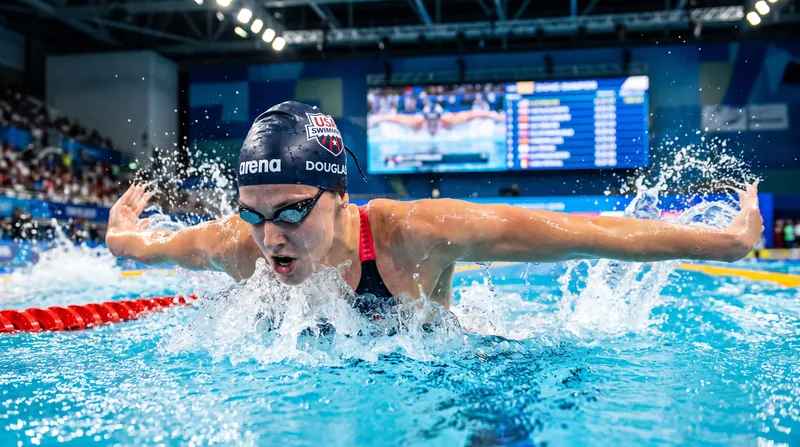
The women's butterfly standings are equally dynamic, with international contenders crashing domestic meets to post top times. At the U.S. National Championships, Japan's Mizuki Hirai delivered a stunning performance in the 100-meter butterfly, winning the event in 57.52. Hirai executed a brilliant tactical race, turning slightly behind the leaders at the halfway mark before unleashing a dominant final fifty meters to hold off Michigan's Hannah Bellard and secure the gold medal on American soil. Her victory served as a powerful statement of intent from the Japanese national team.
Hirai's victory serves as a major momentum builder ahead of the Pan Pacific Championships, where she will anchor the Japanese butterfly contingent against a deep field of North American and Australian challengers. Her speed adds another layer of intrigue to a global leaderboard that has been heavily influenced by North American talent in recent years, proving that the race for the podium will be a truly global affair. As she refines her stroke mechanics heading into mid-August, Hirai is widely expected to drop her times even further.
Meanwhile, American standout Torri Huske continues to build on a dominant 2026 campaign that began in the short-course yards format. After sweeping the butterfly events at the NCAA Championships in March—including a blistering 48.49 in the 100-yard fly—Huske transitioned seamlessly to the long course. She showcased her raw power by winning the 50-meter butterfly at the TYR Pro Swim Series in Sacramento with a time of 25.95, cementing her status as one of the most versatile sprinters in the world.[3]
With Huske, Hirai, and a deep roster of emerging talent all peaking at the right time, the women's butterfly landscape is primed for a spectacular showdown at the Pan Pacific Championships in Irvine.
The convergence of these elite athletes in a single pool will provide a definitive test of where the global standings truly lie, as head-to-head racing often extracts performances that the clock alone cannot predict. Coaches and analysts will be watching closely to see how race strategies adapt when the world's best are forced to react to one another in real time.[3]
Ultimately, the August standings reveal a sport in the midst of a thrilling generational clash and a resurgence of historic rivalries. Between Milak's triumphant return to dominance in Europe and Kharun's record-breaking arrival in the United States, the race for global butterfly supremacy has never been faster—or more unpredictable.
As the championship season reaches its crescendo, the only certainty is that the times required to reach the podium are dropping at a historic rate. Fans across the globe are now guaranteed a spectacular finish to the 2026 aquatics calendar, with every major final carrying the potential for new world-leading marks.[1][2]
The essentials
- Ilya Kharun posted a world-leading 50.05 in the 100m butterfly at the U.S. National Championships.
- Kharun also broke the U.S. Open record in the 50m butterfly with a time of 22.59.
- Hungary's Kristof Milak has returned to elite form, clocking a 50.22 in the 100m butterfly earlier this year.
- Japan's Mizuki Hirai won the women's 100m butterfly at the U.S. Nationals with a time of 57.52.
- The European Championships and Pan Pacific Championships will serve as the final major showdowns of the 2026 season.
Timeline
March 2026
Torri Huske dominates the NCAA Championships, winning the 100-yard butterfly in 48.49.
April 2026
Kristof Milak returns to competition at the Hungarian Nationals, clocking a 50.22 in the 100m butterfly.
June 2026
Milak breaks the Hungarian national record in the 50m butterfly with a 22.86 at the Sette Colli Trophy.
July 2026
Ilya Kharun posts a world-leading 50.05 in the 100m butterfly and breaks the U.S. Open record in the 50m butterfly at the U.S. National Championships.
August 2026
The European Aquatics Championships and Pan Pacific Championships serve as the final major showdowns of the summer season.
- North American Analysts
- Focuses on Ilya Kharun's record-breaking times and his addition to the U.S. roster as a major shift in global butterfly power.
- European Aquatics Observers
- Emphasizes Kristof Milak's return to form and the impending clash between Europe's elite sub-50-second butterfly specialists.
- Global Standings Trackers
- Views the tightening times across both the men's and women's fields as a sign of unprecedented depth heading into the championship season.
Perspectives this story doesn't cover
- Australian Swimming Analysts
- Canadian Swimming Federation Officials
Sources
Source coverage
4 outlets
3 viewpoints surfaced




- [1]Swimming World MagazineEuropean Aquatics Observers
Could Return of Kristof Milak Spark the Races of the Summer?
Read on Swimming World Magazine → - [2]Field Level MediaNorth American Analysts
Ilya Kharun breaks meet record in 50m butterfly at U.S. Championships
Read on Field Level Media → - [3]Collegiate Women Sports AwardsGlobal Standings Trackers
Torri Huske Named Honda Sport Award Winner for Swimming & Diving
Read on Collegiate Women Sports Awards → - [4]World AquaticsGlobal Standings Trackers
Men's 100m Butterfly Rankings
Read on World Aquatics →
More in Sports
See all →Power ranking
Global Men's Sprint Freestyle Power Rankings: Alexy and Jack Ignite a New US-Australia Rivalry
3 sources
Standings
Global Distance Freestyle Standings Upended: Liebmann Demolishes 1500m World Record as Short Dominates Pan Pacs
5 sources
Standings
Global Sprint Backstroke Standings: Teenager Sara Curtis Shatters World Record to Upend McKeown-Smith Duopoly
4 sources
Standings
Global Breaststroke Standings: Douglass Dominates as Teen Prodigy Ohashi Surges Ahead of Pan Pacs
6 sources
Comments
Every angle. Every day.
Get Sports stories with full source coverage and perspective breakdowns, free every day.