
Ford's $29,945 Fathom Pickup Tests the Clean-Sheet EV Strategy Against Legacy Trucks
Ford's 'skunkworks' division has unveiled the Fathom, a $29,945 midsize electric pickup that abandons traditional truck architecture for extreme cost efficiency. The launch crystallizes a broader industry debate over whether the future of EVs lies in affordable, right-sized utility or massive, uncompromised towing capacity.
By Marina Lopez

Share this story
The auto industry has spent the last five years trying to electrify the American pickup truck by brute force. Vehicles like the Ford F-150 Lightning and Chevrolet Silverado EV pack massive battery packs into heavy architectures, achieving impressive towing figures but driving sticker prices well past $60,000. Consumers have balked at the premiums, and automakers are absorbing billions in EV division losses as inventory piles up.
Ford is now attempting a hard pivot, unveiling the "Fathom"—a $29,945 midsize electric pickup developed not in Dearborn, but by a California-based "skunkworks" team of ex-Tesla and Formula 1 engineers. Targeting a 2027 production launch, the Fathom represents a fundamental shift from the legacy-capability model to a clean-sheet, cost-obsessed architecture designed to achieve price parity with combustion engines.[1][2][3]
The Fathom is the first vehicle built on Ford's Universal Electric Vehicle (UEV) platform. The skunkworks group utilized a total systems engineering approach, ruthlessly optimizing the design to ensure the vehicle is profitable at its $28,350 base MSRP (before a $1,595 destination charge) without relying on federal tax subsidies.[1][2]
To hit that price point, Ford is abandoning the century-old moving assembly line in favor of an "assembly tree" production method. The front, rear, and structural battery sections will be built separately before being joined together. This modular approach reduces the factory footprint, requiring 40 percent fewer workstations and allowing the truck to be built 15 percent faster than traditional models.
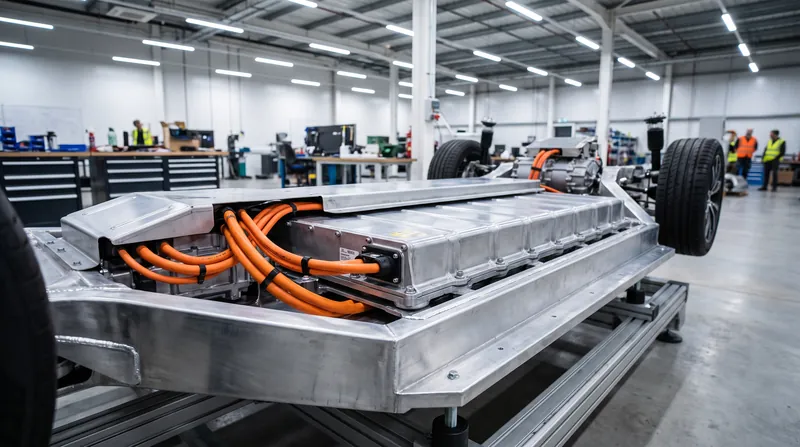
The vehicle's architecture relies on a structural lithium-iron-phosphate (LFP) battery pack that doubles as the cabin floor, eliminating redundant chassis weight. By moving to a highly integrated electrical architecture, engineers stripped out more than 4,000 feet of copper wiring and 20 percent of the total parts compared to Ford's first-generation electric SUVs.[2][3]
This extreme integration allows the Fathom to operate efficiently with a battery pack estimated to be roughly 30 percent smaller than competitors. Despite the smaller footprint, the five-passenger truck features a 5.5-foot bed, a front trunk, and more interior passenger volume than a Toyota RAV4. It is designed from the ground up for aerodynamic efficiency, bypassing the traditional blocky truck profile to ensure air flows cleanly over the roof.[2]
The Fathom's unveiling crystallizes a broader industry crossroads. Automakers must now choose between two distinct electrification strategies: the premium legacy-capability model that prioritizes towing and payload, or the clean-sheet affordable model that prioritizes aerodynamic efficiency, software integration, and price parity.
The financial stakes for getting this balance right are existential. Ford's Model e division has reported billions in losses, driven largely by the high material costs of large-battery vehicles. When the F-150 Lightning launched, its base price quickly ballooned, severely dampening demand. The Fathom is expected to land roughly $26,000 below the current Lightning base price, targeting the exact gap left by escalating truck costs.[2]
However, the clean-sheet approach requires sacrificing the extreme capabilities that traditional truck buyers have been conditioned to expect. The Fathom will not tow 10,000 pounds, nor will it offer 400 miles of range under heavy load. It is designed explicitly as a lifestyle vehicle and daily commuter, equipped with native Apple Maps routing, bidirectional power for tools, and standard BlueCruise hardware.[1]
Proponents of the legacy model argue that a truck without heavy-duty capability is a niche product. They point out that the American market has consistently favored full-size, body-on-frame trucks for decades, and that fleet operators require the payload capacity that only a large architecture can provide. For these buyers, the high cost of a massive battery is viewed as a necessary trade-off for uncompromised utility.[2]
Conversely, clean-sheet advocates argue that most truck owners rarely tow heavy loads, instead using their vehicles for commuting and light hauling. By right-sizing the battery and optimizing the aerodynamics, automakers can deliver a vehicle that meets the vast majority of a driver's daily needs at half the price, while drastically reducing the carbon footprint of the manufacturing process.[3]
As Ford prepares to retool its Louisville Assembly Plant with a nearly $5 billion combined investment to build the Fathom and its batteries, the market will soon test these competing philosophies. The success or failure of the UEV platform will determine whether the future of the American road belongs to electrified behemoths, or to highly optimized, software-defined utility vehicles.[1]
Key points
- Ford's California-based 'skunkworks' team has unveiled the Fathom, a $29,945 midsize electric pickup targeting 2027 production.
- The vehicle utilizes a clean-sheet Universal Electric Vehicle (UEV) platform, abandoning traditional body-on-frame architectures.
- By integrating a structural LFP battery and a 48-volt zonal system, Ford stripped out 20 percent of the parts and 4,000 feet of wiring.
- The Fathom represents a strategic pivot away from $60,000-plus heavy-duty EV trucks toward affordable, software-defined daily utility vehicles.
What we don’t know
- The exact EPA-estimated range of the standard LFP battery pack.
- The final exterior design, as only camouflaged prototypes have been spotted.
- How much dealers might mark up the $29,945 base price once deliveries begin.
- EV Adoption Advocates
- Argue that right-sizing batteries and optimizing aerodynamics is the only path to EV profitability and mass adoption.
- Automotive Traditionalists
- Maintain that American buyers and commercial fleets will not compromise on traditional towing and payload metrics, regardless of powertrain.
- Industry Observers
- Focus on the technical specifications, production timelines, and platform architecture of the new vehicles.
Perspectives this story doesn't cover
- Commercial fleet operators who rely on heavy-duty payload capacities.
- Legacy auto union workers facing assembly line changes and reduced workstation counts.
Sources
Source coverage
3 outlets
3 viewpoints surfaced



- [1]WikipediaIndustry Observers
Ford Fathom
Read on Wikipedia → - [2]AutoblogAutomotive Traditionalists
Ford's $28,350 electric pickup has the specs, now it needs the looks
Read on Autoblog → - [3]Ford Motor CompanyIndustry Observers
Meet Fathom™, the all-new midsize electric truck from Ford
Read on Ford Motor Company →

More in Transportation
See all →Battery Management
The State of Charge and Temperature Limits: How EV Battery Management Systems Cap Regenerative Braking Power
7 sources
Motor Architecture
Axial Flux vs. Radial Flux Motors: The Trade-Offs Defining Next-Generation EV Performance
7 sources

Battery Chemistry
Balancing EV Fast Charging Between Continuous SEI Growth and Acute Lithium Plating
9 sources

Urban EV Infrastructure
Curbside Level 2 vs. Centralized DC Fast Hubs: How Cities Are Resolving the Urban EV Charging Bottleneck
7 sources

Comments
Every angle. Every day.
Get Transportation stories with full source coverage and perspective breakdowns, free every day.