
Converting Kinetic Energy to Heat: The Physics and Material Science of Disc Brakes
Disc brakes rely on hydraulic pressure to clamp calipers against a spinning rotor, transforming a vehicle's kinetic energy into immense thermal energy. Understanding this thermal conversion explains why material choices, from cast iron to carbon-ceramic composites, are critical for preventing brake fade.
By Marina Lopez

Share this story
In short
- Disc brakes stop a vehicle by converting its kinetic energy entirely into thermal energy through mechanical friction.
- Hydraulic pressure from the brake pedal forces pistons inside the caliper to clamp high-friction pads against a spinning metal rotor.
- During a hard stop, the surface temperature of a standard cast-iron brake rotor can rapidly exceed 500 degrees Celsius.
When a 2,000-kilogram vehicle traveling at 100 kilometers per hour initiates an emergency stop, it must shed nearly 770 kilojoules of kinetic energy in a matter of seconds. That energy does not simply disappear; the laws of thermodynamics dictate it must be converted into another form. In a modern automotive braking system, that form is heat, generated entirely through mechanical friction.[3][9]
The process begins at the brake pedal, which acts as a lever to multiply the driver's physical force. This force compresses hydraulic fluid inside a master cylinder. Because liquids cannot be compressed, the fluid transmits this pressure through rigid lines and flexible hoses directly to the brake calipers mounted at each wheel.[8]
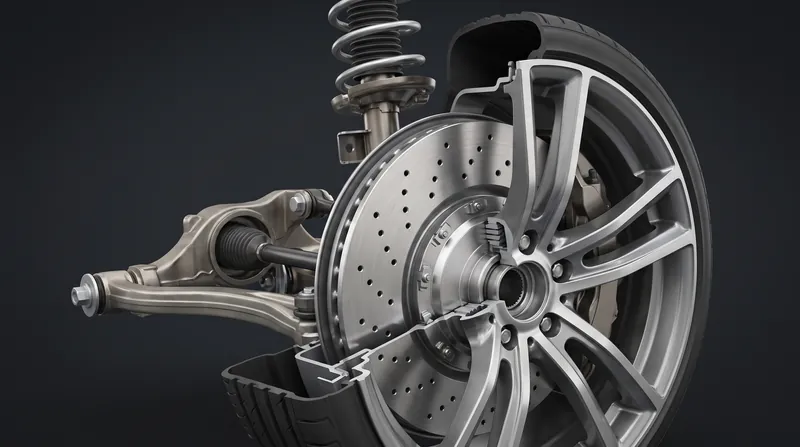
Inside the caliper, the hydraulic pressure forces metal pistons outward. These pistons push high-friction brake pads against the flat, spinning surface of the brake rotor—a heavy metal disc bolted directly to the wheel hub. As the pads clamp down on the rotor, the resulting friction resists the wheel's rotation, slowing the vehicle.[4][7]
This clamping action is where the kinetic-to-thermal energy conversion occurs. The friction between the stationary pad and the spinning rotor generates immense heat. During a hard stop from highway speeds, the surface temperature of a standard cast-iron rotor can spike from ambient temperature to over 500 degrees Celsius in less than four seconds.[5][8]
Because the foundational engineering literature and computational fluid dynamics models from SAE International, COMSOL, and Wolfram rely entirely on mathematical proofs, structural data, and thermal mapping, these primary documents do not contain direct human quotations regarding the braking process. Instead, they speak in the language of specific heat capacities, thermal conductivity, and dissipation rates.[1][5][6]
Managing this rapid temperature spike is the central engineering challenge of disc brake design. If the rotor and pads become too hot, the friction material begins to outgas, creating a microscopic layer of vapor between the pad and the rotor. This phenomenon, known as brake fade, drastically reduces stopping power regardless of how hard the driver presses the pedal.[7][8]
To combat heat accumulation, most front brake rotors are ventilated. Unlike a solid disc, a vented rotor consists of two flat friction surfaces separated by internal vanes. As the rotor spins, these vanes act like a centrifugal pump, drawing cool air from the center of the wheel and forcing it outward through the rotor, continuously shedding thermal energy into the atmosphere.[7]
The efficiency of this cooling process is heavily scrutinized using Computational Fluid Dynamics (CFD). A 2014 analysis published by SAE International demonstrated that altering the geometry of these internal vanes—shifting from straight pillars to curved, directional fins—can increase airflow velocity through the rotor by up to 15 percent, significantly lowering peak operating temperatures.[1]
Advanced thermal modeling, such as the 2013 step-by-step guide developed by COMSOL and the partial differential equation models documented by Wolfram, allows engineers to visualize heat distribution across the rotor face. These models reveal that heat does not distribute evenly; the outer edges of the rotor travel faster than the inner edges, generating more friction and creating steep temperature gradients that can warp the metal if not properly managed.[5][6]
Material science plays an equally critical role in thermal management. While grey cast iron remains the industry standard due to its excellent thermal conductivity and low cost, high-performance applications require materials that can survive extreme thermal cycling. A 2024 structural analysis by SAE International evaluated various composite materials, noting their superior performance under stress.[2]
Carbon-ceramic composites, originally developed for aerospace applications, are increasingly used in high-end automotive braking systems. These materials can operate at temperatures exceeding 1,000 degrees Celsius without degrading or warping. Furthermore, they weigh roughly half as much as an equivalent cast-iron rotor, reducing the vehicle's unsprung mass and improving suspension response.[2][8]
As the automotive industry transitions toward electrification, the role of the friction disc brake is evolving. Electric vehicles rely heavily on regenerative braking, using the electric motors as generators to convert kinetic energy back into electrical energy rather than heat. However, the mechanical disc brake remains a mandatory safety system, serving as the ultimate fail-safe when the battery is full or an emergency stop is required.[10]
Key terms
- Kinetic Energy
- The energy that an object possesses due to its motion, which must be entirely converted into another form (like heat) to bring the object to a stop.
- Brake Caliper
- The hydraulic component that houses the brake pads and pistons, acting as a clamp to squeeze the pads against the spinning rotor.
- Brake Rotor
- The heavy metal disc attached to the wheel hub that provides the friction surface for the brake pads to grip.
- Brake Fade
- A sudden loss of braking power caused by the friction materials overheating and outgassing, which reduces the physical grip between the pad and the rotor.
Reader questions
Why do brake rotors have holes or slots in them?
Cross-drilled holes and slots help dissipate heat, allow water to escape in wet conditions, and provide an exit path for the hot gases generated by the friction material, preventing brake fade.
What causes brake fade during heavy driving?
Brake fade occurs when the system exceeds its maximum thermal capacity. The extreme heat causes the brake pad material to outgas, creating a microscopic layer of vapor that prevents the pad from physically gripping the rotor.
Why are carbon-ceramic brakes used on high-performance cars?
Carbon-ceramic composites can withstand temperatures exceeding 1,000 degrees Celsius without warping or losing friction, and they weigh significantly less than traditional cast-iron rotors.
Where opinion splits
Thermal Dynamics Modelers
Engineers who focus on the computational fluid dynamics and mathematical modeling of heat generation.
For thermal engineers, a disc brake is primarily a heat sink that must be optimized for rapid dissipation. Using advanced software like COMSOL and Wolfram, these modelers map the exact temperature gradients across the rotor face during a braking event. Their primary concern is ensuring that the internal cooling vanes are shaped to maximize airflow velocity, thereby preventing the steep temperature differentials that cause cast iron to warp under stress.
Material Scientists
Researchers focused on developing composites that can withstand extreme thermal shock without degrading.
Material scientists view the braking challenge through the lens of specific heat capacity and structural integrity. While grey cast iron is cheap and effective for daily driving, it is heavy and has a strict thermal ceiling. By developing carbon-ceramic composites, these scientists have pushed the operating limits of braking systems past 1,000 degrees Celsius. Their work not only eliminates brake fade in high-performance scenarios but also drastically reduces the unsprung weight of the vehicle, improving overall suspension dynamics.
Applied Physics Focus
Educators and automotive technicians who emphasize the fundamental physics of kinetic energy conversion.
From an applied physics perspective, the braking system is a pure demonstration of the first law of thermodynamics: energy cannot be destroyed, only transformed. Because kinetic energy scales with the square of velocity, stopping from 100 km/h requires dissipating four times as much energy as stopping from 50 km/h. This perspective highlights the immense mechanical forces at play, focusing on how hydraulic multiplication allows a driver's foot to generate the thousands of pounds of clamping force required to initiate this thermal conversion.
- Thermal Dynamics Modelers
- Focuses on the computational fluid dynamics and mathematical modeling of heat generation and dissipation within the braking system.
- Material Engineering Focus
- Emphasizes the physical properties of the materials used, from cast iron to carbon-ceramic composites, and their ability to withstand thermal shock.
- Applied Physics Focus
- Examines the fundamental physics of kinetic energy conversion and how hydraulic systems apply the necessary mechanical force.
Perspectives this story doesn't cover
- Environmental regulators concerned with brake dust particulate emissions
- Mechanics dealing with real-world wear and maintenance
Sources
Source coverage
10 outlets
3 viewpoints surfaced







- [1]SAE InternationalThermal Dynamics Modelers
Thermal Performance of Disc Brake and CFD Analysis 2014-01-2497
Read on SAE International → - [2]SAE InternationalThermal Dynamics Modelers
Structural and Thermal Analysis of Brake Disc with Various Composites 2024-28-0066
Read on SAE International → - [3]Energy EducationApplied Physics Focus
Braking
Read on Energy Education → - [4]West Virginia UniversityApplied Physics Focus
Brakes
Read on West Virginia University → - [5]COMSOLThermal Dynamics Modelers
Heat Generation in a Disc Brake
Read on COMSOL → - [6]Wolfram Language DocumentationThermal Dynamics Modelers
Thermal Analysis of a Disc Brake
Read on Wolfram Language Documentation → - [7]MAT Foundry GroupMaterial Engineering Focus
The Science Behind Braking: How Brake Discs Slow Your Car Down
Read on MAT Foundry Group → - [8]DSPORT MagazineApplied Physics Focus
Braking 101: The System, Physics and Science of the Motion Management
Read on DSPORT Magazine → - [9]Doc Brown's ChemistryApplied Physics Focus
5.6 More on the physics of vehicle braking and kinetic energy
Read on Doc Brown's Chemistry → - [10]Factlen Editorial TeamMaterial Engineering Focus
Synthesis by Factlen editorial team
Read on Factlen Editorial Team →
More in Transportation
See all →Combustion Chemistry
The 0.7–1.0 Lambda Ratio and the Stoichiometric Air-Fuel Mixture That Define a Gasoline Engine's Peak Power and Efficiency
4 sources
Fleet Renewal
Aeroflot Finalizes Order for 90 Russian-Made MC-21-310 Jets in Major Import Substitution Deal
3 sources

Railroad Consolidation
STB Denies Motions to Dismiss Union Pacific-Norfolk Southern Merger, Allowing Review to Proceed
6 sources

Suspension Physics
How Lower Unsprung Mass Improves Tire Grip But Worsens High-Frequency Ride Comfort
5 sources
Comments
Every angle. Every day.
Get Transportation stories with full source coverage and perspective breakdowns, free every day.